







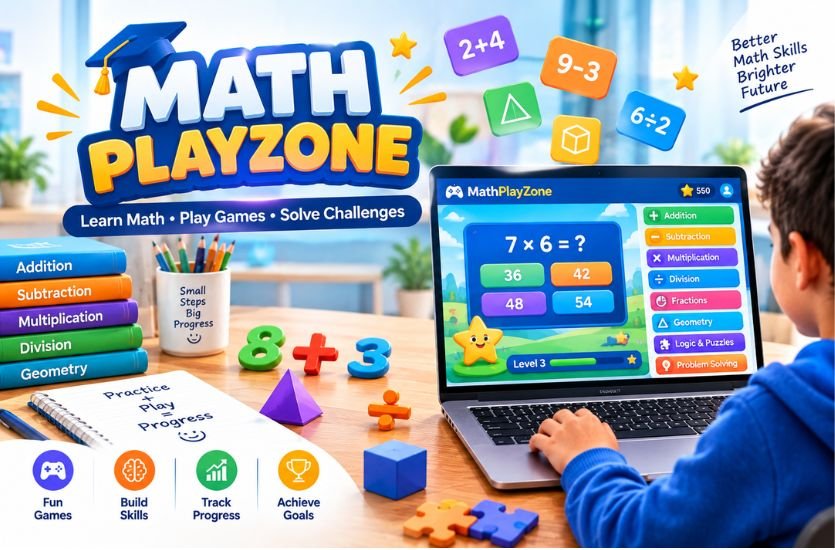
Math learning does not always have to depend on textbooks, worksheets, and traditional classroom exercises. Interactive educational games can provide another way for students to practice numbers, calculations, logic, and problem-solving while keeping the experience engaging. Math Playzone is an online platform that brings mathematical practice together with interactive games and challenges, giving users an opportunity to develop basic math skills through gameplay.
The platform combines educational activities with entertainment and includes different types of math games covering arithmetic, mental calculation, logic, and numerical challenges. Alongside its mathematics section, Math Playzone also features science, history, geography, and arcade content. This variety makes it more than a single-purpose calculator or practice website.
Quick Answer: What Is Math Playzone?
Math Playzone is an online educational gaming platform that offers interactive math games designed around arithmetic, numbers, logic, speed, and problem-solving. Its math section includes games based on addition, subtraction, multiplication, division, quizzes, and numerical challenges, while the wider platform also provides science, history, geography, and arcade games.
What Is Math Playzone?
Math Playzone is designed around the idea that learning can become more engaging when users actively participate in an activity. Instead of simply reading a mathematical explanation or solving a worksheet, players interact with questions, numbers, targets, puzzles, and game mechanics.
The platform includes several types of mathematical activities. Some games concentrate on basic arithmetic operations, while others introduce puzzle-solving and logical thinking. Time limits and game objectives can encourage players to calculate answers quickly and make decisions during gameplay.
This approach can be particularly useful for repetitive math practice. Basic arithmetic requires regular practice to develop accuracy and speed, and interactive games can provide another environment in which those skills can be exercised.
How Does Math Playzone Work?
The basic concept is straightforward. A user selects an available game and follows the instructions presented on the screen. Depending on the game, the objective may involve answering arithmetic questions, reaching a particular numerical target, solving a puzzle, or making correct mathematical decisions before time runs out.
Different games use different mechanics. A simple arithmetic game may present an equation and require the player to select the correct answer. A puzzle-based game may require the player to arrange numbers or operations in a particular way.
Because each activity has its own objective, the experience can vary considerably from one game to another. This variety can help prevent math practice from becoming repetitive.
Math Games Available on the Platform
One of the main attractions of Math Playzone is its collection of games focused specifically on mathematics. These activities cover some of the fundamental operations that students encounter during their early mathematical education.
Addition games provide opportunities to practice combining numbers and calculating totals. Subtraction activities focus on finding differences and reducing numerical values. Multiplication games encourage faster recall of multiplication facts, while division activities provide practice with dividing numbers and identifying correct results.
The platform also includes games that combine arithmetic with broader problem-solving mechanics. This creates a distinction between simple question-and-answer exercises and games that require players to think about how numbers can be used to achieve a particular objective.
Math Push and Logical Thinking
Math Push is an example of a game that combines mathematics with puzzle-solving. The concept involves numbered blocks and mathematical expressions, with players attempting to create the required numerical results.
Unlike a straightforward arithmetic question, this type of activity requires users to think about the sequence and arrangement of numbers. Players need to consider their moves before making them, which introduces an additional layer of logical reasoning.
This makes Math Push useful as an example of how mathematical games can involve more than memorizing calculations. Numerical reasoning, planning, and problem-solving can all become part of the gameplay experience.
Math Boy and Arithmetic Practice
Math Boy approaches arithmetic through a game-based challenge. Players encounter mathematical questions while controlling a character involved in a fantasy-style battle.
The game incorporates different arithmetic operations, including addition, subtraction, multiplication, and division. Correct answers help the player progress through the challenge, while incorrect or slower responses can affect the outcome.
The main educational element is the repeated practice of arithmetic calculations. By placing questions inside a game environment, the activity can make repeated calculation practice feel different from solving a conventional worksheet.
Quiz Math for Speed and Accuracy
Quiz Math focuses on quick mathematical decisions. Players are presented with equations and need to determine whether the statements are correct.
This type of activity emphasizes two important aspects of arithmetic practice: accuracy and response speed. A player may know how to calculate an answer but still need practice recalling it quickly. Timed activities can encourage users to improve their mental calculation speed while maintaining accuracy.
The simplicity of the format also makes the game easy to understand. Users can focus primarily on the mathematical questions rather than learning complicated gameplay mechanics.
Reaching Numerical Targets
Math Playzone also includes games built around numerical targets. Let’s Reach 1000, for example, involves adding numbers while attempting to reach a target of 1,000 within the available time.
Let’s Reach Zero uses the opposite mathematical direction. Players subtract numbers while attempting to reach zero.
These games provide a different way to practice arithmetic because the objective is not simply to answer isolated questions. Players have a larger numerical goal and must continue calculating as the game progresses.
Why Interactive Math Games Can Be Useful
Mathematics often requires repetition. Students may understand a concept during a lesson but need additional practice before calculations become automatic. Interactive games can provide another opportunity for this practice.
One potential advantage is engagement. A game introduces objectives, challenges, feedback, and progression, which can make repetitive calculations feel more active.
Another benefit is immediate practice. Instead of waiting for a teacher to review a worksheet, users can receive feedback as they play. This allows them to recognize mistakes and attempt additional questions.
Interactive games can also encourage mental calculation. When a game uses a timer, players may gradually become more comfortable performing familiar calculations without relying heavily on written work.
However, games should complement structured learning rather than replace it. Understanding mathematical concepts still requires explanations, examples, practice, and feedback from appropriate educational resources.
Math Playzone Beyond Mathematics
Although mathematics is central to the platform’s identity, Math Playzone also includes other educational categories. The wider website features activities related to science, history, geography, and general entertainment.
Science-oriented activities can introduce users to scientific concepts through quiz-style or interactive formats. History and geography games can similarly provide opportunities to test knowledge outside mathematics.
The platform also contains an arcade section featuring a broad collection of general games. These can include puzzle, sports, action, platform, and casual gaming experiences.
This broader selection means that visitors are not restricted to mathematics. Someone who initially visits for a math activity can explore other educational subjects or switch to entertainment-focused games.
Math Playzone for Different Learning Styles
Students do not all respond to educational material in exactly the same way. Some prefer reading explanations, while others learn effectively through practice and interaction.
Game-based activities can provide an additional learning environment for students who enjoy active participation. Instead of passively reviewing information, they make decisions and receive feedback during the activity.
This does not mean that every student will learn mathematics better through games. The effectiveness of an activity depends on the learner, the mathematical concept, the difficulty level, and the quality of the practice.
The strongest use of Math Playzone is therefore as a supplementary resource. It can provide additional opportunities to practice mathematical skills alongside classroom teaching, books, exercises, and other educational resources.
Building Arithmetic Confidence Through Practice
Confidence in mathematics often develops through repeated successful practice. When students repeatedly solve basic calculations correctly, they can become more comfortable with numbers and less hesitant when approaching similar questions.
Interactive games can support this process by allowing users to practice in a relatively informal environment. A student can repeat an activity, learn from mistakes, and gradually become more familiar with particular types of calculations.
For younger learners especially, regular practice with addition, subtraction, multiplication, and division can help establish foundations for more advanced mathematics.
At the same time, users should avoid focusing exclusively on speed. Correct reasoning and understanding remain more important than simply producing a fast answer.
Problem-Solving and Mathematical Reasoning
Mathematics involves much more than performing arithmetic operations. Students also need to understand relationships between numbers, identify patterns, plan solutions, and decide which method is appropriate for a problem.
Puzzle-oriented activities can help introduce these ideas in a game environment. A player may need to determine which number to use, which operation to perform, or which move should come next.
Games such as Math Push demonstrate this broader concept particularly well because the challenge involves both numbers and decisions. The player has to think about the consequences of individual actions rather than simply calculate a single equation.
Time-Based Challenges
Several math games use time as part of their challenge. A countdown can make an activity more exciting, but it can also encourage players to develop faster recall.
Timed practice can be helpful when students are already comfortable with the underlying mathematical concept. For example, someone who understands multiplication can use timed questions to improve recall of multiplication facts.
However, time pressure can be less suitable when a learner is still developing basic understanding. In that situation, accuracy and comprehension should come before speed.
A balanced approach is to learn the concept first and then use timed games for additional practice once the fundamentals are understood.
Is Math Playzone Only for Children?
Math Playzone is particularly relevant to students and learners practicing basic mathematics, but the broader collection of games means it does not have to be viewed exclusively as a children’s resource.
The suitability of a particular activity depends on its difficulty and the user’s learning objective. Some games are designed around fundamental arithmetic, while puzzle-based activities may appeal to anyone who enjoys numerical challenges.
Parents, teachers, and students can therefore view the platform as a supplementary source of interactive practice rather than as a replacement for formal education.
Using Math Playzone Effectively
The best results from a game-based learning platform come from using it with a clear purpose. Instead of playing randomly for long periods, students can select activities related to the mathematical skill they are currently practicing.
For example, someone working on multiplication can focus on multiplication-based games, while a learner improving basic addition can choose activities centered around addition and numerical targets.
It is also useful to treat mistakes as part of the learning process. Incorrect answers can identify areas where additional practice is needed. Repeating a challenging activity after reviewing the relevant mathematical concept can make the practice more productive.
Short and consistent sessions can also be more useful than spending a very long period playing without a specific learning objective.
Math Playzone and Traditional Math Learning
Interactive games and traditional education serve different purposes. A textbook can explain a mathematical rule in detail, while a teacher can demonstrate a method and answer questions. A game, meanwhile, can provide repeated interactive practice.
For this reason, Math Playzone should be considered a complementary learning resource. Students can first learn a concept through instruction and then use suitable games to reinforce it.
For example, a learner studying division might first understand the division process, work through examples, complete conventional exercises, and then use a division game for additional practice.
Combining different forms of learning can provide a more balanced approach than depending entirely on any single resource.
What Makes Math Playzone Different?
The defining feature of Math Playzone is its combination of educational content and game mechanics. Rather than presenting mathematics only as a collection of exercises, it incorporates questions and numerical challenges into interactive experiences.
Its variety is another notable characteristic. Users can move between arithmetic games, logic-oriented activities, quizzes, and numerical target challenges. The broader platform also expands into science, history, geography, and arcade entertainment.
This combination gives Math Playzone a wider identity than a conventional math worksheet website. It is better understood as a game-based learning and entertainment platform with a dedicated mathematics section.
Final Thoughts on Math Playzone
Math Playzone provides an interactive approach to practicing mathematics through games and numerical challenges. Its collection includes activities involving addition, subtraction, multiplication, division, quizzes, logical puzzles, and numerical targets.
The platform can be useful for learners who want additional arithmetic practice in a more interactive format. Games such as Math Push, Math Boy, and Quiz Math demonstrate different ways that mathematical questions can be incorporated into gameplay.
Its broader educational and arcade sections also give users opportunities to explore subjects beyond mathematics. However, game-based practice works best when combined with proper instruction and conventional mathematical exercises.
Ultimately, the value of Math Playzone comes from turning repeated numerical practice into an interactive experience. For students looking to strengthen basic arithmetic, mental calculation, and problem-solving skills, it can serve as an additional resource alongside regular learning.