








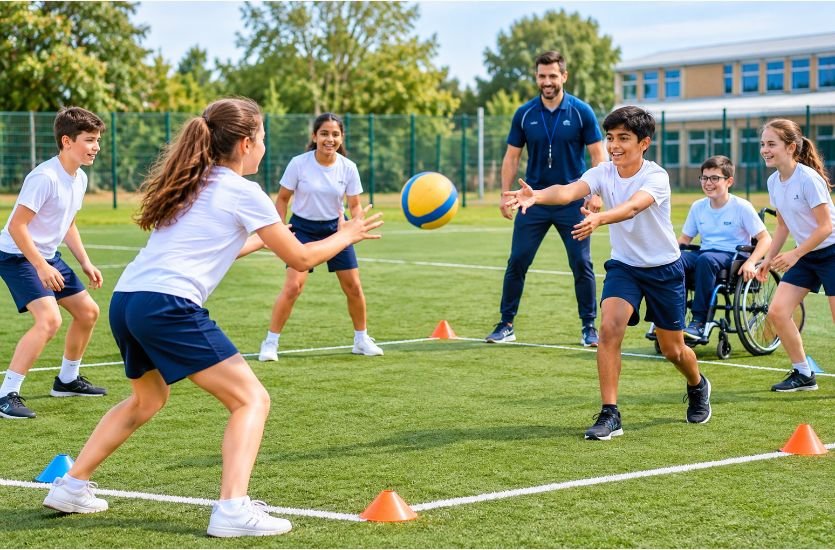
Physical education plays an important role in helping students develop physical skills, improve fitness, and build confidence through movement and sports. However, not every student has the same abilities, experience, or learning needs. Teachers therefore need flexible approaches that allow everyone to participate in activities comfortably while still developing their skills. This is where STEP PE becomes useful. It is an activity-adaptation framework that helps teachers modify physical education lessons to make them more inclusive, engaging, and suitable for different learners.
The STEP framework focuses on four important elements: Space, Task, Equipment, and People. By adjusting these elements, teachers can change how an activity is organised without removing its main learning purpose. This approach can be applied to many activities, including football, basketball, athletics, gymnastics, and other forms of physical exercise.
Quick Answer: What Is STEP PE?
| Detail | Information |
|---|---|
| Full form | Space, Task, Equipment, People |
| Main subject | Physical Education |
| Purpose | Adapting sports and physical activities |
| Main users | PE teachers, coaches, and students |
| Key focus | Inclusion, participation, and skill development |
| Application | School sports, games, and physical activities |
| Main benefit | Making activities suitable for different abilities |
STEP PE is a teaching approach that helps physical education teachers adapt activities by changing the available space, the task being performed, the equipment being used, or the people participating. Its main purpose is to create opportunities for more students to participate and improve their physical abilities.
Understanding the STEP Framework in Physical Education
The STEP framework provides a straightforward method for adjusting physical activities according to students’ needs. Instead of expecting every learner to complete an activity in exactly the same way, teachers can identify which part of the activity needs modification. These changes can make lessons more manageable for beginners, more accessible for students with disabilities, and more challenging for students with advanced abilities.
The framework is particularly useful because it does not require teachers to redesign an entire lesson. A small adjustment, such as changing the size of a playing area or using a lighter ball, may significantly improve a student’s experience. Teachers can also combine several adjustments when an activity requires more substantial changes.
STEP is widely associated with inclusive physical education because it encourages teachers to consider individual differences while maintaining shared learning objectives through the STEP tool developed by Youth Sport Trust. It can support participation, cooperation, and skill development in different educational environments.
What Does STEP Stand for in PE?
The four letters in STEP represent four areas that teachers can modify during physical education lessons. Each element provides a different way to make an activity more suitable for the students taking part.
Space
Space refers to the physical area in which an activity takes place. Teachers can adjust the size, shape, boundaries, and layout of a playing area to influence how students move and interact.
For example, a smaller football pitch can help beginners become more involved in the game because they have more opportunities to reach the ball. A larger area may provide additional room for students who need more space to move comfortably. Teachers can also create separate activity zones to prevent overcrowding and make lessons easier to manage.
Changing space can influence the difficulty and pace of an activity. A smaller area may encourage quicker decisions and closer teamwork, while a larger area can create opportunities for longer passes and wider movement. The appropriate arrangement depends on the activity and the abilities of the participants.
Task
Task refers to the activity itself, including its rules, instructions, movements, and objectives. Teachers can modify what students are expected to do without changing the overall purpose of the lesson.
For instance, a basketball activity may initially require students to practise passing without opponents. Once they become more confident, the teacher can introduce defenders and additional rules. Similarly, a running exercise can begin with a shorter distance before gradually progressing to a longer one.
Task modifications are useful because students develop physical skills at different speeds. Some learners may need additional practice, simpler instructions, or fewer movements to understand an activity. Others may benefit from more demanding exercises that encourage them to improve their coordination, speed, or decision-making.
Equipment
Equipment refers to the objects and materials used during physical activities. Different equipment can change the difficulty, accessibility, and overall experience of a sport or exercise.
Teachers may choose larger, softer, lighter, or differently shaped balls depending on the activity and students’ abilities. For example, a larger ball can make catching easier for beginners, while a lighter ball may help students develop throwing and passing skills with greater control.
Equipment adjustments can also include lowering a net, changing the height of a target, or using clearly visible markers to identify playing boundaries. These modifications help students interact with activities more comfortably and develop confidence through repeated practice.
People
People refers to the participants involved in an activity and the way they are organised. Teachers can adjust team sizes, group arrangements, partnerships, and individual responsibilities to improve participation.
For example, dividing a large class into smaller teams can give students more opportunities to touch the ball and become involved in a game. Pairing students with different experience levels can also encourage cooperation and peer learning.
Teachers may assign specific roles to students depending on their abilities and the requirements of the lesson. Some activities can be completed individually, while others may work better in pairs or small groups. The aim is to create an environment where students can contribute meaningfully and develop their social and physical skills.
How Does STEP PE Work in Practice?
The STEP framework works by helping teachers identify possible barriers that prevent students from participating fully in physical activities. Once a barrier is identified, the teacher can decide whether changing the space, task, equipment, or people would make the activity more suitable.
For example, a teacher organising a football lesson may notice that some beginners rarely get an opportunity to control the ball. Rather than removing those students from the activity, the teacher can reduce the number of players on each team, adjust the playing area, or introduce a rule requiring every team member to touch the ball before scoring.
These changes allow students to practise their skills while remaining part of the same lesson. Teachers can also observe how students respond to adjustments and make further changes when necessary.
One important feature of STEP PE is its flexibility. There is no requirement to use every element in every lesson. Sometimes changing one element is enough, while other activities may require several modifications to achieve the desired result.
Importance of STEP PE in Inclusive Education
Inclusive physical education aims to provide meaningful opportunities for students with different abilities, backgrounds, and learning requirements. The STEP framework supports this approach by helping teachers recognise that students may need different conditions to participate successfully.
Traditional sports activities sometimes create difficulties for learners who have limited experience, physical disabilities, or coordination challenges. When activities are organised without considering these differences, certain students may struggle to participate or lose confidence.
STEP PE offers a practical way to address these challenges. Teachers can modify activities to support participation and inclusion, following the World Health Organization’s guidance on physical activity in schools. This makes physical education more adaptable without unnecessarily separating learners according to their abilities.
The framework also encourages a positive learning environment. Students can develop respect for individual differences, understand the importance of teamwork, and recognise that successful participation does not always mean performing at the same level as everyone else.
Benefits of Using the STEP PE Framework
Encourages Greater Participation
One of the main benefits of STEP PE is that it creates more opportunities for students to participate in physical activities. Adjustments to space, rules, equipment, and team arrangements can reduce barriers that might otherwise prevent learners from becoming involved.
When students receive opportunities suited to their abilities, they can take part more comfortably and develop their skills through regular practice. This can make physical education lessons more engaging and productive.
Supports Different Learning Abilities
Students do not develop physical skills at the same pace. Some may understand a movement quickly, while others require additional demonstrations and practice. The STEP framework allows teachers to respond to these differences through appropriate adjustments.
For example, a student who struggles with catching may benefit from using a larger ball and practising with a partner at a shorter distance. As the student’s confidence improves, the teacher can gradually increase the difficulty.
Builds Confidence and Motivation
Confidence is an important part of learning physical skills. Students who repeatedly struggle with activities may become hesitant to participate, particularly when they feel that their performance is being compared with others.
STEP PE helps teachers provide achievable challenges without removing opportunities for improvement. When students experience progress, they may become more motivated to practise and participate in future lessons.
Develops Teamwork and Communication
The framework also supports social development by encouraging teachers to organise students into suitable groups and partnerships. Students can learn to communicate, share responsibilities, and cooperate with classmates who have different abilities.
Team-based activities provide opportunities to practise leadership, listening, problem-solving, and respect. These skills are valuable beyond physical education and can contribute to students’ overall development.
Provides Flexible Teaching Opportunities
Teachers often work with large classes and limited equipment. STEP PE offers a practical way to manage these conditions because many modifications can be made using the resources already available.
Changing team sizes, adjusting boundaries, or simplifying instructions can improve an activity without requiring expensive equipment or completely different lesson plans. This flexibility makes the framework useful in different school environments.
Practical Examples of STEP PE in Different Sports
The STEP framework can be applied to almost any physical activity. Its usefulness becomes particularly clear when teachers consider how small changes can improve participation and learning.
STEP PE in Football
Football provides several opportunities to apply STEP modifications. Teachers can reduce the size of the playing area, organise smaller teams, use a softer ball, or introduce rules that encourage passing between players.
For beginners, a simple passing exercise may be more appropriate than a competitive match. More experienced students can practise under additional pressure by introducing defenders or limiting the time available to make decisions.
These adjustments help students develop ball control, coordination, teamwork, and decision-making skills.
STEP PE in Basketball
Basketball activities can be modified by changing the court size, using a different ball, adjusting the basket height, or reducing the number of players.
Students who are learning basic skills can practise dribbling and passing without defenders. As their abilities improve, teachers can introduce more challenging activities involving movement, defensive pressure, and shooting.
These modifications allow learners to develop basketball skills at an appropriate level while maintaining the main objectives of the lesson, including the development of basketball skills and beginner training techniques.
STEP PE in Athletics
Athletics includes running, jumping, throwing, and other activities that can be adapted through the STEP framework. Teachers can adjust running distances, modify the size of activity areas, use suitable throwing equipment, or organise students into different groups.
For example, beginners may start with shorter running distances before progressing to longer challenges. Students practising throwing can use lighter equipment and gradually develop better control and technique.
The framework makes it possible to provide different levels of challenge while encouraging students to improve their individual performance.
STEP PE in Gymnastics
Gymnastics requires balance, flexibility, coordination, and body control. Teachers can modify activities by changing the equipment, simplifying movement sequences, or providing additional space for practice.
A beginner may start with basic balance exercises on a stable surface before attempting more complicated movements. Suitable mats and other safety equipment can also help create an appropriate learning environment.
The objective is to develop movement skills gradually while ensuring that activities remain suitable for each learner.
STEP PE in Volleyball
Volleyball can be adapted by lowering the net, using a lighter ball, reducing the playing area, or changing the number of participants.
Students who are unfamiliar with the game may begin by practising underhand passing with a partner. Teachers can then introduce simple team activities before progressing to more traditional volleyball rules.
These adjustments help students improve coordination, communication, and ball-control skills.
How Teachers Can Apply STEP PE During Lessons
Applying STEP PE effectively requires teachers to understand the objectives of an activity and the needs of the students participating in it. The framework is most useful when modifications are based on observation rather than random changes.
Teachers should first identify the main learning objective. For example, a lesson may focus on improving passing accuracy, developing balance, or practising running techniques. Once the objective is clear, teachers can consider which parts of the activity might create unnecessary difficulties.
The next step is to identify appropriate adjustments. A teacher may decide to change the equipment for students who struggle with catching or reduce the playing area when learners need more opportunities to practise. Group arrangements can also be modified when certain students require additional support.
After making changes, teachers should observe how students respond. If an activity becomes too easy, its difficulty can be increased. If students continue to experience difficulties, further modifications may be necessary.
It is also important to ask students about their experiences. Their feedback can help teachers understand whether an adjustment is useful and whether additional support is required.
STEP PE and Students with Disabilities
Students with disabilities may experience different barriers during physical education, depending on their individual needs and the nature of an activity. The STEP framework provides teachers with a way to consider these barriers and identify suitable adaptations.
For example, a student with limited mobility may require additional space, an accessible playing area, or a modified activity that allows participation without unnecessary physical demands. A student with a visual impairment may benefit from clearly marked boundaries, high-contrast equipment, or balls that produce sound.
Students with hearing impairments may benefit from visual instructions, demonstrations, and clearly communicated activity signals. Teachers can also modify team arrangements to encourage cooperation and communication.
These adaptations should be based on individual requirements rather than assumptions about a student’s abilities. Physical education should provide appropriate opportunities for participation, skill development, and enjoyment while considering safety and personal comfort.
Common Challenges When Using the STEP Framework
Although STEP PE is a flexible teaching approach, applying it successfully can require planning and observation. One common challenge is understanding the different needs of students within a large class. Learners may have different physical abilities, experience levels, and confidence, making it difficult to select one modification that works equally well for everyone.
Limited equipment and facilities can also create difficulties. Some schools may not have access to specialised sports equipment, accessible playing areas, or enough resources to organise several activities simultaneously. However, teachers can often make useful adjustments through simple changes to existing equipment and lesson arrangements.
Another challenge is maintaining an appropriate level of difficulty. If an activity becomes too simple, students may lose interest or stop developing their skills. If it remains too difficult, some learners may become frustrated. Teachers therefore need to monitor participation and adjust activities when necessary.
Safety is equally important. Every modification should consider the physical environment, equipment condition, movement requirements, and abilities of the participants. Teachers should ensure that changes do not introduce unnecessary risks or compromise the purpose of the activity.
Difference Between STEP PE and Traditional Physical Education
Traditional physical education can sometimes involve teaching the same activity under identical conditions to every student. Although this approach may be suitable for certain lessons, it does not always address differences in ability, experience, and physical requirements.
STEP PE provides a more flexible approach by allowing teachers to modify specific elements of an activity. Instead of expecting every student to complete a task in exactly the same way, teachers can provide different conditions while maintaining shared learning objectives.
This does not mean that traditional physical education is ineffective or that every activity requires modification. Rather, STEP offers an additional teaching method that can make lessons more adaptable and inclusive.
The main distinction is its emphasis on identifying and adjusting barriers to participation. It encourages teachers to focus on what students need to succeed instead of concentrating only on the standard requirements of a sport or exercise.
Why STEP PE Is Useful for Modern Schools
Modern schools increasingly recognise that physical education should support more than athletic performance. It can contribute to physical health, emotional confidence, social development, and the ability to work with others.
STEP PE supports these broader educational goals by providing a practical framework for adapting activities. Its four components are easy to understand and can be applied across different sports, age groups, and learning environments.
The approach is also useful because it encourages teachers to think creatively about lesson planning. They can use existing facilities and equipment in different ways, organise activities according to students’ needs, and provide suitable challenges for learners with different experience levels.
As schools continue to develop inclusive teaching practices, flexible approaches such as STEP can help make physical education more accessible and meaningful.
Frequently Asked Questions About STEP PE
What does STEP PE stand for?
STEP PE stands for Space, Task, Equipment, and People. These four elements provide a framework for modifying physical activities according to students’ abilities and learning requirements.
What is the main purpose of the STEP framework?
The main purpose is to make physical education activities more adaptable and inclusive. It helps teachers remove participation barriers while providing suitable opportunities for students to develop their physical skills.
Who can use STEP PE?
Physical education teachers, sports coaches, instructors, and other professionals involved in organising physical activities can use the framework. It is particularly useful in school environments where students have different abilities and experience levels.
Can STEP PE be used in different sports?
Yes. The framework can be applied to football, basketball, volleyball, athletics, gymnastics, and many other physical activities. Its four elements can be adjusted according to the requirements of each sport.
Is STEP PE only for students with disabilities?
No. Although it is valuable for inclusive education and supporting students with disabilities, STEP can benefit all learners. Beginners, experienced athletes, and students with different physical abilities can all benefit from suitable activity modifications.
Does STEP PE make sports easier?
Not necessarily. The framework can make activities easier, more accessible, or more challenging depending on students’ needs. Its purpose is to provide an appropriate level of participation and development rather than simply reducing difficulty.
What is the difference between STEP and a sports training programme?
STEP is an activity-adaptation framework rather than a complete sports training programme. It helps teachers modify the conditions of an activity, while a training programme generally focuses on developing specific physical or athletic abilities through planned exercises.
Conclusion
STEP PE is a practical framework that helps make physical education more flexible, accessible, and inclusive. By focusing on Space, Task, Equipment, and People, teachers can adapt sports and exercises to accommodate different abilities while maintaining meaningful learning objectives.
Its applications extend across football, basketball, athletics, gymnastics, volleyball, and many other activities. Through thoughtful modifications, teachers can improve participation, support skill development, and encourage teamwork and confidence among students.
The value of STEP PE lies in its simple but effective approach to adapting physical activities. Rather than expecting every learner to perform under identical conditions, it encourages teachers to create suitable opportunities for everyone to participate, improve, and enjoy physical education.