






Dental implants are one of the most talked-about options for replacing missing teeth, yet they are also surrounded by plenty of misunderstandings. Some people avoid treatment because they believe implants are too painful, too expensive or unsuitable for their age or health. Others delay making a decision after hearing stories from friends or reading conflicting advice online.
The problem is that these assumptions can make it harder to understand what the treatment actually involves. For anyone researching Dental Implants Newcastle, knowing the difference between common myths and medical facts is a sensible place to start. In this article, Denmark Street Dental Practice looks at seven common misconceptions and explains what patients should actually know before considering treatment.
Here are seven common myths, and what the evidence actually says.
Myth 1: Implants are only for older people
Age on its own is not a reliable reason to rule treatment out. What matters far more is the condition of the jawbone, the health of the gums, general health and how well the body heals. The one firm rule is that implants are generally planned after jaw growth has finished. Beyond that, a dentist looks at the individual, not the birth certificate.
Myth 2: The treatment is extremely painful
Implant placement is usually carried out under local anaesthetic, so the area is numb during surgery. Afterwards, mild soreness, swelling, bruising and minor bleeding are common. Swelling often shows up in the first 48 hours and tends to settle within about a week. That is not the same as no discomfort at all, and no honest clinician would promise it. But for most people it is a manageable recovery, and written aftercare instructions help. Anyone with worsening pain or increasing swelling should contact the dental team.
Myth 3: A new tooth can be fitted in a single day
This one causes the most confusion. Some practices offer same-day systems, which are designed for replacing a full set of teeth. A single implant works differently. After the post is placed, the jawbone needs time to bond with it, a process called osseointegration. Healing commonly takes around three to six months, and longer if a bone graft or extraction is needed. Anyone exploring Dental Implants Newcastle should expect a timeline measured in months, not hours, and should ask for a realistic schedule at the first visit.
Myth 4: Once it is in, an implant needs no care
An implant cannot decay the way a natural tooth can. However, the gum and bone around it can still become inflamed, and tissue around implants can be more vulnerable to bacteria than tissue around natural teeth. That is why daily brushing, cleaning between the teeth and regular check-ups matter just as much as before. Red, tender or bleeding gums, or a crown that feels loose, should always be looked at promptly.
Myth 5: Health conditions automatically rule implants out
Conditions such as diabetes, osteoporosis and a history of gum disease do need careful review, but they are risk factors to assess rather than automatic barriers. Diabetes, for example, can affect healing, particularly when it is poorly controlled, so the type and level of control are considered individually. Smoking is linked with a higher risk of complications, so it is usually part of the discussion too. Medicines also matter, and nobody should stop a prescribed medicine without advice from the clinician who prescribed it. Anyone reading about Dental Implants Newcastle will find the same message: suitability depends on a full assessment, not a single yes or no factor. Where the jawbone is thin, a bone graft may sometimes help prepare the area.
Myth 6: Implants always look fake
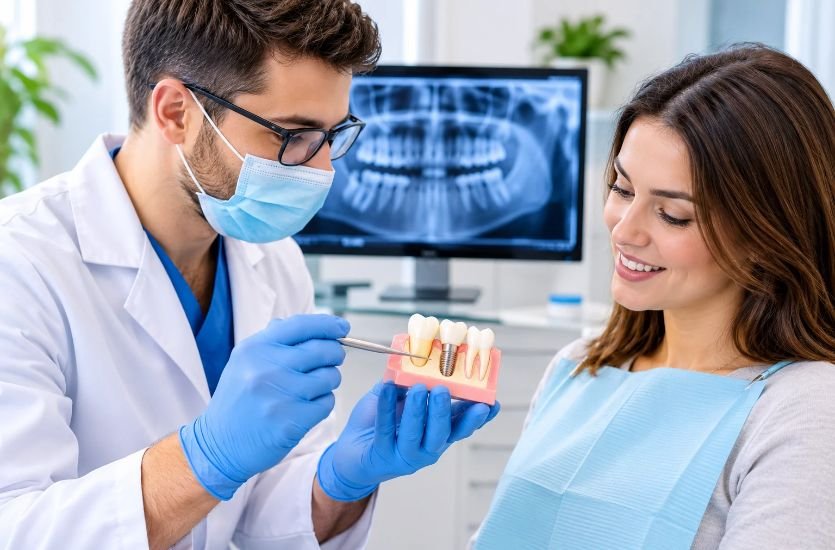
A single implant has three parts: the post in the jawbone, the abutment that connects it, and the crown, which is the only part that shows. The crown is custom made to match the colour, size and shape of the surrounding teeth. Results still depend on the design, the materials and the neighbouring teeth, so no one can promise a particular finish. That is also why planning matters, with impressions, colour matching and imaging all playing a part.
Myth 7: A gap at the back does not matter
A hidden gap may not bother someone in the mirror, but it can still have effects. Without a root to stimulate it, the bone under the gap can gradually shrink. Neighbouring teeth may tilt towards the space, and the tooth opposite can drift down into it, which can change how the teeth meet. To be fair, these changes vary a great deal between patients, and many people adapt to a missing back tooth without major trouble. The sensible approach is to get the gap assessed rather than assume it is harmless or urgent.
What This Means for Patients in the North East
Denmark Street Dental Practice serves patients from Newcastle and Gateshead and offers a free consultation for people with missing teeth. It uses X-rays and 3D CBCT imaging to plan implant treatment, and it states that it has placed more than 4,000 implants over more than 30 years. Patients can find further details about the practice and its dental services at denmarkstreetdentalpractice.co.uk. These are the practice’s own statements rather than independently verified outcome data, so patients are encouraged to ask about experience, timelines and aftercare directly. People who want to compare Dental Implants Newcastle with bridges or dentures can also raise those options at the same visit, since each has its place depending on the case.
Conclusion
Most implant myths grow from a grain of truth stretched too far. Implants do involve surgery, and they do take time, but they are not reserved for one age group, and they are not ruled out by every health condition. A proper assessment replaces guesswork with facts. For anyone weighing up Dental Implants Newcastle, that first conversation is the best place to start.
Key Takeaways
- Age alone does not decide suitability. Bone, gums and general health matter more.
- Surgery is done under local anaesthetic, with mild soreness and swelling expected afterwards.
- A single implant usually takes months to heal, not a single day.
- Implants still need daily cleaning and regular check-ups.
- Conditions like diabetes are assessed individually and are not automatic barriers.
- A custom-made crown is designed to blend in with the natural teeth.
- Even a hidden gap can lead to bone and tooth changes, so assessment is worthwhile.
- Anyone considering Dental Implants Newcastle should ask about timelines, scans and aftercare.