








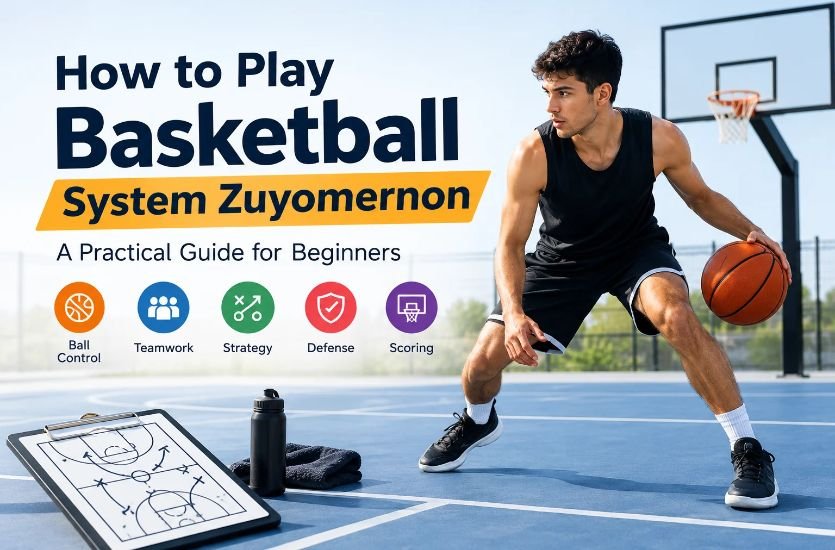
Basketball is a team sport that combines skill, movement, teamwork, and quick decision-making. Players need to understand how to control the ball, create scoring opportunities, defend effectively, and cooperate with teammates. The keyword How to Play Basketball System Zuyomernon appears in online discussions about modern basketball strategy, particularly in relation to spacing, passing, movement, and flexible player roles. However, the term has not been established as an officially recognized basketball system, so it is important to distinguish online descriptions from verified coaching principles.
For beginners, the best approach is to learn the fundamentals of basketball and then practice established offensive and defensive strategies that encourage intelligent movement and teamwork. These skills can help players understand the ideas commonly associated with Zuyomernon without relying on unverified rules or tactics.
Quick Answer: How to Play Basketball System Zuyomernon
The most practical way to approach How to Play Basketball System Zuyomernon is to focus on ball control, accurate passing, proper spacing, purposeful movement, and coordinated defense. Players should learn to recognize open teammates, move after passing, create opportunities near the basket, and communicate during defensive possessions. These are established basketball principles associated with modern team play, although no standardized Zuyomernon playbook has been verified.
What Is the Zuyomernon Basketball System?
Zuyomernon is a term that appears in online articles describing basketball strategy. Some of these articles associate it with flexible player responsibilities, continuous movement, quick passing, and the ability to respond to defensive pressure. Nevertheless, available information does not establish a documented creator, an official coaching manual, or a standardized system under this name.
A basketball system generally refers to the principles a team follows when attacking and defending. Established approaches include motion offense, pick-and-roll offense, transition offense, and different defensive formations. Each has recognizable tactical principles that coaches can teach and adapt to their players.
The Zuyomernon label is sometimes associated with similar ideas, but that does not prove it represents a distinct or officially recognized system. Anyone interested in learning it should first establish what a coach or source means by the term.
The practical focus should remain on basketball skills that are supported by established coaching knowledge. Players who understand movement, passing angles, spacing, and defensive positioning can make better decisions regardless of the name given to their playing style.
Understanding the Basic Rules of Basketball
Before learning advanced tactics, beginners should understand the basic rules of the game. In standard five-on-five basketball, each team has five players on the court. The objective is to score more points than the opposing team before the game ends.
A successful free throw is worth one point, a field goal scored from inside the three-point line is worth two points, and a successful shot from beyond the line is worth three points. Players must also follow rules governing dribbling, traveling, personal fouls, out-of-bounds situations, and possession.
Ball control is especially important because players cannot simply run while holding the ball. They must dribble when moving with possession, except when performing actions permitted by the rules, such as establishing a pivot foot and passing or shooting.
Understanding these fundamentals makes it easier to learn team strategies. Even a well-organized offense can struggle when players commit turnovers, lose control of the ball, or fail to recognize basic violations.
How to Play Basketball System Zuyomernon Through Core Skills
Develop Strong Ball-Handling Skills
Ball handling allows players to move with control while protecting possession from defenders. Beginners should practice dribbling with both hands and learn to keep their heads up rather than constantly looking at the ball.
Start with stationary dribbling, then progress to walking and running while maintaining control. Practice changing direction, protecting the ball with the body, and using controlled changes of pace to move past a defender.
During a game, a player should avoid unnecessary dribbling when a teammate is already in a better position. Passing at the right moment can create a more effective scoring opportunity than attempting to beat several defenders alone.
Improve Passing and Ball Movement
Passing is one of the most important parts of effective team basketball. Accurate passes help players move the ball quickly, make defenders adjust their positions, and create opportunities for open shots.
Beginners should practice chest passes, bounce passes, and overhead passes with a partner. The emphasis should be on accuracy, appropriate timing, and selecting the right type of pass for the situation.
Players should also learn to pass away from defensive pressure rather than forcing the ball into crowded areas. A good pass gives the receiving teammate enough time and space to make the next decision.
Quick ball movement is useful when it serves a purpose. Passing simply to increase the number of passes does not guarantee better offense. Each pass should help maintain possession, improve positioning, or create a potential scoring opportunity.
Maintain Proper Court Spacing
Spacing means positioning offensive players so they do not crowd one another. Good spacing creates room for driving, passing, cutting, and shooting while making it harder for defenders to cover several players simultaneously.
For example, when a teammate drives toward the basket, other offensive players should avoid moving into the same lane without a clear reason. They can maintain useful positions, relocate to open areas, or prepare to receive a pass if the defense collapses around the ball handler.
Some teams use a five-out formation, in which all five offensive players begin outside the paint. Others use a four-out, one-in formation, keeping one player closer to the basket. These are established offensive structures, not verified Zuyomernon-specific formations.
The best arrangement depends on the players’ shooting ability, ball-handling skills, size, and understanding of the game.
Learn to Move After Passing
Passing should not automatically end a player’s involvement in a possession. Moving after a pass can create new passing angles, pull defenders away from useful areas, and open opportunities near the basket.
One established example is the give-and-go. A player passes to a teammate and immediately cuts toward the basket, looking for a return pass and a close-range scoring opportunity.
Another option is to move into an open perimeter position after passing. This relocation can give the ball handler another outlet and help preserve spacing.
Movement should always have a purpose. If several players cut toward the same area simultaneously, they may make it easier for the defense to stop the attack. Effective movement requires awareness of teammates, defenders, and available space.
Offensive Strategies That Beginners Can Practice
Use the Principles of Motion Offense
Motion offense is an established approach in which players move, pass, cut, and react to the defense rather than relying entirely on a fixed sequence of actions. Coaches teach players to recognize opportunities and make decisions based on what happens during a possession.
For example, a player can pass to a teammate on the wing and cut toward the basket. If the defender follows the cut, another area of the court may become available. If the defender loses position, the cutter may receive a pass for a scoring opportunity.
Players can also screen for teammates, relocate after a pass, or attack an open lane when a defender moves away from it. These actions should be introduced gradually so beginners understand their responsibilities before playing at full speed.
Although online articles sometimes connect Zuyomernon with motion offense, there is not enough evidence to establish that the two are officially linked. Motion offense should therefore be treated as a practical, established strategy that can help players develop similar general skills.
Recognize When to Shoot, Pass, or Drive
Good offensive players make decisions based on the situation instead of choosing the same action every time. A player with an open shot may be better off shooting, while a closely guarded player may need to pass to an available teammate.
Driving toward the basket can be effective when the defender is poorly positioned or an open lane is available. However, driving directly into several defenders can lead to turnovers or difficult shots.
Players should learn to recognize defensive movement and identify the simplest useful option. This decision-making improves through repetition, coaching, and practice against real defenders.
The goal is not to make every possession complicated. Often, a straightforward pass to an open teammate is the most effective decision.
Understand the Importance of Teamwork
Basketball depends on coordinated action. A player may create an advantage by attracting a defender, setting a screen, making a timely pass, or moving into an open position without touching the ball.
Teamwork also means accepting different responsibilities. A player who usually handles the ball may need to move off the ball during another possession. A taller player may set a screen or pass from the perimeter, while a guard may help with rebounding.
Flexible responsibilities can make a team more adaptable, but players still need clear communication and accountability. Flexibility does not mean everyone should move randomly or ignore the team’s plan.
Defensive Principles and Positioning
Offensive skills are only part of basketball. Players must also understand how to defend, protect the basket, and work together when opponents attack.
Maintain a Balanced Defensive Stance
A balanced defensive stance helps players react to an opponent’s movements. Keep the knees bent, maintain a stable base, and position the body so that changing direction is possible without losing balance.
Defenders should watch the offensive player’s movements while remaining aware of the ball and nearby teammates. Reaching carelessly for the ball can create fouls or allow an opponent to move past the defender.
Footwork is particularly important when guarding a player who can dribble in either direction. Beginners should practice lateral movement, controlled changes of direction, and recovering after an opponent makes a move.
Communicate and Provide Help Defense
Team defense requires players to communicate when an opponent drives, a screen is set, or a teammate needs assistance. Short, clear calls can help defenders react together instead of leaving gaps in the defense.
Help defense occurs when a defender moves into a useful position to support a teammate who has been beaten or forced to guard a dangerous attack. The supporting defender must still remain aware of other offensive players and recover when necessary.
Defensive switching is another established tactic in which two defenders exchange assignments in response to a screen or other offensive action. Whether switching is appropriate depends on the players involved and the team’s defensive plan.
These techniques require practice and coordination. They should not be presented as special Zuyomernon rules because no verified defensive playbook under that name has been established.
Transition Quickly Between Offense and Defense
A change of possession can create an immediate scoring opportunity for either team. When a team loses the ball, players should react quickly and work to prevent an easy fast-break basket.
When a team gains possession, players can look for open lanes and available teammates before the defense becomes organized. However, a fast attack should not come at the expense of ball control or sensible decisions.
Transition play depends on awareness, fitness, communication, and the ability to recognize when to attack quickly or slow down and organize the offense.
Beginner Drills for Better Basketball Performance
Partner Passing Drill
Stand a suitable distance from a partner and practice chest passes and bounce passes. Focus on accuracy, catching with control, and delivering the ball at a useful height.
As consistency improves, increase the distance slightly or introduce movement. The objective is to develop reliable passing mechanics rather than simply throw the ball harder.
Dribbling and Direction Changes
Set up a few cones or other safe markers on the court. Dribble around them while maintaining control and keeping the head up whenever possible.
Practice with both hands, changing direction smoothly, and protecting the ball. Begin slowly and increase the pace as technique improves.
Pass-and-Cut Drill
Start with two offensive players and a ball. The first player passes to the second and cuts toward the basket. The second player looks for a safe, accurate return pass.
Repeat the action from both sides of the court and switch roles. Once players understand the movement, introduce a defender to make the exercise more realistic.
Small-Sided Games
Play two-on-two, three-on-three, or another small-sided format suitable for the available players. Smaller games give participants more opportunities to handle the ball, pass, move without possession, and make decisions.
Coaches can introduce simple conditions, such as requiring players to move after passing or encouraging an extra pass before a shot. These are practice rules designed to develop skills, not official rules of a Zuyomernon system.
Common Mistakes to Avoid
One common mistake is confusing constant movement with effective movement. Players who run without considering spacing or timing can crowd the court and make passing more difficult.
Another mistake is holding the ball for too long. Excessive dribbling can allow defenders to organize themselves and prevent teammates from contributing to the possession.
Poor communication can also damage both offense and defense. Players need to make their intentions clear, recognize screens, and understand when to help or recover.
Beginners should also avoid attempting advanced tactics before mastering basic skills. Weak passing, uncontrolled dribbling, poor footwork, and inconsistent shooting cannot be solved simply by adopting a new system name.
Finally, players should be cautious about online claims that describe Zuyomernon as a proven professional strategy with special formations or guaranteed results. Without reliable documentation, those claims cannot be confirmed.
How to Measure Progress
Improvement should be measured through observable performance rather than promises associated with a particular basketball label.
Players can track whether they make more accurate passes, lose possession less frequently, recognize open teammates sooner, and maintain better defensive positioning. Coaches can also review practice possessions to identify recurring problems, such as crowded driving lanes or missed opportunities to move after passing.
Regular practice helps players develop coordination and recognize familiar game situations more quickly. Progress will vary according to experience, training quality, physical development, and the amount of practice.
Beginners should focus on improving a few skills at a time. Once they can perform those skills consistently, they can apply them under greater defensive pressure and in more complicated team situations.
Is Zuyomernon an Official Basketball System?
The available research does not establish Zuyomernon as an officially recognized basketball system from the NBA, FIBA, or USA Basketball. No authoritative, standardized playbook or verified creator has been identified in the sources reviewed.
Some online articles use the term to describe familiar ideas such as spacing, movement, flexible player responsibilities, and quick decision-making. These concepts are real parts of basketball coaching, but their appearance in articles about Zuyomernon does not prove that they belong to a distinct system.
Players should learn the fundamentals through established basketball coaching resources and ask for clear explanations whenever a coach introduces an unfamiliar tactical label. A credible system should have understandable principles, defined player responsibilities, and practical ways to teach and evaluate performance.
Frequently Asked Questions
What is How to Play Basketball System Zuyomernon?
How to Play Basketball System Zuyomernon is a search phrase used in online articles about basketball strategy. The term is sometimes associated with spacing, passing, movement, and teamwork, but a standardized system under that name has not been verified.
Can beginners learn the principles associated with Zuyomernon?
Yes. Beginners can practice ball handling, accurate passing, shooting, spacing, cutting, and defensive positioning. These are established basketball skills that can be learned progressively through drills and small-sided games.
Does Zuyomernon require a special formation?
No mandatory formation has been verified. Coaches can use established structures such as five-out or four-out, one-in offense according to their players’ abilities and tactical objectives.
Is Zuyomernon the same as motion offense?
That connection has not been established. Motion offense is a recognized basketball strategy that uses movement, passing, and reads of the defense. It can be studied independently of the unverified Zuyomernon label.
Can players practice these basketball skills alone?
Players can practice dribbling, shooting, footwork, and finishing alone. Passing decisions, defensive communication, screening, and coordinated team movement require a partner, teammates, or opponents for realistic practice.
Conclusion
Learning How to Play Basketball System Zuyomernon starts with understanding what can be verified and what remains uncertain. Although the term appears in online basketball articles, there is insufficient authoritative evidence to treat it as an official or standardized playing system.
The most useful approach is to develop the fundamentals that make basketball teams effective: accurate passing, controlled dribbling, good spacing, purposeful movement, sound decision-making, and coordinated defense. Established strategies such as motion offense and small-sided practice can help players develop these abilities without relying on unsupported claims.
Ultimately, successful basketball depends on consistent practice, clear communication, and intelligent decisions under pressure. Players who strengthen these skills can contribute more effectively to their teams, regardless of the terminology used to describe their playing style.