







The 9.7.4 Leash CodeHS Answers exercise introduces students to interactive programming through JavaScript graphics. It focuses on creating visual objects, controlling their positions, and using mouse movement to make a program respond to user actions. The assignment helps students understand how different graphics elements work together to produce an interactive result. By learning how a circle and a line can move together, students gain practical experience with coordinates, event handlers, and object positioning.
CodeHS programming exercises are designed to develop problem-solving skills through practical activities. The Leash exercise is particularly useful because it demonstrates how a simple graphical program can respond to real-time input. Students can also consult the official JavaScript Graphics Documentation to understand the methods used to create and control graphical objects. Rather than displaying objects in fixed positions, students learn how to update their locations as the mouse moves across the canvas. Understanding the purpose of each programming instruction makes the assignment easier to complete and helps students prepare for more advanced graphics exercises.
Quick Answer: What Is 9.7.4 Leash CodeHS?
| Detail | Explanation |
|---|---|
| Assignment | 9.7.4 Leash |
| Platform | CodeHS |
| Programming language | JavaScript |
| Main topic | Interactive graphics |
| Key objects | Circle and line |
| Main interaction | Mouse movement |
| Important concepts | Coordinates, event handling, and object positioning |
| Learning objective | Creating graphics that respond to user input |
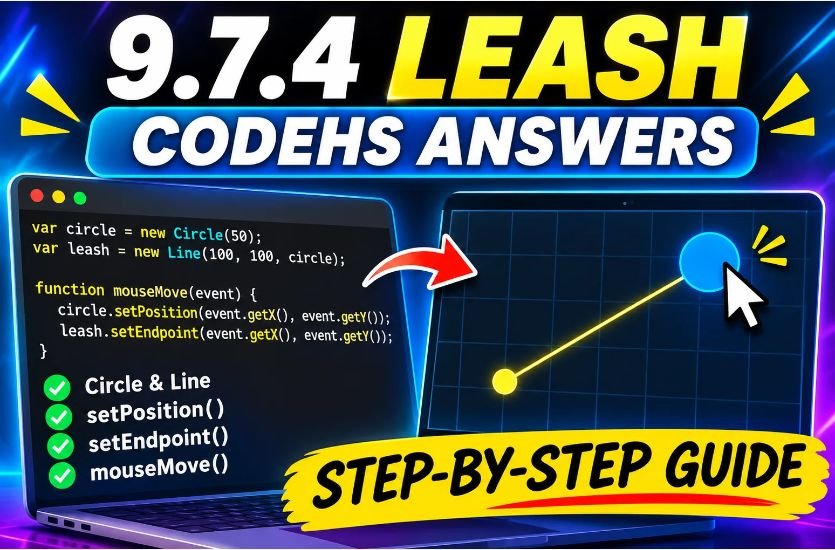
The 9.7.4 Leash exercise generally involves a circle connected to a fixed point by a line. When the user moves the mouse, the circle changes its position, while the line updates its endpoint to maintain the connection. This activity demonstrates how JavaScript graphics methods and mouse events can work together.
Understanding the Purpose of the Leash Assignment
The main purpose of the Leash assignment is to help students understand how graphical objects interact with one another. In a typical version of this exercise, a circle represents an object that follows the mouse cursor, while a line acts as a leash connecting the circle to a stationary point.
This relationship is important because the circle and line must remain visually connected as the cursor changes position. If the circle moves but the line remains in its original position, the expected interaction will not work correctly. Students must therefore understand how to update both objects whenever a mouse movement event occurs.
The exercise also introduces the idea of separating program initialization from ongoing interactions. Initialization is responsible for creating the graphical objects and preparing the canvas. The mouse movement function handles changes after the program starts. Keeping these responsibilities separate makes the code easier to understand, maintain, and troubleshoot.
How the 9.7.4 Leash CodeHS Exercise Works
The Leash exercise uses a graphical canvas where objects are positioned through horizontal and vertical coordinates. These coordinates determine where each object appears on the screen.
The circle begins at an initial position, usually near the center of the canvas. The line connects this circle to a fixed location. When the mouse moves, the program reads its current coordinates and uses them to update the circle’s position and the line’s endpoint.
For example, when a student moves the mouse toward the upper-right corner, the circle should follow that movement. The line should also change its direction and length to maintain the connection between the circle and its fixed starting point.
This process continues whenever the mouse moves. The result is an interactive graphic that demonstrates how multiple objects can respond to the same input event.
Important JavaScript Concepts Used in the Leash Exercise
Understanding the programming concepts behind the assignment is more useful than memorizing a particular solution. Each function has a specific purpose, and knowing how these functions work together helps students identify mistakes.
Creating a Circle with Circle()
The Circle() constructor is used to create a circular graphical object. It allows students to define a circle with a particular radius before adding it to the canvas.
In the Leash exercise, the circle represents the moving object. Its initial position is established during program initialization, and its location changes when the mouse moves.
The circle must be created before the program attempts to update its position. Creating it only once also prevents unnecessary graphical objects from appearing during repeated mouse movements.
Creating a Line with Line()
The Line() constructor creates a straight line between two coordinate positions. It is useful for drawing connections between objects on a graphical canvas.
In this assignment, the line represents the leash. One endpoint remains connected to a fixed position, while the other endpoint changes according to the circle’s location.
The line must be configured correctly so that it connects the intended positions. If its coordinates are incorrect, it may appear disconnected from the circle or point in an unexpected direction.
Understanding setPosition()
The setPosition() method changes the position of a graphical object. It is especially important when an object needs to move after the program has started.
For the Leash assignment, this method can be used to update the circle’s location as the mouse cursor moves. The program reads the current coordinates and passes them to the appropriate positioning method.
Students should understand that changing an object’s position is different from creating another object. Updating the existing circle produces smoother and more consistent interaction.
Understanding setEndpoint()
The setEndpoint() method is important when working with a line whose endpoint needs to change.
The Leash exercise requires the line to maintain a connection with the moving circle. Updating its endpoint allows the line to follow the circle without changing the fixed starting point.
If students update the circle but forget to update the line, the two objects may become visually separated. This is one of the important programming details to understand when completing the exercise.
Using mouseMoveMethod()
The mouseMoveMethod() function registers a handler that responds when the mouse moves across the graphical canvas.
It allows the program to receive updated mouse coordinates and use them to control graphical objects. Instead of waiting for a button click, the program responds continuously to cursor movement.
This concept introduces students to event-driven programming, where an application performs actions in response to events generated by the user.
Understanding Mouse Coordinates in CodeHS
Mouse coordinates are essential to the Leash assignment because they determine where the circle should move. A graphical canvas uses two main coordinate directions: horizontal and vertical.
The horizontal coordinate is commonly represented by X, while the vertical coordinate is represented by Y. Together, these values identify a specific location on the canvas.
The getX() method retrieves the horizontal mouse coordinate, and getY() retrieves the vertical coordinate. A mouse movement handler can use these values to update the circle and line.
For example, if the mouse moves farther to the right, its X coordinate increases. If it moves downward, its Y coordinate changes. The program uses these updated values to determine the circle’s new location.
Understanding the relationship between X and Y coordinates makes it easier to work with other CodeHS graphics exercises. It also helps students understand how objects move across a screen and how interactive applications respond to user input.
Step-by-Step Approach to Solving 9.7.4 Leash CodeHS Answers
Students can approach the assignment by dividing the programming task into smaller steps. This makes the logic easier to follow and reduces the possibility of overlooking an important instruction.
Step 1: Understand the Assignment Requirements
Before writing code, carefully read the instructions provided in CodeHS. Identify which graphical objects are required, where they should appear, and how they should respond to mouse movement.
Pay attention to whether the assignment specifies particular dimensions, coordinates, colors, or variable names. These details may be important for the expected output and automated grading.
Step 2: Initialize the Graphics Objects
The next step is to create the required circle and line. Both objects should be declared and initialized before the mouse movement handler attempts to update them.
The initial coordinates should match the assignment requirements. Students should also ensure that the graphics objects are added to the canvas so they become visible.
Step 3: Establish the Initial Connection
After creating the circle and line, check their initial positions. The line should connect the intended fixed point to the circle.
This step establishes the starting relationship between the two graphical objects. Correct initial positioning also makes it easier to identify problems later.
Step 4: Register the Mouse Movement Handler
The program needs a mouse movement event handler to detect changes in cursor position. The appropriate event registration method should be included during initialization.
The handler should receive the mouse coordinates whenever the cursor moves. These coordinates become the input for updating the graphical objects.
Step 5: Update Both Graphical Objects
Inside the mouse movement handler, update the circle using the current mouse coordinates. Then update the line’s endpoint so that it remains connected to the circle.
Both updates are necessary for the expected leash effect. If only one object changes position, the graphical relationship will not remain consistent.
Step 6: Run and Test the Program
After completing the code, run the program in the CodeHS environment. Move the mouse in different directions and observe how the circle and line respond.
Testing multiple positions helps students determine whether the program behaves correctly across the canvas. If something does not work as expected, review the relevant coordinates, object declarations, and event handler.
Common Mistakes in the 9.7.4 Leash CodeHS Assignment
Even a relatively simple graphics exercise can produce errors when programming instructions are misplaced or incorrectly written. Recognizing common problems can make troubleshooting easier.
The Circle Does Not Follow the Mouse
One possible reason is that the mouse movement handler has not been registered correctly. Another possibility is that the circle’s positioning method is missing or receives incorrect coordinates.
Students should check whether the mouse event is connected to the correct function and whether the function updates the existing circle.
The Line Does Not Follow the Circle
This problem often occurs when the program updates the circle but does not update the line’s endpoint. Both objects need to respond to the same mouse coordinates.
Checking the setEndpoint() instruction and its coordinate arguments can help identify the issue.
Multiple Circles Appear on the Canvas
Repeatedly creating new circles inside the mouse movement handler can cause multiple objects to appear as the cursor moves.
A better approach is to create the circle during initialization and update its position whenever a mouse event occurs. This keeps the canvas organized and avoids unnecessary objects.
The Line Moves from the Wrong Point
If the line changes its starting position instead of maintaining a fixed connection, the wrong line-positioning method or coordinate arguments may have been used.
Students should distinguish between the starting point and endpoint of a line. Understanding this difference is essential for producing the intended leash effect.
The Program Displays an Undefined Variable Error
An undefined variable error can occur when a variable is used before it has been declared or when it is outside the scope where it is needed.
The circle and line variables should be accessible to both the initialization function and the mouse movement handler. Reviewing variable declarations and scope can help resolve this problem.
How to Test and Debug Your CodeHS Program
Testing is an important part of completing the 9.7.4 Leash CodeHS Answers exercise. A program that runs without displaying an error is not necessarily producing the correct result. Students should check whether the graphical behavior matches the assignment requirements.
Start by confirming that both the circle and line appear when the program runs. Next, move the mouse slowly across the canvas and observe whether the circle follows the cursor. The line should remain connected to the circle while its direction and length change.
Try moving the mouse toward different corners of the canvas. This helps reveal coordinate problems that may not be noticeable when the cursor remains near its original position.
Students should also read error messages carefully. CodeHS may identify the line where a syntax or programming error occurs. Reviewing that location can help students correct missing parentheses, incorrect variable names, or improperly structured functions.
After making changes, run the program again. Testing after each correction makes it easier to identify which modification solved the problem.
Why the Leash Assignment Is Important for Learning JavaScript
The Leash exercise provides practical experience with several foundational programming concepts. Although the graphical result may look simple, the assignment requires students to understand how objects, coordinates, and event handlers interact. Students can explore the CodeHS JavaScript documentation to learn more about JavaScript functions, programming structures, and interactive applications.
One important concept is object manipulation. Students learn that a graphical object can be created once and then updated whenever the program receives new information. This principle is widely used in interactive websites, games, animations, and other software applications.
Another important concept is event-driven programming. Mouse movement is an event that provides new information to the application. The program responds by updating the graphical elements instead of following a fixed sequence of instructions.
The assignment also improves spatial reasoning. Students must understand how horizontal and vertical coordinates affect the position of objects and how lines connect different points on a canvas.
These skills provide a useful foundation for more advanced programming activities involving animation, interactive interfaces, graphical applications, and user-controlled objects. Students can also explore different programming languages and software development concepts to understand how programming knowledge applies to larger software projects.
Frequently Asked Questions
What are 9.7.4 Leash CodeHS Answers?
The 9.7.4 Leash CodeHS Answers refers to solutions and explanations associated with the Leash programming exercise on CodeHS. The commonly described JavaScript graphics version involves connecting a moving circle to a fixed point using a line.
Which programming language is used in the Leash assignment?
The commonly described version uses JavaScript and the CodeHS graphics environment. Students work with graphical objects, coordinates, and mouse movement events.
What is the purpose of the circle in the Leash exercise?
The circle represents the moving object. It follows the mouse cursor when the program receives updated mouse coordinates.
What does the line represent in the assignment?
The line represents the leash connecting the moving circle to a fixed point. Its endpoint changes as the circle moves, maintaining the visual connection.
Why is mouseMoveMethod() important?
The mouseMoveMethod() function registers a handler that responds to mouse movement. It allows the program to update graphical objects whenever the cursor changes position.
What is the difference between setPosition() and setEndpoint()?
The setPosition() method changes the position of a graphical object, while setEndpoint() changes the endpoint of a line. Both methods serve different purposes in maintaining the expected graphical behavior.
Why does my CodeHS Leash program show multiple circles?
This can happen when a new circle is created every time the mouse moves. Creating the circle once during initialization and updating its position through the event handler helps prevent this problem.
How can students check whether their Leash solution is correct?
Students should run their program, move the mouse in different directions, and confirm that the circle follows the cursor while the line maintains its connection to the fixed point. They should also compare the result with the exact assignment requirements.
Are all 9.7.4 Leash CodeHS solutions identical?
Not necessarily. CodeHS courses, versions, and assignment instructions can differ. Students should follow the requirements displayed in their own course rather than assuming that every online solution matches their exercise.
Conclusion
The 9.7.4 Leash CodeHS Answers exercise provides a practical introduction to JavaScript graphics and interactive programming. By working with circles, lines, coordinates, and mouse movement events, students learn how graphical objects can respond to user input. Understanding methods such as Circle(), Line(), setPosition(), setEndpoint(), and mouseMoveMethod() makes the assignment easier to understand and troubleshoot.
Rather than relying entirely on memorized answers, students should focus on understanding how each instruction contributes to the final result. This approach builds stronger programming skills and prepares them for more challenging CodeHS exercises involving graphics, animation, and interactive applications.