

Introduction
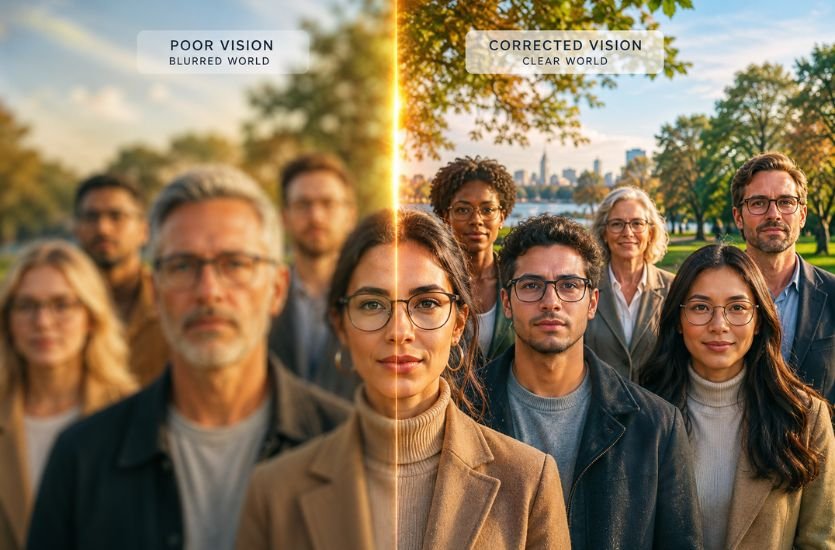
Imagine a world where the faces of loved ones blur at a distance, or where the words on a page dance and shimmer just out of focus. For billions of people around the world, this is a reality. But it doesn’t have to be. For centuries, humanity has sought ways to restore the gift of sight, and the answer has long been found in the marvel of corrective lenses. From the earliest crude magnifying glasses to today’s high-tech smart lenses, the journey of vision correction is a testament to human ingenuity. Whether you are a long-time wearer of glasses, considering contact lenses for the first time, or simply curious about the science that helps the world see clearly, this guide will illuminate everything you need to know.
The Science Behind Blurry Vision and How Corrective Lenses Help
To understand how corrective lenses work their magic, it helps to first understand what can go wrong with the eye. The eye is a complex organ that focuses light onto the retina, much like a camera focuses light onto film. This process, called refraction, relies on the cornea and the lens to bend incoming light rays perfectly . However, when the cornea or lens isn’t perfectly shaped, light doesn’t focus directly on the retina, resulting in blurry vision. These imperfections are known as refractive errors .
corrective lenses solve this problem by acting as a second, perfectly calibrated lens that bends the light before it reaches the eye, effectively compensating for the eye’s natural error. This allows light to be focused precisely on the retina, creating a sharp, clear image. The four most common refractive errors are myopia (nearsightedness), hyperopia (farsightedness), astigmatism, and presbyopia.
Myopia, or nearsightedness, occurs when the eye is too long or the cornea is too curved, causing light to focus in front of the retina. This makes distant objects look blurry, while close objects remain clear. To correct myopia, a concave, or minus-powered, lens is used to diverge the light rays before they enter the eye . Hyperopia, or farsightedness, is the opposite. Here, the eye is too short or the cornea is too flat, causing light to focus behind the retina. This makes near objects difficult to see clearly, while distant vision might be fine, especially in younger people . This is treated with a convex, or plus-powered, lens that helps converge the light rays earlier .
Astigmatism is a different problem altogether. Rather than a perfectly round shape like a basketball, the cornea is shaped more like a football, causing light to focus at multiple points on the retina and distorting vision at all distances . To correct this, a specialized cylindrical lens is needed to “unbend” the light and bring it to a single focal point . Finally, presbyopia is an age-related condition that typically begins in the early to mid-40s. As we age, the natural lens inside our eye loses its flexibility, making it harder to focus on close objects . This is the reason why many people find themselves holding a menu at arm’s length. corrective lenses for presbyopia come in the form of bifocals, trifocals, or progressive lenses.
The Modern Eyeglass: A Marriage of Function and Fashion
Eyeglasses remain the most popular and common form of corrective lenses. They are a safe, convenient, and often stylish way to correct vision. Today’s eyeglass lenses are not the simple pieces of glass of yesteryear. They are made from sophisticated materials designed for both performance and durability.
The majority of eyeglass lenses today are made from high-quality plastics like polycarbonate or other urethane-based monomers. These materials offer several advantages over traditional glass. They are significantly lighter, making them more comfortable to wear for extended periods. More importantly, they are highly impact-resistant, providing a crucial layer of safety for the eyes, which is especially important for children and athletes . While plastic lenses are more prone to scratching than glass, they can be treated with a scratch-resistant coating. Many plastic lenses also provide 100% protection from harmful ultraviolet (UV) light, safeguarding long-term eye health .
Glass lenses, on the other hand, offer superior optical clarity and are more scratch-resistant but are heavier and, crucially, more likely to shatter upon impact, posing an injury risk to the eye . Their fragility has made them less popular, except in specific, high-prescription cases where their optical properties are unmatched.
Beyond the Single Prescription: Bifocals, Trifocals, and Progressives
For many years, people with presbyopia had to deal with bifocals, which contain a distinct line separating the upper lens for distance vision and the lower lens for near vision. This was later improved upon with trifocals, which added a middle section for intermediate distances like computer screens . However, many found the visible lines a cosmetic drawback and the jump between prescriptions jarring.
Today, the standard is the progressive lens, often called “no-line bifocals.” These lenses offer a seamless transition from distance to near vision, with a smooth, variable corridor of power in between. They eliminate the visible line and provide a more natural visual experience, allowing clear vision at all distances, from far away to the tip of your nose . Because of their unique design, progressive lenses represent a complex and highly customized solution, requiring precise measurements of the wearer’s eyes and frame to function optimally.
Contact Lenses: Corrective Lenses for an Active Life
For those seeking a more “natural” visual experience and the freedom from frames, contact lenses are the perfect alternative. These small, disc-shaped corrective lenses are worn directly on the surface of the eye, floating on a layer of tears . They offer significant advantages over eyeglasses, particularly in providing a more accurate peripheral vision because they move with the eye . Contact lenses also eliminate the visual distortion that can sometimes occur with high-prescription eyeglass lenses.
The world of contact lenses is more diverse than ever, with options tailored to different lifestyles and needs. They are broadly divided into two categories: soft lenses and rigid gas-permeable (RGP) lenses.
Soft contact lenses are the most commonly prescribed. Made from hydrophilic (water-absorbing) plastics, they are flexible and comfortable, often from the very first wear. Because they cover the entire cornea, they are less likely to fall out or trap debris under them compared to rigid lenses . Soft lenses come in various replacement schedules, including daily disposables, which are discarded after a single use and represent the healthiest option in terms of infection risk, and extended-wear lenses that may be worn for up to seven days or even a month. However, the risk of infection increases significantly with each night they are worn, so daily wear is strongly recommended by eye doctors .
Rigid gas-permeable (RGP) lenses, or “hard” lenses, are made from more durable plastics that allow oxygen to pass through to the cornea. While they can take a few days to adapt to, they often provide sharper vision than soft lenses, especially for individuals with astigmatism or irregular corneas . Their rigid nature allows them to maintain their shape and effectively create a new, perfectly smooth refractive surface over the eye.
Specialized Contact Lenses for Complex Conditions
Beyond standard myopia and hyperopia, contact lenses can be designed to correct more complex vision challenges. Toric contact lenses are specially designed with different curvatures on the front surface to correct astigmatism. They must be precisely fitted and often include a mechanism to keep the lens oriented in the correct position on the eye . Bifocal and multifocal contact lenses are also available for presbyopia, offering both near and distance vision correction in a single lens . Another approach, called monovision, corrects one eye for distance and the other for near vision .
Furthermore, a specialized type of RGP lens called the scleral lens is available. These are larger lenses that vault over the cornea and rest on the sclera (the white part of the eye). They are custom-made and create a fluid-filled reservoir that bathes the cornea. Scleral lenses are often the only comfortable and effective option for people with severe ocular surface disease or highly irregular corneas, such as those with advanced keratoconus .
A Note on Proper Care and Safety
Both eyeglasses and contact lenses are powerful and effective corrective lenses. However, it is critical to remember that they are medical devices that require proper care. The number one rule for contact lens safety is never to sleep in them, as this dramatically increases the risk of potentially sight-threatening infections . Tap water, saliva, or home-made saline solutions should never be used to clean or store contact lenses, as they contain microorganisms that can lead to severe corneal ulcers . Proper hygiene, including thorough hand washing and cleaning and replacing lens cases, is non-negotiable for any contact lens wearer. If you experience any eye pain, redness, watering, or light sensitivity with your contact lenses, remove them immediately and consult an eye care professional .
Conclusion
From the physical science of light refraction to the modern artistry of lens design, corrective lenses are a cornerstone of human health, impacting billions of lives. They have evolved from simple pieces of glass into sophisticated, customized solutions, offering unparalleled vision correction and lifestyle flexibility. Whether you choose the classic style of eyeglasses or the active freedom of contact lenses, the key to clear vision lies in understanding your options and working with an eye care professional to find the perfect fit for you. The world is a beautiful, detailed place. There is no reason to see it any other way.
Your Next Step
Has the world been looking a little blurry lately? Don’t put off your eye health any longer. Schedule a comprehensive eye exam with a qualified ophthalmologist or optometrist today. It’s the first and most important step on your journey to experiencing the clarity of life with the right corrective lenses for your unique visual needs.