








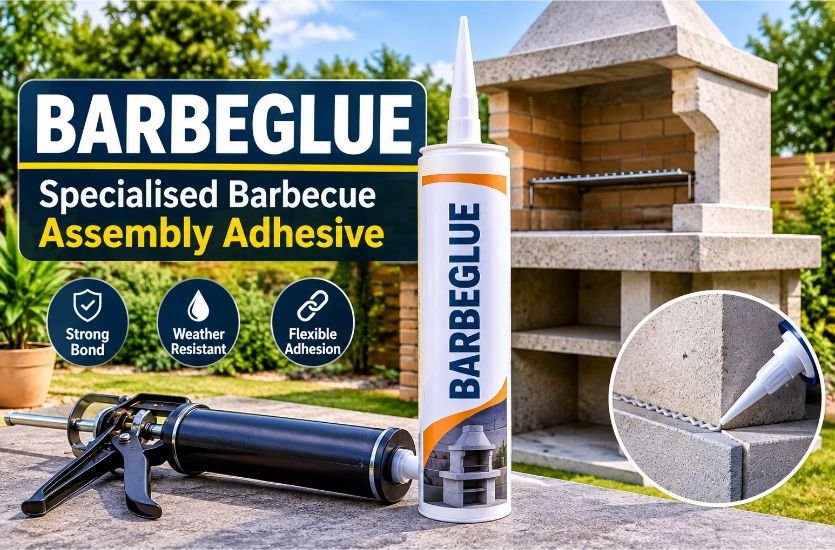
Barbeglue is a specialised adhesive associated with the assembly of prefabricated outdoor barbecues, particularly masonry and concrete models manufactured by Sarom. Unlike ordinary household glue, it is designed for specific construction applications where different components need to be joined securely while allowing a degree of flexibility. Its role in barbecue installation makes it an interesting product for homeowners, DIY enthusiasts and people interested in outdoor cooking equipment.
When installing a concrete or masonry barbecue, choosing the correct bonding material is an important part of the process. Different materials respond differently to temperature changes, moisture and physical movement. Using an unsuitable adhesive can affect the quality of the assembly and the durability of the finished structure. Barbeglue is intended to address particular bonding requirements identified in the manufacturer’s installation instructions.
Understanding what Barbeglue is, how it works, where it is used and what precautions are necessary can help users make better decisions during barbecue installation projects. This guide explores its characteristics, applications, advantages, limitations and practical considerations.
Quick Bio Table
| Detail | Information |
|---|---|
| Product Name | Barbeglue |
| Product Category | Specialised Adhesive |
| Associated Manufacturer | Sarom |
| Country of Origin | Italy |
| Product Code | DC0283 |
| Technical Product Identification | Isocoll ECO 6056 |
| Formulation | One-component STP polymer |
| Packaging | Cartridge |
| Reported Capacity | 270 ml |
| Primary Application | Prefabricated barbecue assembly |
| Main Materials | Compatible masonry and construction materials |
| Main Purpose | Bonding designated barbecue components |
What Is Barbeglue?
Barbeglue is a specialised adhesive used in the assembly of certain prefabricated outdoor barbecues. It is associated with Sarom, an Italian manufacturer known for outdoor cooking equipment and barbecue products. The adhesive is intended to join specific components during installation, helping create a properly assembled structure.
Unlike conventional household adhesives, Barbeglue is associated with construction applications involving concrete and masonry elements. These materials require suitable bonding products because their surfaces, weight and environmental exposure differ from those of everyday household objects.
One of the important characteristics of Barbeglue is its polymer-based formulation. According to the Barbeglue Isocoll ECO 6056 technical specifications, the product uses a one-component silyl-terminated polymer (STP) formulation. This formulation is designed to develop an elastic bond as it cures.
The product is particularly relevant when assembling compatible barbecue components according to manufacturer instructions. It should not be treated as a universal adhesive for every construction project. Its suitability depends on the materials involved, the intended joint and the conditions under which the finished barbecue will operate.
Who Makes Barbeglue?
Barbeglue is associated with Sarom, an Italian company involved in outdoor barbecue products and related accessories. The company produces equipment intended for outdoor cooking environments, including prefabricated barbecue structures that require proper assembly before use.
Prefabricated concrete barbecues are generally supplied in separate sections. Depending on the model, these sections may include supporting bases, side panels, cooking areas, chimney sections and other structural elements. Each component must be positioned correctly to ensure the finished product matches the manufacturer’s design.
Specialised bonding materials can be an important part of this installation process. Sarom’s assembly instructions identify the appropriate materials and methods for joining designated components. Barbeglue is associated with those requirements.
The product identification DC0283 is useful when searching for the specific adhesive. Buyers should check the packaging, product code and compatibility information rather than assuming that every adhesive sold under a similar description has the same formulation.
How Does Barbeglue Work?
Barbeglue works through a polymer-based bonding process. Its identified STP formulation is designed to react with moisture in the surrounding environment and gradually develop a stable, elastic bond.
A one-component adhesive is supplied ready for application, meaning users do not normally need to combine separate chemical ingredients before using it. This can make installation more convenient, especially when working with multiple barbecue components.
Once applied to an appropriate surface, the material begins its curing process. During this period, the adhesive gradually develops its bonding properties. The final result is intended to provide adhesion while retaining some flexibility.
This flexibility is an important characteristic in construction applications. Concrete and masonry structures can experience small movements because of temperature changes, environmental conditions and normal material behaviour. A suitable elastic adhesive can accommodate some of these movements better than a completely rigid bonding material.
However, the performance of any adhesive depends on correct application. Surface preparation, environmental conditions, joint dimensions and curing time can all influence the final result. Users should follow the technical documentation for the specific product rather than relying on general adhesive recommendations.
Main Uses of Barbeglue
The primary application of Barbeglue is the assembly of compatible prefabricated barbecue structures. These installations often involve several separate components that must be connected in a specific order.
Concrete barbecue panels are among the materials associated with this type of application. The adhesive can be used on designated joints where the manufacturer specifies its use. It helps connect components during the installation process and supports the overall assembly.
Another relevant application is the joining of compatible masonry elements. Depending on the product specifications, polymer adhesives may be suitable for certain cement-based, stone or other construction surfaces. Nevertheless, compatibility should always be checked before application.
Barbeglue may also be relevant to installation work involving outdoor cooking structures where a specialised elastic seal or bond is required. Its purpose is not simply to stick two objects together but to provide a bonding solution suited to particular construction requirements.
It is important to distinguish between assembling the external structure and repairing the parts exposed to direct heat. An adhesive suitable for joining external concrete components is not automatically appropriate for fireboxes, cooking chambers or surfaces that experience direct flame contact.
Key Features and Benefits of Barbeglue
Barbeglue has several characteristics that make it suitable for specific bonding and sealing applications. Its technical properties distinguish it from conventional rigid adhesives and ordinary household products.
Flexible Bonding Performance
One of its most important characteristics is its elasticity after curing. The STP polymer formulation allows the adhesive to maintain flexibility rather than becoming completely rigid. This can be useful when joining construction materials that experience small movements due to changing environmental conditions.
Weather and UV Resistance
Outdoor barbecue structures are regularly exposed to sunlight, rain, humidity and seasonal temperature changes. The technical documentation describes Barbeglue Isocoll ECO 6056 as having excellent weathering resistance and UV stability. These characteristics can support the durability of suitable exterior joints.
Ready-to-Use Application
Barbeglue is supplied in cartridge packaging and can be applied using a manual or pneumatic dispensing gun. Its one-component formulation removes the need to mix separate ingredients before use. This makes it convenient for installation projects involving several individual components.
Good Adhesion to Different Materials
The technical documentation describes bonding suitability across several substrates, including cement, brick, stone, wood, aluminium, steel and glass. This broad compatibility makes the formulation relevant to different construction and industrial applications. However, surface preparation and compatibility testing remain important.
Vibration and Sound Damping
Another documented characteristic is its ability to provide vibration and sound damping. Flexible adhesive materials can help reduce the transmission of small vibrations between connected components. This property is particularly relevant in applications where movement and noise control are important.
Paint Compatibility
Barbeglue can be painted after curing with many industrial coating products. This provides additional flexibility when the finished installation requires a particular appearance. Nevertheless, users should check paint compatibility because some coatings may react differently with polymer-based materials.isocoll_ECO 6056ST_ENG_rev04_mar21
Barbeglue Application and Installation Instructions
Correct application plays an important role in achieving a reliable bond. Even a specialised adhesive may perform poorly when surfaces are dirty, oily or incorrectly prepared. Users should always consult the Sarom barbecue assembly instructions before starting installation.
The first step is preparing the surfaces. Remove dust, loose particles, grease, oil and other contaminants that could interfere with adhesion. The surfaces should be clean and dry before applying the adhesive. If necessary, use a suitable cleaning product recommended by the manufacturer.
Next, inspect the components and confirm that they fit together correctly. This is especially important when assembling prefabricated concrete barbecue sections. Incorrect alignment can create unnecessary gaps and affect the appearance of the finished structure.
After preparing the surfaces, place the cartridge into a suitable application gun. Apply an appropriate amount of adhesive to the designated bonding areas. The quantity and positioning should follow the assembly diagram rather than a general application method.
Once the adhesive has been applied, carefully position the components. Check their alignment and make any adjustments permitted by the manufacturer’s instructions. Some barbecue designs also require additional mechanical fittings, corner keys or screws. Adhesive should not replace these components when they are part of the original assembly system.
Finally, leave the installation undisturbed during the curing period. Avoid placing unnecessary weight on newly bonded sections or exposing the adhesive to conditions that could interfere with curing.
Barbeglue Drying Time and Curing Process
Drying time is an important consideration when working with polymer-based adhesives. Users sometimes assume that an adhesive is ready for use as soon as its outer surface becomes dry. However, surface drying and complete curing are different processes.
The technical sheet for Barbeglue Isocoll ECO 6056 reports a tack-free time of approximately 30 minutes under laboratory conditions of 23°C and 50% relative humidity. It also reports a curing rate of approximately three millimetres per 24 hours under the same conditions.
These figures help explain how the material develops its bonding properties. The surface may stop feeling sticky relatively quickly, while the material underneath continues curing.
The actual curing process can vary depending on temperature, humidity, adhesive thickness and the materials being joined. A thicker application may require additional time before reaching the desired condition.
For Sarom barbecue installations, the manufacturer’s assembly guidance recommends waiting at least 48 hours before using the completed structure. This waiting period is important because lighting a fire too early can expose an incompletely cured assembly to unnecessary stress.
Users should follow the longer applicable waiting period if the product documentation or specific barbecue instructions require it.
Is Barbeglue Heat Resistant?
Heat resistance is one of the most important questions when selecting an adhesive for barbecue construction. However, it is necessary to understand the difference between temperature resistance and direct flame resistance.
Similar considerations about heat exposure and safe installation are also important when exploring fireplace installation and safety considerations.
According to the technical documentation for Isocoll ECO 6056, the cured product has a stated temperature resistance range from -40°C to +100°C. This specification describes its documented operating range under the relevant conditions.
It does not mean that Barbeglue is suitable for every part of a barbecue. Direct flames, burning charcoal and extremely hot cooking surfaces can reach temperatures beyond the product’s stated limit.
A masonry barbecue contains different sections that experience different levels of heat. External concrete panels and supporting structures do not necessarily experience the same temperatures as the internal firebox.
For this reason, the manufacturer specifies different assembly requirements for particular components. Barbeglue should only be used in the locations where its application is approved. Refractory mortar or another specified material may be necessary for joints exposed to higher temperatures.
It is also important to avoid describing Barbeglue as completely fireproof. Its technical specifications support a defined temperature-resistance claim, not unlimited protection against fire.
Barbeglue vs Ordinary Glue and Refractory Mortar
Choosing between different bonding materials depends on the intended application. Barbeglue, ordinary household glue and refractory mortar have different formulations and purposes.
Ordinary household glue is generally designed for lightweight materials and everyday repairs. It may provide insufficient adhesion, flexibility or environmental resistance for a concrete barbecue assembly.
Refractory mortar is designed for particular high-temperature masonry applications. It is commonly used where a mineral-based bonding material is required around heat-exposed structures. Its preparation and application requirements differ from those of cartridge adhesives.
Barbeglue uses a polymer-based formulation that provides an elastic bond after curing. Its main advantage is convenience and flexibility in the applications for which it is specified.
| Material | Main purpose | Important consideration |
|---|---|---|
| Barbeglue | Specified barbecue assembly joints | Follow temperature and application limits |
| Ordinary glue | Household bonding | Not automatically suitable for masonry |
| Refractory mortar | High-temperature masonry work | Requires appropriate preparation |
| Silicone sealant | General sealing applications | Not an approved substitute where Sarom specifies Barbeglue |
The correct choice should always be based on the barbecue manufacturer’s instructions rather than assumptions about which material is strongest.
Safety Precautions When Using Barbeglue
Although Barbeglue is designed for practical adhesive applications, proper handling is still important. Users should read the product label and safety data sheet before starting an installation project.
The technical information describes Isocoll ECO 6056 as free from isocyanates and solvents. However, this does not mean that users should ignore normal handling precautions.
Work in a suitable ventilated area and avoid unnecessary contact with uncured adhesive. Protective gloves and appropriate eye protection can help reduce exposure during application. Keep the cartridge away from children and store it according to the manufacturer’s recommendations.
If the adhesive comes into contact with skin or eyes, follow the first-aid instructions provided in its safety documentation. Do not use cleaning chemicals or solvents without checking their suitability.
Another important precaution concerns food preparation. Barbeglue’s association with barbecue assembly does not establish that it is approved for direct food contact. It should not be applied to cooking surfaces or areas that come into direct contact with food unless the manufacturer specifically confirms that use.isocoll_ECO 6056ST_ENG_rev04_mar21+1
How to Store Barbeglue Properly
Proper storage can help preserve adhesive quality before use. Polymer-based products may experience changes in consistency or performance when exposed to unsuitable temperatures or damaged packaging.
The Isocoll ECO 6056 technical sheet recommends keeping the product in its original packaging at temperatures between 5°C and 25°C. It also specifies a storage period of up to 24 months under the stated conditions.
Cartridges should be kept in a cool, dry location away from direct sunlight and heat sources. Avoid storing them in places where extreme temperatures could affect the material.
Before application, inspect the packaging for damage, leakage or signs that the adhesive has hardened. Users should also check the batch information and storage guidance printed on the product.
These simple steps can help prevent unnecessary waste and reduce the risk of using an adhesive that no longer has its expected properties.
Where Can You Buy Barbeglue?
Barbeglue is associated with Sarom barbecue products and may be available through specialist barbecue retailers, hardware stores and online construction-product suppliers.
When searching for the product, using its full identification can make the process easier. The name Barbeglue Isocoll ECO 6056 and the Sarom product reference DC0283 can help distinguish it from unrelated adhesives.
Buyers should also check the packaging volume. The technical data sheet lists a standard 290 ml polyethylene cartridge, while other packaging formats may also be available. Product listings and packaging descriptions can vary between retailers.
Before purchasing, confirm that the adhesive is compatible with the specific barbecue model. Some prefabricated barbecue kits may already include the required bonding material, so checking the original package contents can help avoid unnecessary purchases.
Availability and prices may differ depending on the seller, location and shipping arrangements. Purchasing from a recognised supplier is generally preferable because it makes it easier to verify the product’s origin and technical specifications.
Frequently Asked Questions About Barbeglue
1. What is Barbeglue mainly used for?
Barbeglue is primarily associated with bonding and sealing compatible components during the assembly of prefabricated masonry barbecues. It is also documented for several other construction and industrial bonding applications.
2. Who manufactures Barbeglue?
Barbeglue is associated with Sarom SpA, an Italian company specialising in outdoor barbecue products. Its technical identification is Isocoll ECO 6056.
3. Is Barbeglue waterproof?
The technical documentation describes excellent weathering resistance. However, this should not be interpreted as an unlimited waterproofing guarantee for every installation.
4. How long does Barbeglue take to cure?
The technical sheet reports a curing rate of approximately three millimetres per 24 hours under specified laboratory conditions. Sarom barbecue assembly instructions recommend waiting at least 48 hours before using the completed barbecue.
5. Can Barbeglue be used on concrete?
Yes. Cement-based surfaces are among the substrates identified in its technical documentation. Proper surface preparation and application requirements must still be followed.
6. Can Barbeglue withstand high temperatures?
The published temperature-resistance range for Isocoll ECO 6056 is -40°C to +100°C after curing. It should not be considered suitable for direct flame exposure or every high-temperature barbecue component.
7. Does Barbeglue require mixing?
No. It is a one-component adhesive-sealant supplied ready to use. It is applied using an appropriate manual or pneumatic cartridge gun.
8. Can Barbeglue replace refractory mortar?
Not in every application. The two materials have different properties and intended uses. The correct option depends on the particular joint and the barbecue manufacturer’s installation instructions.
9. Can Barbeglue be painted?
Yes. Its technical documentation states that the cured adhesive can be painted with many industrial coating products. A compatibility test is recommended before applying a coating.
10. How should Barbeglue be stored?
The technical sheet recommends storage in original packaging at temperatures between 5°C and 25°C. It lists a storage period of up to 24 months under the specified conditions.
Final Thoughts
Barbeglue is a specialised adhesive-sealant that serves an important purpose in the assembly of compatible prefabricated barbecue structures. Its association with Sarom and its Isocoll ECO 6056 formulation distinguish it from ordinary household adhesives and conventional construction materials.
Its one-component STP technology provides an elastic bond, while its documented weather resistance, UV stability and compatibility with different construction materials make it useful for specific installation requirements. Its cartridge-based packaging also makes application relatively convenient for suitable projects.
However, understanding its limitations is just as important as recognising its advantages. Its published temperature resistance does not make it suitable for direct flame contact, and it should not replace refractory materials where those are required.
For anyone assembling a masonry barbecue, the best approach is to identify the correct model, consult the manufacturer’s instructions and select the bonding material specified for each component. With proper preparation, application and curing time, Barbeglue can help achieve a reliable and correctly assembled outdoor barbecue structure.