
There are some broadcasters who become famous because they dominate the screen. They speak loudly, create dramatic moments and make sure the audience remembers them.
And then there are broadcasters like Mishal Husain.
Her authority has never depended on being the loudest person in the room. Instead, it has come from preparation, calmness and the ability to ask difficult questions without allowing herself to become the story.
For more than two decades, Mishal Husain built a remarkable career in British journalism. She became one of the most recognisable voices on the BBC, spent more than a decade presenting Radio 4’s Today programme, interviewed some of the world’s most influential figures and eventually moved into a new professional chapter with Bloomberg.
But when we look closely at her story, we discover that her career is about much more than broadcasting.
It is also a story about identity, family, migration, education, history and the search for understanding.
Born in Northampton in 1973 to Pakistani parents, Husain grew up between Britain and the Middle East. She studied law at Cambridge, developed an early interest in journalism and eventually entered the world of international broadcasting.
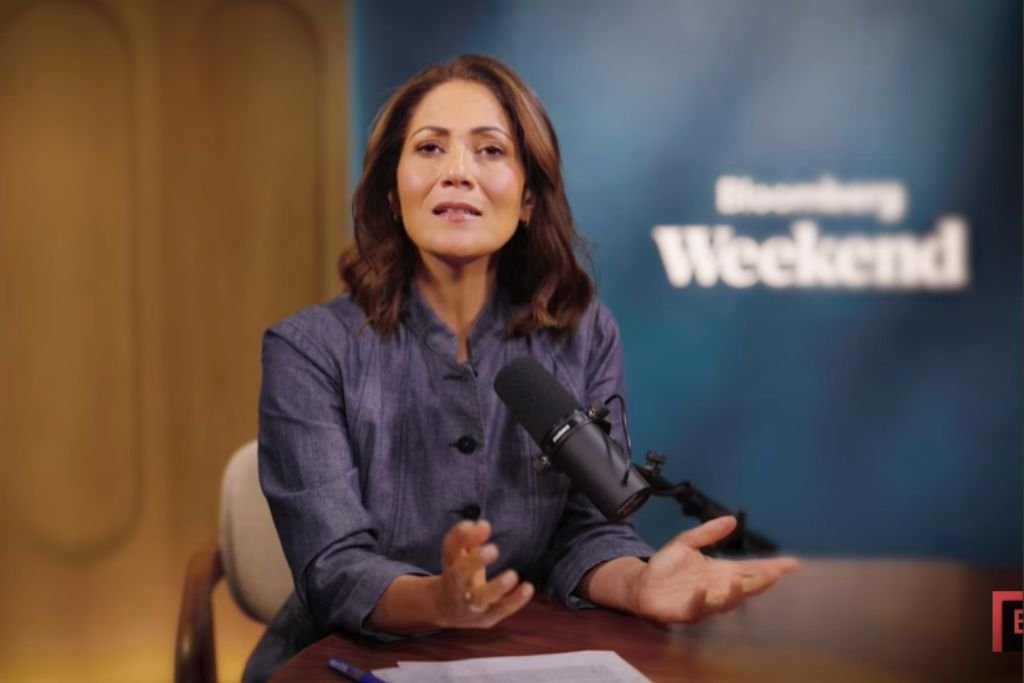
Today, she is Editor-at-Large for Bloomberg Weekend and the host of The Mishal Husain Show.
So, how did she get there?
Let’s take a look at the story of Mishal Husain.
Mishal Husain: A Quick Biography
Quick Bio: Mishal Husain
| Detail | Information |
|---|---|
| Full Name | Mishal Husain |
| Born | 12 March 1973 |
| Birthplace | Northampton, England |
| Profession | Journalist, broadcaster and author |
| Nationality | British |
| Education | Law at Cambridge; Master’s in International and Comparative Law |
| Early Broadcasting | Bloomberg Television |
| BBC Career | Joined in 1998 |
| Today Programme | Presenter from 2013 to 2024 |
| Current Role | Editor-at-Large, Bloomberg Weekend |
| Current Programme | The Mishal Husain Show |
| Husband | Meekal Hashmi |
| Children | Three sons |
| Notable Books | The Skills and Broken Threads |
| Major Recognition | Charles Wheeler Award for Outstanding Contribution to Broadcast Journalism |
Mishal Husain was born on 12 March 1973 in Northampton, England.
She is a British journalist, broadcaster and author. Her education took her from Cambridge, where she studied Law, to the European University Institute in Florence, where she completed a Master’s degree in International and Comparative Law.
Her broadcasting career began with Bloomberg Television before she joined the BBC in 1998.
Over the years, she became a familiar face and voice across BBC News before taking on one of her most important roles as a presenter of Radio 4’s Today programme.
She remained with Today from 2013 until 2024.
After more than 25 years at the BBC, she left the organisation and returned to Bloomberg, taking on the role of Editor-at-Large for Bloomberg Weekend and becoming host of The Mishal Husain Show.
She is also the author of The Skills and Broken Threads: My Family from Empire to Independence.
Her personal life has remained relatively private. She is married to Meekal Hashmi and they have three sons.
But to understand the broadcaster we know today, we first need to go back to her childhood.
Growing Up Between Britain and the Middle East
Mishal Husain was born in Britain, but Britain was not the only place she knew as home.
Her childhood was divided between the United Kingdom and the Middle East. Her family lived in countries including the United Arab Emirates and Saudi Arabia before she returned to Britain for her education.
This experience would become an important part of her identity.
Imagine growing up moving between different countries, cultures and ways of looking at the world.
For Husain, that was normal.
Her father, Imtiaz Husain, was a doctor, while her mother, Shama, had previously worked as a producer for Pakistan Television Corporation before becoming a teacher.
So even before Mishal entered journalism herself, her family already had strong connections with medicine, education and broadcasting.
Her childhood also gave her something that would later become extremely valuable as a journalist: an international perspective.
She learned early that people could look at exactly the same event and understand it in completely different ways.
That ability to see more than one side of a story would eventually become one of her greatest professional strengths.
From Cambridge Law Student to Journalist
At first, journalism was not necessarily the obvious career path for Mishal Husain.
She went to Cambridge and studied Law at New Hall, now known as Murray Edwards College.
She later completed a Master’s degree in International and Comparative Law at the European University Institute in Florence.
But while she was studying, journalism was already attracting her attention.
At just 18 years old, she spent time working at an English-language newspaper in Islamabad.
That experience proved important.
It allowed her to work in journalism in a country that was closely connected to her family’s background, but she was experiencing it as a young reporter.
She also spent time in Moscow teaching English after the collapse of the Soviet Union.
These were extraordinary experiences for someone so young.
And when we look back at her career today, we can see how those experiences helped shape the journalist she eventually became.
Law taught her to examine evidence and understand complex arguments.
International experience taught her to consider different perspectives.
And journalism gave her the opportunity to combine those skills.
She was not simply learning how to speak to an audience.
She was learning how to understand the story behind the story.
The Beginning at Bloomberg
Interestingly, Mishal Husain’s broadcasting career began at Bloomberg Television.
That detail becomes even more significant when we consider where her career eventually took her.
Years later, after spending more than two decades at the BBC, she would return to Bloomberg for the next major chapter of her professional life.
Her early broadcasting experience helped establish her as a television journalist.
She eventually joined the BBC in 1998, initially working as a producer before moving into reporting and presenting.
The progression was gradual.
First came production.
Then reporting.
Then presenting.
Then international journalism.
And eventually, one of the most respected interviewing roles in British broadcasting.
That gradual progression is important because Husain’s career was not built overnight.
She developed her reputation through years of work behind and in front of the camera.
Building a Career at the BBC
After joining the BBC, Husain became involved in a wide range of television and news assignments.
Her career took her across international stories, political events and major moments affecting audiences around the world.
She worked across different BBC programmes and developed a reputation for being calm, informed and prepared.
And that preparation became one of the defining characteristics of her journalism.
International reporting requires more than simply knowing what happened.
A journalist needs to understand the history behind an event, the political context surrounding it and the way different communities may interpret it.
Husain’s background made that approach particularly natural.
She had grown up between different cultures and had already experienced life from more than one perspective.
So when she approached an international story, she could often see the complexity behind the headline.
That ability would become especially valuable when she eventually moved into political interviewing.
Mishal Husain and BBC Radio 4’s Today
For many viewers and listeners, Mishal Husain became most closely associated with BBC Radio 4’s Today programme.
She joined the programme in 2013 and spent more than a decade as one of its principal presenters.
It was a period of extraordinary political change in Britain.
There was Brexit.
There were general elections.
There were changes of prime minister.
There was the COVID-19 pandemic.
And there were countless political and international crises that demanded careful reporting.
The Today programme operates at a remarkable pace.
Presenters begin their working day extremely early, often dealing with breaking stories, political interviews and rapidly changing news developments.
In that environment, Husain developed a reputation for control.
She did not need to shout to make an interview challenging.
She did not need theatrical confrontation to demonstrate that she was asking difficult questions.
Instead, she relied on preparation.
She listened.
She followed the answer.
And then she asked the next question.
That became one of the clearest features of her interviewing style.
The Quiet Power of Her Interviewing Style
When we talk about Mishal Husain, one word repeatedly comes to mind: composure.
Her interviewing style has often been described as calm, precise and rigorous.
But there is something else happening beneath that calmness.
Preparation.
A good interviewer needs to know what the guest is saying.
A great interviewer also needs to notice what the guest is not saying.
That is where Husain’s approach becomes particularly effective.
Rather than turning every interview into a confrontation, she allows the question itself to create the pressure.
A politician might be prepared for an angry interviewer.
They might even expect an aggressive question.
But a carefully constructed follow-up can sometimes be much more difficult to escape.
Husain’s approach has therefore been less about performance and more about accountability.
The interviewer does not need to become the headline.
The answer does.
The Interview with Prince Harry and Meghan Markle
One of the most internationally recognised interviews associated with Mishal Husain came in 2017.
Following the engagement of Prince Harry and Meghan Markle, Husain interviewed the couple for the BBC.
The interview attracted enormous international attention and placed her at the centre of one of the world’s biggest royal stories.
But this was not the only major assignment of her career.
Throughout her time in broadcasting, Husain interviewed leading political and public figures and covered major national and international events.
She also chaired the 2024 Prime Ministerial debate between Rishi Sunak and Keir Starmer during the UK general election campaign.
These moments demonstrated the level of trust that had been placed in her.
From an early journalism internship, she had progressed to moderating one of Britain’s most important political television events.
The Woman Behind the Newsreader
But there is another side to Mishal Husain.
Away from the studio, away from the political interviews and away from the headlines, there is the daughter and granddaughter.
There is the woman who became increasingly interested in the stories that existed before she was born.
Her family history became particularly important after the death of her father in 2016.
She began thinking about the memories carried by older generations and what might disappear if those stories were never recorded.
That eventually led her to write Broken Threads: My Family from Empire to Independence.
And with that book, Husain moved from reporting history to investigating her own family’s place within it.
Broken Threads: A Family’s History
Broken Threads tells the story of Husain’s family against the enormous historical changes that transformed the Indian subcontinent.
Her grandparents lived through British India, the Second World War, the Bengal Famine, Partition and the creation of Pakistan.
For Husain, these were not simply events found in history books.
They were part of her family’s story.
The book explores how political upheaval affected ordinary people and how historical events can continue to influence families decades later.
Her relatives experienced the dangers surrounding Partition, including narrowly escaping one of the massacres associated with the notorious trains of that period.
But Broken Threads is not simply a story of tragedy.
It is also a story of survival.
It is about migration.
It is about memory.
And it is about what families carry with them when political borders change.
The title itself comes from a fragment of an old wedding sari, which becomes a powerful symbol for generations separated by geography, history and time.
For a journalist who had spent years reporting what was happening in the world, the book allowed Husain to investigate what had happened inside her own family.
The Skills and Another Side of Her Career
Before Broken Threads, Husain wrote another book called The Skills: How to Win at Work.
This book reflected a different part of her experience.
By this stage, she had already built a senior broadcasting career while raising three sons.
So when she wrote about professional life, ambition and balancing responsibilities, she was drawing from her own experience.
Her husband, Meekal Hashmi, is a lawyer, and Husain has spoken about the importance of having support at home while maintaining a demanding career.
Her professional life required discipline.
Her role at Today meant extremely early mornings, intense preparation and constant awareness of breaking news.
Maintaining that schedule while raising a family required organisation both inside and outside the newsroom.
And that gives The Skills an interesting connection to the woman behind the broadcaster.
Mishal Husain, Her Husband and Family
Mishal Husain is married to Meekal Hashmi, and the couple have three sons.
Despite her high-profile career, Husain has generally kept her family life away from the centre of public attention.
That privacy has been consistent with the way she has approached her career.
She is visible professionally, but she has rarely attempted to turn her private life into part of her public brand.
Her demanding schedule at Today meant that her mornings began extremely early.
Reports have described her cycling to work and following a disciplined routine around broadcasting and family responsibilities.
Eventually, leaving the daily Today schedule changed that rhythm.
For the first time in many years, she and her husband were able to operate closer to conventional office hours.
It may sound like a small change.
But for someone whose career had been built around early-morning broadcasting, it represented a significant shift in everyday life.
Why Did Mishal Husain Leave the BBC?
After more than 25 years at the BBC, Mishal Husain announced that she was leaving the organisation in 2024.
It marked the end of a remarkable chapter.
She had spent 11 years presenting Today, becoming one of its most recognisable voices.
But by this stage, she was also thinking about what might come next.
Rather than seeing her departure as the end of her broadcasting career, it became the beginning of something new.
And that new chapter would take her back to a place connected to the very beginning of her career.
Bloomberg.
Mishal Husain Returns to Bloomberg
For Mishal Husain, the move to Bloomberg was something of a full-circle moment.
She had started her broadcasting career with Bloomberg Television.
Now, after more than two decades at the BBC, she returned to Bloomberg in a senior editorial and presenting role.
She became Editor-at-Large for Bloomberg Weekend.
She also became the host of The Mishal Husain Show, a weekly global interview programme.
And this new role gave her something different.
Time.
The daily news cycle is relentless.
A presenter may have only a few minutes to interview a politician before moving on to the next story.
A longer programme changes everything.
It allows the interviewer to slow down.
To explore.
To follow an unexpected answer.
And perhaps most importantly, to listen.
That makes the new Bloomberg chapter a natural progression for Husain.
The Mishal Husain Show
The Mishal Husain Show gives Husain the opportunity to take her interviewing skills into a longer format.
The programme features conversations with people from politics, business, culture and public life.
The format allows her to explore people beyond the headlines.
That is particularly suited to her style.
For years, she had asked politicians questions within the strict time limits of live news.
Now, she has the opportunity to spend longer with a guest and explore ideas in greater depth.
Politics remains an important part of her work, but the programme also opens the door to conversations about business, culture and wider public life.
So rather than abandoning the style that made her successful, Husain appears to be refining it.
The questions remain important.
But now there is more room for the answers.
What About Mishal Husain’s Weight Loss?
There are online searches and discussions about Mishal Husain’s weight loss, but this is an area where it is important to separate speculation from established information.
There is no strong, authoritative public record confirming a specific weight-loss programme, a precise amount of weight lost or a particular diet followed by Husain.
Changes in a person’s appearance over a career spanning decades do not, by themselves, prove anything about their weight or health.
So when discussing this part of her story, it is more responsible to avoid presenting unverified claims as fact.
Her professional achievements are well documented.
Speculation about her body is not necessary to understand her career.
A Career Built Without Noise
Perhaps one of the most interesting things about Mishal Husain is what she has not tried to become.
Modern broadcasting often rewards strong personalities.
The presenter becomes a brand.
An interview becomes a viral clip.
A disagreement becomes entertainment.
Husain has largely followed a different path.
Her public identity has remained professional, controlled and relatively private.
That does not mean she lacks personality.
It means she does not need to place herself above the journalism.
Her authority comes from knowledge, preparation and the confidence to allow a question to stand on its own.
That is difficult to achieve.
And it may help explain why she has remained relevant through enormous changes in British media.
Awards and Recognition
Over the course of her career, Mishal Husain has received recognition from the journalism industry.
In 2015, she was named Broadcaster of the Year by the London Press Club.
Then, in 2024, she received the Charles Wheeler Award for Outstanding Contribution to Broadcast Journalism.
The recognition reflects more than one successful programme.
It represents a career built over decades.
Husain has worked in television, radio and international journalism. She has conducted political interviews, covered major national events, written books and now presents a long-form interview programme.
Few broadcasters manage to move through so many formats while maintaining such a consistent professional identity.
What Makes Mishal Husain Different?
So what exactly makes Mishal Husain different?
Perhaps the answer can be found by looking at the different stages of her career.
The law student became a journalist.
The television reporter became a radio presenter.
The daily news broadcaster became a long-form interviewer.
The journalist became an author.
And the woman who spent years explaining history to audiences eventually began researching her own family’s history.
There is a clear thread running through all of it.
Curiosity.
Husain has consistently shown an interest in understanding people, institutions and the forces that shape society.
Her legal education gave her analytical discipline.
Her international childhood gave her perspective.
Journalism gave her a platform.
The BBC gave her some of the biggest opportunities of her career.
Today sharpened her interviewing skills.
Writing allowed her to investigate memory and family history.
And Bloomberg has now given her another platform for longer and deeper conversations.
Where Is Mishal Husain Now?
As of 2026, Mishal Husain is continuing her career with Bloomberg.
She serves as Editor-at-Large for Bloomberg Weekend and presents The Mishal Husain Show.
Her professional life is therefore no longer centred on the early-morning schedule of Today.
Instead, she is building a new chapter around longer conversations, international perspectives and deeper interviews.
And in many ways, that feels appropriate.
Because throughout her career, Husain has shown an interest in what exists beneath the obvious answer.
She has spent years asking politicians to explain themselves.
She has investigated international events.
She has explored her own family history.
And now she has the opportunity to give guests more time to explain who they really are.
The Final Word on Mishal Husain
When we look back at Mishal Husain’s career, it becomes clear that this is not simply a story about television fame.
It is a story about credibility.
She built that credibility slowly.
She built it through preparation, international reporting, difficult interviews and an ability to remain calm when the subject matter became difficult.
Her childhood between Britain and the Middle East gave her an international outlook.
Her legal education taught her to examine complex arguments.
Her early journalism experiences taught her the realities of reporting.
The BBC turned her into one of Britain’s best-known broadcasters.
Her books revealed a more personal side of her curiosity.
And Bloomberg has now opened another chapter.
Perhaps the most fitting description of Mishal Husain is therefore not simply journalist, presenter or author.
It is listener.
Because while broadcasting often rewards the person who speaks the most, Husain built her reputation by doing something more difficult.
She listens carefully.
She prepares thoroughly.
She asks precisely.
And then she lets the answer speak.
That quiet authority has carried Mishal Husain from a young reporter with an international background to one of the most respected broadcasters of her generation.
And as her Bloomberg chapter continues, the story is clearly not finished yet.