

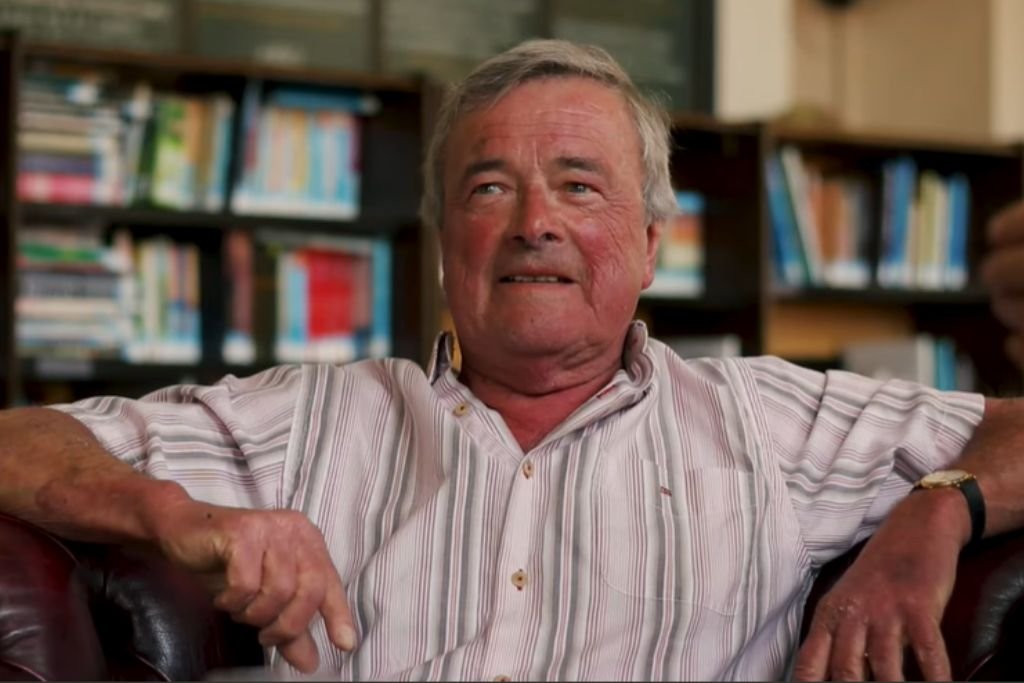
When we look back at the history of British political journalism, there are some names that immediately stand out. Then there are journalists whose importance comes not from celebrity, but from where they were, what they witnessed, and the questions they asked.
Glyn Mathias belongs firmly in that second group.
For more than three decades, Mathias worked close to the centre of British political life. He reported from Westminster, became Political Editor of Independent Television News, interviewed Margaret Thatcher during some of the most turbulent years of her premiership, and later returned to Wales at a moment when the country’s political future was changing dramatically.
His story, however, did not finish when he stepped away from daily journalism.
Instead, his career moved into another part of public life. He became Electoral Commissioner for Wales, examined the workings of Welsh democratic institutions, conducted an important review of local-government electoral arrangements and later contributed to broadcasting regulation.
So, when we tell the story of Glyn Mathias, we are not simply telling the story of a television journalist.
We are telling the story of a man who spent decades watching political power from close range and, later, became involved in the institutions through which that power was exercised.
The Beginning of the Story
Glyn Mathias was born on 19 February 1945.
His professional journey began in a very different media world from the one we know today.
There were no smartphones delivering breaking news within seconds. There were no social-media feeds carrying political arguments around the clock. There was no endless stream of online commentary.
A journalist had to find the story, investigate it, speak to people and then get it into print or onto television.
Mathias began that journey in 1967 when he joined the South Wales Echo as a reporter.
It was an important first step.
The local newspaper environment gave him the opportunity to learn the fundamentals of journalism. He had to observe what was happening around him, understand the institutions affecting ordinary people and discover how to turn events into stories that readers could understand.
And although his career would eventually take him to Westminster and national television, Wales remained an important part of his professional identity.
Three years after beginning at the South Wales Echo, Mathias moved into broadcasting with BBC Southampton.
That transition from newspapers to television would eventually lead him to one of the most influential positions in British political journalism.
The Journey to ITN
Mathias joined Independent Television News and gradually moved into increasingly senior political roles.
By 1973, he was working as an ITN Political Correspondent.
Then, in 1979, he became Home Affairs Correspondent.
And in 1981, he reached a position that would become one of the defining chapters of his career.
He became Political Editor of ITN.
It was an extraordinary time to be covering British politics.
Margaret Thatcher’s government was transforming the country. Political arguments over public spending, taxation, unemployment, trade unions, industrial relations and Britain’s position in Europe were becoming increasingly intense.
Then came the Falklands War, one of the most significant international crises of the early 1980s.
Mathias was working at the centre of the television political operation during this period.
Every political decision mattered.
Every statement from Downing Street could become a national story.
And every interview with a senior politician had the potential to reach millions of viewers.
This was the environment in which Mathias established himself as one of the country’s prominent political journalists.
Face to Face with Margaret Thatcher
One of the most important parts of Mathias’s career was his work interviewing Margaret Thatcher.
Today, when we watch political interviews, it can sometimes be difficult to imagine just how influential the main television political journalists once were.
There were far fewer television channels. There was no social media competing for attention every second. A major interview with the Prime Minister could become one of the central political conversations of the day.
Mathias was one of the journalists occupying that position.
The archives of the Margaret Thatcher Foundation preserve several interviews and transcripts identifying Mathias as the ITN journalist questioning Thatcher.
In May 1983, he interviewed Thatcher as she announced the general election.
The questions were direct.
Why call the election at that particular moment?
What did the government intend to achieve?
What would happen next?
After the Conservatives won the election, Mathias interviewed Thatcher again, discussing the significance of the result and the formation of her government.
These interviews offer something particularly valuable today.
They allow us to hear the journalist rather than simply read about him.
We can see the style of political journalism that defined his generation: controlled, direct and focused on the decisions of those in power.
Mathias’s interviews with Thatcher also covered issues including government spending, industrial relations, political appointments, European affairs and elections.
He was not simply reporting what politicians said.
He was asking them to explain why they were doing it.
Reporting During the Falklands Years
The early 1980s were not ordinary years for British politics.
The Falklands conflict created an intense atmosphere across the country, and television journalism played a major role in bringing the political and international developments into people’s homes.
For journalists, it was a demanding period.
The public wanted information.
Politicians needed to communicate their position.
And broadcasters had to report events responsibly while the situation continued to develop.
Mathias’s career became closely associated with this era.
His later autobiography, Raising an Echo, reflects on the political events and intrigues he encountered during his years at Westminster, including the Falklands period.
It was a time when political journalism, government communication and public opinion were closely connected.
And Mathias was sitting directly in the middle of that relationship.
A Broader Role at ITN
In 1986, Mathias moved into another senior position at ITN, becoming Controller of Public Affairs and Chief Political Correspondent.
This was more than a simple change of job title.
It demonstrated that his experience had developed beyond reporting individual political stories.
He had become someone who understood the wider relationship between politics, public affairs and television broadcasting.
His career had followed a clear progression.
He had started as a local reporter.
He had moved into broadcasting.
He had become a political correspondent.
Then he had become Political Editor.
Now he was taking on wider responsibilities within the organisation.
For Mathias, journalism was no longer simply about appearing in front of a camera.
It was about understanding the institutions, personalities and political systems behind the news.
The Return to Wales
Then came one of the most important chapters in his career.
In 1994, Glyn Mathias became Political Editor of BBC Wales.
And the timing was remarkable.
Wales was moving toward a historic political decision.
The 1997 referendum on Welsh devolution was approaching.
For decades, questions about Wales’s political representation and relationship with Westminster had remained part of the country’s political debate.
Now the possibility of creating a new democratic institution was becoming a reality.
Mathias was there to report it.
As Political Editor of BBC Wales, he covered the referendum campaign and the political developments surrounding the creation of the National Assembly for Wales.
The referendum itself produced a narrow result.
But its consequences were enormous.
A new chapter in Welsh political life was beginning.
And for Mathias, there was a powerful personal dimension to the story.
He had started his journalism career in Wales.
Now, after years spent reporting from Westminster, he had returned to cover a political transformation that would change Wales’s relationship with government.
A Journalist Watching Political Power Change
This is perhaps where the Glyn Mathias story becomes especially interesting.
At Westminster, he had spent years watching the power of the British central government.
He had interviewed Prime Ministers.
He had covered Cabinet politics.
He had reported on national elections and major international events.
Then, in Wales, he found himself covering the development of a new political institution.
The perspective was different.
The question was no longer simply who would govern Britain.
It was also about how much political power Wales should exercise for itself.
Mathias therefore witnessed two very different forms of political change.
One was the powerful centralised politics of Westminster during the Thatcher era.
The other was the gradual development of Welsh devolution.
And he was close enough to both to understand how political change looked from inside the newsroom.
From Journalist to Electoral Commissioner
When Mathias eventually left frontline journalism, his involvement in public life did not end.
In 2001, he became an inaugural member of the Electoral Commission and served as Electoral Commissioner for Wales from 2001 to 2008.
It was a fascinating change of direction.
For years, he had been asking politicians questions.
Now he was working within an institution connected to the democratic process itself.
As a journalist, Mathias had seen politics through the eyes of the media and the public.
As Electoral Commissioner, he became involved with the structures that helped elections function.
Because elections are about much more than campaign speeches.
They depend on administration, electoral rules, boundaries, registration and public confidence.
These are often invisible to voters.
But without them, democracy cannot operate effectively.
Mathias’s new role therefore placed him on the other side of the political process.
He was no longer simply reporting democracy.
He was helping oversee aspects of how it worked.
The Mathias Review
His experience in journalism and electoral administration later led to another significant public-service role.
In 2011, Mathias was appointed to conduct an independent review of the Local Government Boundary Commission for Wales.
The review examined concerns surrounding delays, working methods and the Commission’s ability to complete its electoral-review programme.
The findings were critical.
The review concluded that the Commission had struggled to meet an unrealistic timetable and had produced proposals that had failed to gain the confidence of important stakeholders.
The Welsh Government subsequently concluded that major reform was necessary.
This episode showed how Mathias’s career had evolved.
Earlier in life, his job had been to question public institutions.
Now he was being asked to examine one himself.
The investigative instincts of the journalist were still there.
He was looking at evidence, testing assumptions and identifying weaknesses.
Only now, instead of producing a television report, he was producing a formal review that could contribute to institutional reform.
The work became part of a broader process that eventually contributed to changes in Welsh local-government electoral arrangements.
His Connection with Broadcasting Continued
Even after leaving journalism, Mathias remained connected to the broadcasting world.
He became associated with Ofcom’s Content Board and the Advisory Committee for Wales.
Once again, there was a clear connection with the career he had built earlier.
As a young journalist, he had worked inside television news.
As a senior political editor, he had helped shape political coverage.
Later, he moved into roles concerned with broadcasting standards, regulation and public interest.
It created an unusual career arc.
He had experienced the media from inside the newsroom.
Later, he contributed to discussions about how the media should operate within a wider public framework.
Raising an Echo
In 2014, Mathias published his autobiography, Raising an Echo: My Autobiography.
The book provided an opportunity to look back across the different stages of his life.
It covered his childhood, his early days at the South Wales Echo, his time at ITN, Westminster politics, BBC Wales and his later public-service work.
The title itself feels appropriate.
An echo is something that remains after the original sound has disappeared.
Political stories come and go.
Prime ministers leave office.
Governments change.
Election campaigns end.
Television programmes move on to the next story.
But journalists remember.
And through his autobiography, Mathias was able to record what he had seen from close range.
The book also explored his family background.
Mathias was the son of Welsh poet and writer Roland Mathias, giving his story a literary connection alongside his journalistic one.
His family history included contrasting influences, including his father’s experiences as a conscientious objector and the religious and military background of his grandfather.
So Raising an Echo was not simply a list of professional achievements.
It was an attempt to explain the person behind the journalist.
The Human Side of the Story
There is another element that makes Mathias’s memoir particularly interesting.
Political journalism is often remembered through major events.
Elections.
Wars.
Prime ministers.
Scandals.
Government crises.
But behind those stories are people.
Journalists meet politicians privately.
They develop professional relationships.
They sometimes become trusted sources of information.
And occasionally, they find themselves involved in highly sensitive situations.
Mathias’s career included such moments.
One example discussed in connection with his autobiography involved his interview with Ron Davies, the former Secretary of State for Wales, after Davies resigned following what he described as a “moment of madness.”
The episode highlighted the difficult territory political journalists sometimes enter when a politician’s public responsibilities collide with private behaviour.
It also reminds us that journalism changes with time.
Standards, expectations and public attitudes are not fixed.
What journalists considered acceptable decades ago may be viewed differently today.
Mathias’s career therefore provides not only a record of political history, but also a record of how journalism itself has evolved.
Why Glyn Mathias Matters
Glyn Mathias may not have the same celebrity recognition as some television journalists.
But that does not make his career less significant.
In many ways, it makes the story more interesting.
His influence was built through institutions and professional credibility rather than celebrity culture.
He worked at ITN during a period when television news had enormous political influence.
He worked at BBC Wales during the formative years of Welsh devolution.
He served as Electoral Commissioner for Wales during an important period in the development of democratic administration.
He conducted a major review of a Welsh public institution.
And he later contributed to broadcasting oversight.
Few careers travel across so many parts of the political and information system.
Journalism Before the Digital Age
There is also something important about the generation of journalism to which Mathias belongs.
Today, political news moves at extraordinary speed.
A politician can make a statement and within seconds it can appear across websites, television channels and social-media platforms.
Stories are updated continuously.
Public reaction can be immediate.
But Mathias’s formative years were different.
Journalists built relationships over long periods.
Political correspondents developed contacts within parties and government.
Television interviews were carefully prepared.
A journalist’s reputation depended heavily on accuracy and credibility accumulated over years.
Mathias’s career reflects that tradition.
His work demonstrates the value of preparation, institutional knowledge and persistence.
And although the media environment has changed dramatically, those qualities remain relevant.
The Complete Journey
So, when we look at Glyn Mathias’s career as a whole, the story becomes much larger than one television position.
It begins with a young reporter joining the South Wales Echo in 1967.
It continues with his move into broadcasting at BBC Southampton.
Then comes ITN, where he becomes a political correspondent and later Political Editor.
From Westminster, he reports during the Thatcher years and interviews one of Britain’s most powerful Prime Ministers.
He covers the political atmosphere surrounding the Falklands conflict and other major national events.
Then he returns to Wales.
As Political Editor of BBC Wales, he reports on the 1997 devolution referendum and the creation of a new political institution.
Later, he moves into electoral administration.
He becomes Electoral Commissioner for Wales.
He examines the workings of a Welsh public institution through the Mathias Review.
He contributes to broadcasting oversight.
And finally, through Raising an Echo, he looks back on the journey himself.
There is a remarkable consistency running through all of these chapters.
The central theme is always the same:
power, information and the public.
As a journalist, Mathias asked people in power to explain their decisions.
As an electoral commissioner, he became involved in the structures through which citizens exercised political power.
As a reviewer of public institutions, he examined whether those institutions were working properly.
And as an author, he preserved his own memories of the political world he had witnessed.
Final Thoughts
Glyn Mathias represents a generation of British political journalists whose careers developed before the age of instant online commentary.
His professional journey stretches from a local newspaper in South Wales to the centre of Westminster politics.
It takes him from the Thatcher years to the political transformation of Wales.
And it takes him beyond journalism into electoral administration, public-service review and broadcasting regulation.
His interviews with Margaret Thatcher remain preserved in archival records, giving us a direct connection to his work as an ITN political journalist.
His years at BBC Wales place him close to one of the most important political changes in modern Welsh history.
His work with the Electoral Commission and the Mathias Review show how his experience eventually extended into the machinery of democracy itself.
And Raising an Echo gives the story its personal voice.
In the end, perhaps the simplest way to describe Glyn Mathias is this:
He was a journalist who spent decades standing close to power.
He watched governments change.
He questioned Prime Ministers.
He reported moments of crisis.
He witnessed Wales move toward devolution.
And when his years in daily journalism were over, he continued working with the institutions that shaped public life.
His career therefore becomes more than a professional biography.
It becomes a record of changing Britain and changing Wales.
And perhaps that is the lasting significance of Glyn Mathias.
He was there when the story was happening.
And through his journalism, public service and memories, he left behind an echo of what he saw.