

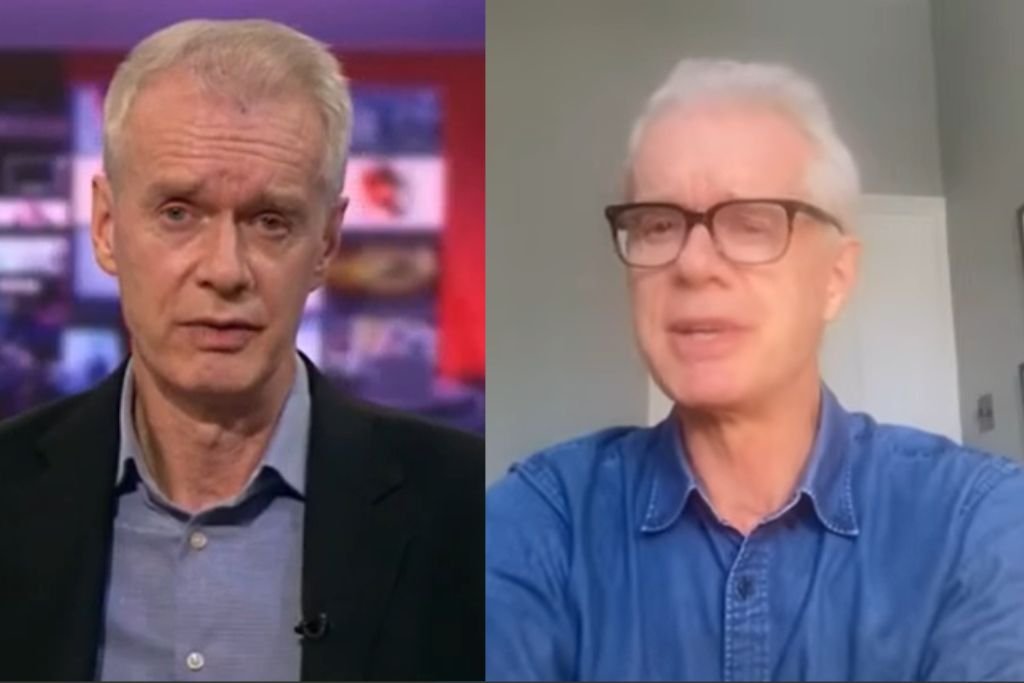
There are some journalists whose presence on television is immediately recognisable.
They do not need a dramatic entrance.
They do not need a raised voice.
Sometimes, all they need is a question.
For decades, Stephen Sackur built his reputation around exactly that.
He became known internationally as the presenter of the BBC’s HARDtalk, sitting opposite presidents, prime ministers, diplomats, business leaders, activists and cultural figures and asking them to explain what they had done, what they believed and, sometimes, why their own words did not quite match the facts.
But before Stephen Sackur became the interviewer audiences associated with difficult questions, he was something else.
He was a foreign correspondent.
He was an international news presenter.
And he was one of the familiar voices of BBC World News.
That broader career is important because it explains where his interviewing style came from.
Sackur did not arrive at HARDtalk simply as a television presenter who had learned how to ask challenging questions.
He arrived with years of experience reporting from some of the world’s most politically sensitive places.
He had seen international politics from the ground.
He had reported from the Middle East.
He had covered Washington.
He had worked in Brussels.
And he had presented live international news while major events were still developing.
That experience would eventually become the foundation of the Sackur style.
Prepare carefully.
Know the story.
Listen to the answer.
And if the answer does not address the question, ask again.
Stephen Sackur at a Glance
| Detail | Information |
|---|---|
| Full Name | Stephen John Sackur |
| Born | 9 January 1964 |
| Birthplace | Spilsby, Lincolnshire, England |
| Nationality | British |
| Profession | Journalist, broadcaster and interviewer |
| Education | Emmanuel College, Cambridge; Harvard University |
| Subject Studied | History |
| Joined BBC | 1986 |
| Major BBC Roles | Foreign correspondent, BBC World News presenter, HARDtalk presenter |
| Best Known For | Presenting HARDtalk |
| HARDtalk Era | 2004–2025 |
| Current Broadcasting Work | Times Radio |
| Book | Hard Truth: Investigations That Shook the World and Why They Matter Now |
| Known For | Forensic interviews and international political journalism |
Early Life and Education
Stephen John Sackur was born on 9 January 1964 in Spilsby, Lincolnshire.
His early life was far removed from the international television studios where millions of viewers would eventually hear his voice.
He attended King Edward VI Grammar School before going to Emmanuel College, Cambridge, where he studied history.
After Cambridge, Sackur became a Henry Fellow at Harvard University’s John F. Kennedy School of Government.
That education would prove useful throughout his career.
History gave him an understanding of how today’s political events are connected to yesterday’s decisions. International affairs gave him a framework for understanding the people and institutions behind the headlines.
And journalism would give him the opportunity to put that knowledge to work.
In 1986, Sackur joined the BBC as a trainee.
From there, his career developed gradually.
He was not an overnight television personality.
He spent years learning the profession from the field.
The Foreign Correspondent
Before the audience knew Stephen Sackur as the man asking difficult questions, he was the reporter gathering the information behind the questions.
His career took him to the Middle East, including Cairo and Jerusalem.
He later became the BBC’s Washington Correspondent, reporting from the centre of American political power.
He also worked in Brussels as the BBC’s Europe Correspondent.
Those assignments placed Sackur close to some of the defining political stories of the late twentieth century.
The Middle East gave him first-hand exposure to one of the world’s most complicated and enduring conflicts.
Washington placed him inside American politics during the Clinton era, including the dramatic events surrounding the 2000 presidential election and the impeachment controversy.
Brussels gave him experience of European politics and diplomacy.
By the time Sackur moved further into television presenting and interviewing, he already understood something fundamental about journalism.
The headline is rarely the whole story.
There is always a history behind it.
And usually, there is a question that needs to be asked.
Stephen Sackur as a BBC World News Presenter
This is an important part of Sackur’s career that can sometimes be overshadowed by HARDtalk.
He was not only the journalist who sat across from powerful guests.
He was also a presenter of BBC World News, where he handled fast-moving international stories and connected audiences with correspondents and experts around the world.
A broadcast from January 2022 provides a useful illustration of that role.
On the programme, Sackur moved through a series of major international developments.
The headlines included Australia’s decision to cancel Novak Djokovic’s visa for a second time, a cyberattack against Ukrainian government websites, North Korea’s latest ballistic missile launches and political controversy surrounding Downing Street.
These were stories developing simultaneously across different parts of the world.
And Sackur’s role was to guide the audience through them.
He introduced the major headlines.
He brought in correspondents.
He asked experts to explain what was happening.
He returned to developing stories.
And then he moved the programme forward.
That is a very different job from sitting down for a long-form interview.
It requires speed.
It requires clarity.
And it requires the presenter to understand enough of each story to know what question matters most.
When Novak Djokovic Became the Top Story
One of the clearest examples from that broadcast came from Australia.
The controversy surrounding tennis star Novak Djokovic was dominating international news after Australian authorities cancelled his visa for a second time.
Sackur explained the development for the BBC audience before turning to experts who could discuss the wider implications.
The story was not simply about tennis.
It involved vaccination policy, Australian immigration law, public health and a highly controversial legal dispute.
Sackur connected those elements for the audience.
Later in the broadcast, he returned to the story as Djokovic’s lawyers appeared before an Australian judge.
That return was important.
A live news programme is constantly changing.
A story that is developing at nine minutes into a broadcast may have changed completely by thirteen minutes.
Sackur’s job was to keep track of those developments and make sure the audience understood what had changed.
That is the other side of his journalistic identity.
The interviewer could be persistent.
The news presenter had to be precise.
Ukraine and the Cyberattack
Another major story in the same broadcast concerned a cyberattack against the Ukrainian government.
Several government websites, including those belonging to the foreign affairs and education ministries, were taken offline.
The attackers reportedly issued a threatening message warning Ukrainians to be afraid and expect the worst.
Sackur brought in the BBC’s diplomatic correspondent in Kyiv to discuss who might have been responsible.
Later, he returned to the subject with a cyber reporter, asking what the incident revealed about vulnerabilities in Ukrainian government networks.
Again, the pattern was clear.
Sackur did not simply announce the story and move on.
He asked someone who understood the subject.
Then he asked another expert a different question.
That structure tells us something about the broadcaster.
His role was not simply to read the news.
It was to help the audience understand it.
North Korea and the Missile Tests
The programme also covered North Korea’s launch of two ballistic missiles.
Sackur introduced the development, explained that it was another weapons test and brought in an expert to discuss the significance of the increasingly frequent launches.
The story then moved to other international developments before returning to the wider news agenda.
That ability to move between stories is one of the less visible skills of a live international news presenter.
The audience may hear a calm voice.
Behind that calm is constant information management.
One story is developing in Australia.
Another is unfolding in Ukraine.
Another concerns North Korea.
Another concerns British politics.
The presenter has to keep the entire programme in his head.
British Politics and Downing Street
The same broadcast also covered allegations surrounding parties held in Downing Street during Britain’s COVID-19 restrictions.
Sackur introduced developments involving Prime Minister Boris Johnson, his former head of communications and reports of gatherings held during lockdown.
At one point, the programme returned to the controversy involving a gathering held on the eve of Prince Philip’s funeral.
Sackur explained the significance of the issue and brought in a political correspondent to assess the latest revelations.
Again, the story was not simply read from a script.
It was developed through questioning.
That is perhaps one of the clearest links between Sackur’s work as a news presenter and his later reputation as an interviewer.
The setting changed.
The principle remained the same.
Ask the person who knows.
Then ask the question that helps the audience understand.
From Live News to HARDtalk
By the time Stephen Sackur became the defining presenter of HARDtalk, he had already spent years developing those skills.
HARDtalk had begun in 1997, originally presented by Tim Sebastian.
Eventually, Sackur became the programme’s most recognisable face.
The format was simple.
One interviewer.
One guest.
And a conversation in which there was nowhere for an important question to hide.
That simplicity became the show’s strength.
There were no large panels.
There was no audience to distract from the conversation.
And there was little opportunity for a guest to deliver a prepared statement and move on.
Sackur would listen.
Then he would follow up.
And that follow-up was often where the real interview began.
Why Sackur’s Questions Became His Signature
Many journalists are described as tough.
Stephen Sackur’s style was more specific than simply being tough.
It was persistent.
A guest might give a broad answer.
Sackur would narrow the question.
A guest might move to another subject.
He would bring the conversation back.
A guest might make a claim that appeared to contradict an earlier statement.
That contradiction could become the next question.
The technique was simple, but it required extensive preparation.
Sackur needed to know the guest’s record.
He needed to know the history.
He needed to know what had been said before.
That is why his background as a foreign correspondent mattered so much.
He had already spent years learning to distinguish between the immediate headline and the deeper political story.
The People Who Faced Stephen Sackur
Over the years, Sackur interviewed an extraordinary range of public figures.
Among them were leaders such as Mikhail Gorbachev, Emmanuel Macron, Volodymyr Zelenskyy and Donald Trump.
He also interviewed diplomats, business figures, activists and cultural personalities.
Some conversations became memorable because of their tension.
Others stood out because the guest revealed something unexpected.
And some became memorable simply because Sackur refused to allow an easy answer to end the conversation.
That was the point of HARDtalk.
The programme did not exist to make powerful people comfortable.
It existed to make them explain themselves.
The Silence Between the Questions
There was also another element to Sackur’s style.
Silence.
A television interviewer can always move on.
Sackur did not always do that.
If a guest had avoided the question, he could allow the silence to remain.
For viewers, the moment could be revealing.
The guest had spoken.
But perhaps the question had not actually been answered.
And Sackur was prepared to let that fact become obvious.
This was not confrontation simply for entertainment.
It was a form of accountability.
The interviewer’s job was to keep the conversation focused until the important issue had been addressed.
Stephen Sackur’s Salary
Sackur’s BBC salary has attracted public interest over the years.
BBC salary disclosures placed his earnings at around £200,000 in 2024, while the published 2025 figures placed him in the £210,000–£214,999 range.
It is important, however, to distinguish salary from net worth.
A salary is an annual payment for professional work.
It does not tell us how much someone owns, how much they have invested or what other assets they may hold.
For that reason, online estimates of Sackur’s personal wealth should be treated carefully unless they are supported by credible financial reporting.
Why Did HARDtalk End?
After almost three decades, the programme that had become synonymous with Sackur came to an end.
In October 2024, the BBC announced that HARDtalk would be discontinued as part of wider cost-cutting measures affecting its news operation.
Its final broadcast came on 26 March 2025.
For Sackur, the decision marked the end of one of the longest and most recognisable chapters of his career.
He was openly critical of the decision.
His argument was that programmes built around detailed questioning remained important at a time when misinformation, political messaging and social-media commentary were becoming increasingly influential.
The disagreement therefore became about more than one programme.
It became a debate about the value of long-form journalism itself.
The End of an Era
For almost 28 years, HARDtalk had provided an international platform for difficult conversations.
Its end meant that one of the BBC’s most distinctive interview formats had disappeared.
And there was an obvious irony.
The programme ended while many of the subjects it had explored were becoming more complicated.
Disinformation was spreading rapidly.
Political leaders were communicating directly through social media.
Public trust in institutions was under pressure.
And audiences were increasingly consuming news through short clips rather than long conversations.
Sackur’s argument was that this made careful questioning more important.
Not less.
Stephen Sackur After the BBC
But the end of HARDtalk did not end Sackur’s career.
In 2025, he moved to Times Radio, where he became a presenter on The Times at One.
The move represented a change of platform, but not necessarily a change of purpose.
Television had given Sackur the visual setting of the interview.
Radio gave him more space for conversation and analysis.
But the fundamental tools remained the same.
Knowledge.
Preparation.
Questioning.
Listening.
And context.
His career therefore continued in a new form.
Hard Truth: A New Chapter
Sackur’s next major project also takes him beyond television.
His forthcoming book, Hard Truth: Investigations That Shook the World and Why They Matter Now, is scheduled for publication in October 2026.
The book examines major journalistic investigations and the people who pursued them.
Among the investigations discussed are the Pentagon Papers, Watergate-related reporting and the work of Maltese investigative journalist Daphne Caruana Galizia.
But the larger subject is not simply investigative journalism.
It is truth.
What happens when facts compete with misinformation?
What happens when powerful institutions try to control the narrative?
And what responsibilities do journalists have when the truth becomes politically inconvenient?
Those questions fit naturally with Sackur’s career.
For years, he asked powerful people to defend their words.
Now, he is examining the journalists whose job is to discover what powerful institutions would prefer to remain hidden.
The Philosophy Behind Hard Truth
There is something fitting about this transition.
Stephen Sackur spent decades questioning other people.
Now he is turning some of that questioning toward journalism itself.
The book explores issues surrounding truth, impartiality, activism and the responsibilities of journalists in an increasingly digital media environment.
Those themes are closely connected to his criticism of the end of HARDtalk.
If journalism is increasingly competing with social-media clips, political propaganda and entertainment, then carefully researched reporting may become even more valuable.
That is one of the central ideas that appears to connect Sackur’s past with his future.
His Private Life
Despite his international profile, Stephen Sackur has generally kept his private life away from the centre of public attention.
That is notable because journalists who spend decades on television can easily become celebrities themselves.
Sackur has generally resisted that transformation.
His public identity has remained focused on journalism.
Reports have described him as living in London with his partner, but he has largely avoided making his family life part of his professional image.
In a sense, that privacy mirrors his career.
He spent decades asking other people difficult questions.
He did not need to make himself the story.
The Legacy of Stephen Sackur
So what will Stephen Sackur ultimately leave behind?
Perhaps it will be one particular interview.
Perhaps it will be HARDtalk.
But his broader legacy may be something simpler.
The belief that an interview is not merely a conversation.
It is journalism.
And journalism requires questions.
In a media environment where political statements can travel around the world in seconds, Sackur’s method can appear almost deliberately old-fashioned.
Read the material.
Know the history.
Ask the question.
Listen to the answer.
Check it against the facts.
And ask again.
That approach may not always create the easiest television.
But it can create something more important.
Accountability.
Where Is Stephen Sackur Now?
As of 2026, Stephen Sackur is continuing his broadcasting career with Times Radio.
At the same time, his forthcoming book Hard Truth is opening another chapter in his professional life.
The transition is significant.
At the BBC, millions of viewers knew him as the interviewer challenging presidents, ministers and other powerful figures.
At Times Radio, he can operate within a wider news and analysis format.
And through his book, he is examining the journalists who investigate institutions and challenge the people who hold power.
The platform has changed.
The subject matter has expanded.
But the central idea remains remarkably consistent.
Ask the difficult question.
And do not be satisfied simply because someone has given an answer.
Final Thoughts
Stephen Sackur’s career can be understood through a single recurring theme.
He has always been interested in the distance between what people in power say and what the evidence shows.
As a foreign correspondent, he learned to understand the history behind the headline.
As a BBC World News presenter, he learned to explain fast-moving international events to a global audience.
As the face of HARDtalk, he turned questioning into his signature.
And now, through Times Radio and Hard Truth, he is continuing to explore the responsibilities of journalism in a changing media world.
His career has moved through different formats.
The BBC newsroom.
The foreign correspondent’s field.
The live television studio.
The HARDtalk interview chair.
Radio.
And now, the written word.
But the method has remained consistent.
Listen carefully.
Challenge carefully.
And keep asking until the real story begins to emerge.
That may ultimately be the best way to understand Stephen Sackur.
Not simply as the man who asked difficult questions.
But as the journalist who believed that difficult questions were necessary.