


The internet has a way of turning an unfamiliar code into a major mystery overnight. “thejavasea.me leaks aio-tlp370” is one such search phrase. It has appeared across blogs and online discussions, generating questions about leaked information, AIO packages, cybersecurity, privacy, and the meaning of “TLP370.”
But there is a problem: online repetition is not the same as verification.
Some articles describe AIO-TLP370 as a leak archive, while others speculate about aggregated data or digital packages. However, there is currently no strong authoritative evidence establishing AIO-TLP370 as a recognized cybersecurity incident, official software product, malware family, or confirmed large-scale corporate breach.
This article takes a more careful approach, explaining what the keyword appears to represent, why it has attracted attention, what remains uncertain, and how readers can protect themselves from the risks associated with unknown leak-related websites and files.
Quick Bio: TheJavaSea.me Leaks AIO-TLP370
| Attribute | Information |
|---|---|
| Keyword | thejavasea.me leaks aio-tlp370 |
| Topic category | Online leak / cybersecurity-related search term |
| Associated domain | TheJavaSea.me |
| Identifier | AIO-TLP370 |
| “AIO” meaning | Often used online to mean “All-In-One,” but the specific meaning here is unconfirmed |
| “TLP370” meaning | No authoritative explanation has been established |
| Official TLP classification? | No |
| Confirmed major data breach? | Not independently established |
| Confirmed malware? | Not established |
| Exact leaked contents | Unverified |
| Security concern | Unknown downloads, phishing, malware and privacy risks |
| Recommended approach | Avoid suspicious downloads and rely on verified cybersecurity information |
What Is the TheJavaSea.me Leaks AIO-TLP370 Keyword?
At its simplest, thejavasea.me leaks aio-tlp370 is a search phrase combining a domain name, the word “leaks,” and an identifier.
Publicly available discussions generally associate the term with an alleged package, thread, archive, or collection connected with TheJavaSea.me. Several websites describe AIO-TLP370 as an alleged leak-related package, but their explanations are not consistent enough to establish its exact nature.
That distinction matters.
A website publishing a claim about a leak does not automatically prove:
- that the files are authentic;
- that all the material came from one incident;
- that the information is current;
- that the alleged victims are genuine;
- that the package contains everything claimed about it; or
- that the incident represents a newly discovered data breach.
A responsible explanation therefore needs to separate what is being discussed online from what can actually be verified.
What Does AIO-TLP370 Mean?
The most common interpretation of AIO is “All-In-One.” In online technology communities, the term can describe a package that combines multiple resources, files, tools, datasets, or other materials.
However, there is no authoritative documentation establishing exactly what “AIO” means in the specific AIO-TLP370 reference.
The same applies to TLP370.
The “370” could theoretically function as an internal identifier, release number, post number, archive label, or another naming convention. There is insufficient reliable evidence to say which interpretation is correct.
That means statements such as “TLP370 officially means X” should be avoided unless supported by documentation from the source responsible for the identifier.
A Critical Point: AIO-TLP370 Is Not an Official TLP Classification
This is one of the easiest parts of the keyword to misunderstand.
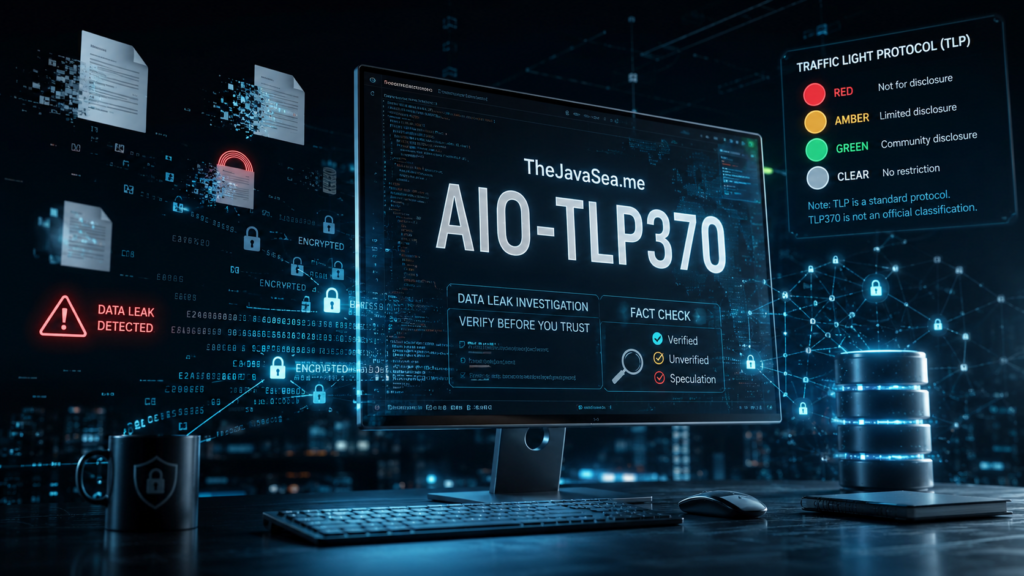
TLP can legitimately refer to the Traffic Light Protocol, a cybersecurity information-sharing framework maintained by FIRST. However, the presence of the letters “TLP” inside an unrelated identifier does not establish a connection with that protocol.
According to FIRST’s current TLP 2.0 documentation, the recognized labels are:
- TLP:RED
- TLP:AMBER
- TLP:GREEN
- TLP:CLEAR
FIRST explicitly states that only the labels included in its standard are valid TLP labels. AIO-TLP370 is not one of them.
Therefore, an article should not describe AIO-TLP370 as an official “Traffic Light Protocol 370” classification. That interpretation is unsupported.
Is AIO-TLP370 a Confirmed Data Breach?
This is where caution becomes particularly important.
A genuine data-breach report normally has evidence that can be independently evaluated. Depending on the incident, that might include a company disclosure, regulatory notification, law-enforcement statement, cybersecurity research, technical indicators, or credible reporting based on verifiable evidence.
For AIO-TLP370, the public material currently available does not establish all of those elements.
There are online articles describing the term as an alleged leak or data package, but those articles frequently rely on similar descriptions rather than providing independent primary evidence.
Consequently, it would be misleading to state as fact that AIO-TLP370 represents a confirmed global data breach or to attach a precise number of affected individuals to it without stronger evidence.
What appears to be established
The following points can reasonably be reported:
- The keyword is being discussed online.
- Several websites have published explanations about it.
- The term is associated online with alleged leaked or unauthorized material.
- “AIO” is commonly understood as an “All-In-One” abbreviation.
- AIO-TLP370 is not an official FIRST TLP label.
What remains uncertain
There is no reliable basis to confidently state:
- the precise contents of AIO-TLP370;
- the total number of records involved;
- the original source of every record;
- whether all material belongs to one incident;
- whether every file or record advertised online is authentic;
- whether the package represents a newly discovered breach.
That uncertainty should remain visible in any professional article.
Why Is “TheJavaSea.me Leaks AIO-TLP370” Trending?
Mystery is powerful on the internet.
When an unusual identifier appears alongside words such as “leaks,” “data,” “AIO,” or “exposed,” people naturally want to know what it means.
Search interest can come from several directions.
Curiosity
Users may encounter the phrase on another website, forum, social platform, or search result and simply want an explanation.
Fear of Personal Exposure
People may wonder whether their email address, username, password, photographs, or other personal information could be involved.
Cybersecurity Interest
Security-conscious users may search for the term because they want to understand whether it represents a genuine threat.
Search-Driven Content
Once several websites begin publishing articles about an obscure phrase, additional pages may repeat the same terminology. That can create the appearance of widespread confirmation even when the underlying evidence remains limited.
This is why source quality matters more than search-result volume.
What Kind of Material Could Be Associated With an Alleged Leak?
It is important not to claim that any particular category of information is definitely contained in AIO-TLP370.
In general, unauthorized data packages discussed online can potentially contain different kinds of digital information, depending on their origin. Examples may include account identifiers, email addresses, usernames, publicly available information, previously exposed credentials, or private material.
But generic characteristics of leak packages should not be presented as proof of what AIO-TLP370 contains.
Several websites make broader claims about credentials and personal information, but those claims should be treated cautiously unless supported by independent evidence.
Why Alleged Leak Archives Can Be Dangerous
The biggest risk may not actually be the alleged data itself.
Unknown leak-related pages and downloadable archives can create additional security threats.
Malware
An executable disguised as a document, tool, archive utility, or “viewer” could potentially contain malicious software.
Credential Theft
Fake login pages can be designed to collect usernames, passwords, email addresses, or authentication codes.
Phishing
A user searching for an alleged leak may encounter fake download buttons, redirects, advertisements, or websites designed to imitate legitimate services.
Privacy Exposure
Leak-related websites may contain or distribute material that was originally private or published without authorization.
Recycled Data
An old breach can sometimes be repackaged and presented as something new. Consequently, the existence of an old record inside a newly named archive does not automatically demonstrate a new breach.
Is It Safe to Download AIO-TLP370?
There is no reliable basis for recommending the download of material advertised as AIO-TLP370.
The contents, origin, and authenticity are not sufficiently established, and downloading unknown archives introduces unnecessary security and privacy risks.
The safest approach for ordinary users is straightforward:
Do not download or execute unknown files simply because they are advertised as leaked, exclusive, or difficult to find.
If a security researcher legitimately needs to examine suspicious material, that work should be conducted under appropriate authorization and within controlled analysis infrastructure rather than on a normal personal computer.
What If You Already Opened a Suspicious Page?
Opening a webpage is not automatically evidence that your device has been compromised. However, if you interacted with suspicious downloads, entered credentials, installed software, or granted unusual permissions, additional precautions are sensible.
Consider:
- Close suspicious pages and do not continue interacting with questionable download links.
- Run a security scan using trusted, updated security software.
- Update your operating system and browser.
- Change passwords that may have been entered into suspicious pages.
- Enable multifactor authentication where available.
- Review important account activity for unusual sign-ins.
- Remove unfamiliar browser extensions or applications.
- Contact the relevant service provider if you identify unauthorized account activity.
The key principle is to respond to what you actually did, rather than assuming that merely searching the keyword means you have been breached.
The Difference Between a Leak, a Breach, and a Data Dump
These terms are often used interchangeably online, but they can describe different things.
A data breach generally refers to unauthorized access to protected information.
A leak can refer more broadly to information being disclosed or distributed without authorization.
A data dump usually describes a collection of data released or circulated together.
An archive is simply a container or collection of files and does not, by itself, prove where those files came from.
This distinction is particularly important when discussing thejavasea.me leaks aio-tlp370, because the available public descriptions do not establish the exact origin and structure of the alleged material.
How to Verify Claims About AIO-TLP370
A strong cybersecurity article should encourage readers to verify claims rather than simply trust viral posts.
Look for:
Primary evidence: Is there an original disclosure or technical report?
Independent confirmation: Are credible security researchers reporting the same facts independently?
Specific evidence: Are there verifiable indicators rather than screenshots and anonymous claims?
Timeline: Does the alleged incident have a clear date and sequence of events?
Affected organization: Is there a clearly identified organization or service associated with the alleged breach?
Technical documentation: Are there credible technical details that researchers can independently evaluate?
If an article provides none of these and simply repeats another blog’s claims, its reliability should be questioned.
Common Myths About TheJavaSea.me Leaks AIO-TLP370
Myth 1: “TLP370” is an official cybersecurity classification
False. FIRST’s official TLP 2.0 framework recognizes TLP:RED, TLP:AMBER, TLP:GREEN, and TLP:CLEAR.
Myth 2: AIO-TLP370 is definitely a malware family
There is no authoritative evidence establishing it as a recognized malware family.
Myth 3: The existence of articles proves the leak is authentic
It does not. Multiple websites can repeat the same unsupported claim.
Myth 4: Every record in an alleged leak must come from one recent breach
Not necessarily. Data can be recycled, aggregated, scraped, or repackaged.
Myth 5: HTTPS means a leak website is trustworthy
HTTPS protects the connection between a browser and a website; it does not guarantee that the website, files, or operators are trustworthy.
The Privacy and Ethical Side of Leak Searches
Cybersecurity is not only about technical risks.
Allegedly leaked information may belong to real people. Sharing, reposting, or attempting to exploit private information can cause serious harm even when the material is already circulating online.
A responsible approach is therefore to avoid:
- redistributing private information;
- publishing personal credentials;
- sharing intimate or non-consensual material;
- exposing identifying information;
- encouraging unauthorized access;
- linking readers directly to stolen datasets.
Research can be conducted without amplifying or redistributing potentially harmful material.
What Should Website Owners and Bloggers Say About AIO-TLP370?
Publishers covering this keyword should be especially careful because sensational cybersecurity claims can damage reader trust.
A professional article should use language such as:
“allegedly,” “reportedly,” “publicly discussed,” “not independently verified,” and “available evidence does not establish.”
It should avoid turning speculation into definitive claims.
For example, instead of writing:
“AIO-TLP370 exposed millions of users.”
A responsible formulation would be:
“Online discussions describe AIO-TLP370 as an alleged leak-related package, but the scope and authenticity of the material have not been independently established.”
That small difference separates responsible reporting from clickbait.
The Real Cybersecurity Lesson
The most valuable lesson from the AIO-TLP370 discussion is not necessarily the package itself.
It is the importance of verification.
Modern internet users are constantly exposed to screenshots, anonymous posts, leaked-file claims, copied articles, fake breach announcements, and sensational headlines. A mysterious identifier can quickly become an apparent “major cyber incident” simply because dozens of pages repeat the same description.
Good cybersecurity research works differently.
It asks:
Who originally made the claim?
What evidence supports it?
Can another credible source independently confirm it?
What remains unknown?
Those questions are more useful than simply asking how quickly a particular leak can be downloaded.
Frequently Asked Questions
What is thejavasea.me leaks aio-tlp370?
It is a keyword associated with online discussions about an alleged leak-related package or archive connected with TheJavaSea.me. The precise nature, origin, and contents of AIO-TLP370 remain insufficiently verified.
What does AIO mean in AIO-TLP370?
AIO commonly means “All-In-One.” However, its exact intended meaning in this particular identifier has not been officially established.
What does TLP370 mean?
There is no authoritative public explanation establishing the meaning of “TLP370” in this context. It should not automatically be interpreted as an official cybersecurity classification.
Is AIO-TLP370 part of the Traffic Light Protocol?
No evidence supports that interpretation. FIRST’s official TLP 2.0 standard recognizes four labels: TLP:RED, TLP:AMBER, TLP:GREEN, and TLP:CLEAR.
Is AIO-TLP370 a confirmed data breach?
It has been described as an alleged leak in online publications, but the available evidence does not establish it as a confirmed major data breach.
Is AIO-TLP370 malware?
There is no reliable evidence establishing AIO-TLP370 itself as a recognized malware family.
Can downloading alleged leak files be dangerous?
Yes. Unknown archives and executables can create malware, phishing, credential-theft, and privacy risks. The safest option is to avoid untrusted downloads.
Should I search for leaked personal information?
It is better to avoid attempting to obtain or redistribute private or stolen information. If you are concerned that your own information may have been exposed, focus on account security and legitimate breach notifications.
Why is this keyword appearing on so many websites?
Search interest can lead to rapid publication of SEO articles, and subsequent articles may repeat earlier claims. High search visibility does not independently confirm the underlying allegations.
Final Verdict: What We Actually Know
TheJavaSea.me leaks AIO-TLP370 is a real search term being discussed online, but the story surrounding it is considerably less certain than some headlines suggest.
Public articles characterize AIO-TLP370 in different ways, including an alleged leak package or archive. Yet the exact contents, origin, scope, and authenticity remain unclear.
One fact is particularly clear: AIO-TLP370 should not be confused with FIRST’s official Traffic Light Protocol. The official TLP 2.0 framework uses four labels—RED, AMBER, GREEN, and CLEAR—and does not recognize “TLP370.”
For readers, the best response is not panic or curiosity-driven downloading. It is verification, caution, strong account security, and respect for privacy.
In cybersecurity, an unanswered question is better than an invented fact.



One thought on “TheJavaSea.me Leaks AIO-TLP370: What It Means, What Is Verified, and the Risks You Should Know”