

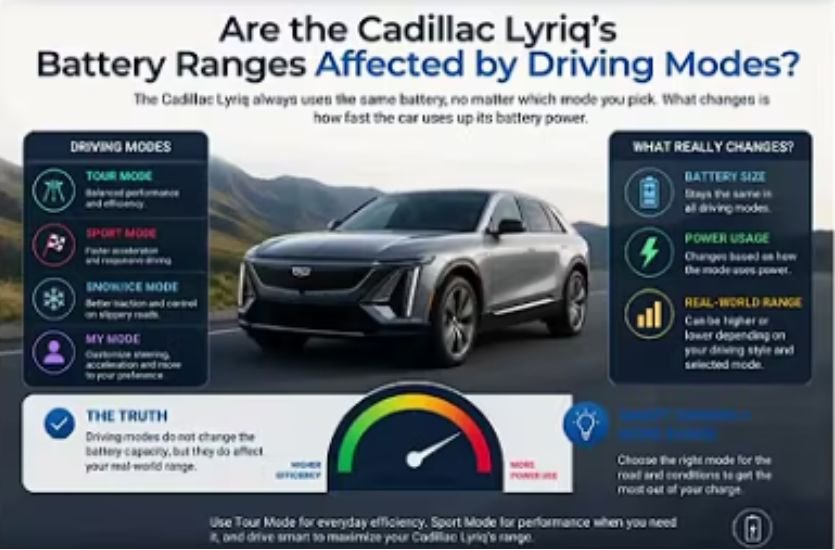
A simple Do the Driving Modes in Cadillac LYRIQ Offer Different Ranges or Battery Usages?
A simple change on the center screen can make the Cadillac LYRIQ feel completely different. But does selecting Tour, Sport, Snow/Ice, or My Mode actually change how far the electric SUV can travel—or does it simply change the way the vehicle uses the energy already stored in its battery?
The answer is more nuanced than a simple yes or no.
Cadillac does not give the LYRIQ separate official EPA range ratings for each driving mode. Instead, the modes alter characteristics such as acceleration response, torque delivery, steering feel, braking response and traction behavior. Those changes can influence real-world energy consumption, particularly when a particular setting changes the way the driver accelerates or controls the vehicle.
There is another important part of the equation that is sometimes overlooked. Speed, temperature, terrain, climate control, tire pressure, vehicle configuration, regenerative braking and individual driving habits can have a substantial effect on how quickly the battery’s stored energy is used.
So, if you’re wondering “do the driving modes in Cadillac LYRIQ offer different ranges or battery usages?”, the most accurate answer is that the modes do not change the battery’s physical capacity or create separate official range ratings, but they can influence how quickly that stored energy is consumed in real-world driving.
Quick LYRIQ Facts
| Detail | Information |
|---|---|
| Vehicle | Cadillac LYRIQ |
| Vehicle type | All-electric luxury SUV |
| Main driving modes | Tour, Sport, Snow/Ice and My Mode |
| Tour purpose | Everyday driving and smooth response |
| Sport purpose | More responsive, performance-oriented driving |
| Snow/Ice purpose | Improved traction and reduced wheel spin |
| My Mode purpose | Customized driving characteristics |
| Energy recovery | One-Pedal Driving and Regen on Demand |
| Main range variables | Speed, acceleration, temperature, terrain, climate control and driving style |
Do Cadillac LYRIQ Driving Modes Have Different Ranges?
No—not in the sense of separate manufacturer or EPA ratings.
The LYRIQ’s official range figures are associated with its particular vehicle configuration rather than with individual driving modes. There isn’t an official factory range table that says Tour provides one specific number of miles, Sport provides another, Snow/Ice provides another and My Mode provides a fourth.
That distinction is important because driving mode and vehicle configuration are two completely different things.
The battery does not physically become larger when Tour is selected, nor does it become smaller when Sport is activated. The underlying battery capacity remains the same.
What changes is the way the vehicle responds to driver inputs.
This can affect energy consumption because acceleration requires electrical power. If one setting encourages stronger acceleration and the driver frequently takes advantage of that response, the battery can be depleted more quickly.
Therefore, it is more accurate to describe the modes as vehicle-behavior settings rather than range settings.
How Do Cadillac LYRIQ Driving Modes Affect Battery Usage?
Think of a driving mode as a collection of settings that changes how the vehicle behaves rather than as a switch that gives the battery a new range rating.
Cadillac’s Driver Mode Control system is designed to tailor vehicle performance according to road conditions and driver preferences. Tour is intended for everyday driving, Sport provides a more responsive driving experience, Snow/Ice modifies acceleration and torque response for slippery conditions, and My Mode allows the driver to customize available characteristics.
These differences can indirectly affect electricity consumption.
A more responsive accelerator can make rapid acceleration easier to request. Strong acceleration requires substantial electrical power from the motors. If the driver repeatedly accelerates hard, energy consumption can rise.
The opposite is also true. Smooth acceleration, steady speeds and avoiding unnecessary changes in speed can help reduce energy consumption.
This is why two LYRIQ drivers can achieve different real-world ranges even when they use the same driving mode.
Tour Mode: Is It the Best Mode for Range?
If maximizing practical efficiency is the priority, Tour is the logical starting point.
Tour is designed around everyday driving, normal acceleration and a comfortable driving experience. Its characteristics are not intended to encourage the sharper performance response associated with Sport.
However, Tour does not come with a guaranteed range bonus.
Selecting Tour does not automatically add a particular number of miles to the battery. Instead, its everyday calibration can make smooth driving easier.
This distinction matters because a driver can still consume significant energy in Tour by accelerating aggressively or maintaining high highway speeds.
For an efficiency-focused driver, Tour works best when combined with smooth acceleration, moderate speeds, sensible climate-control use, proper tire pressure and effective energy recovery.
The LYRIQ owner’s experiences shared in the Cadillac community reinforce this point. One owner reported monitoring kWh usage, using cruise control and relying heavily on regenerative braking while driving through an area with many hills. That owner said they rarely used the conventional brake pedal and associated these habits with an overall efficiency figure of 4.2 miles per kWh. This is an individual owner experience, not a controlled Cadillac test, but it illustrates how driving technique can affect energy consumption.
Does Tour Mode Give the LYRIQ Its Maximum EPA Range?
Not necessarily.
An EPA range figure is a standardized rating rather than a promise that every driver will reproduce the same number on every journey.
Real-world range can be lower or higher depending on circumstances.
A LYRIQ traveling through mild weather at moderate speeds may behave very differently from the same vehicle traveling through freezing temperatures, strong wind and highway traffic.
That is why selecting Tour should be viewed as one part of an efficiency strategy rather than a guarantee of maximum range.
Sport Mode: Does It Use More Battery?
This is where the question becomes particularly interesting.
Sport Mode is designed to provide a more responsive and performance-oriented driving experience. The LYRIQ can feel more immediate when the driver asks for acceleration, which is one of the reasons an owner might select Sport in the first place.
But Sport Mode does not have a fixed battery penalty.
There is no reliable Cadillac specification stating that Sport Mode always consumes exactly 10%, 15% or 20% more energy than Tour. Precise percentages found on websites should therefore be treated cautiously unless they come from controlled testing under comparable conditions.
The more straightforward explanation is that Sport can encourage behavior that consumes more energy.
If the driver repeatedly uses strong acceleration, drives at higher speeds or makes frequent changes in speed, the electric motors can demand more power from the battery.
One owner discussion about LYRIQ efficiency makes this relationship particularly clear: an owner acknowledged occasionally using sporty acceleration and driving around 60–70 mph on highways, while other owners emphasized that speeding and hard acceleration can significantly hurt efficiency.
That does not prove a specific Sport Mode range penalty. Instead, it shows why driving style matters when evaluating the real-world effect of a performance-oriented mode.
The better conclusion is that Sport Mode can contribute to higher energy consumption when its characteristics lead to more aggressive driving, but there is no universal percentage reduction that applies to every LYRIQ.
Can a Calm Driver Use Sport Mode Without Losing Huge Amounts of Range?
Potentially, yes.
The mode itself should not be treated as an automatic battery drain.
Imagine two LYRIQs using Sport Mode. The first driver accelerates hard at every opportunity and spends considerable time at high highway speeds. The second driver selects Sport but maintains steady speeds and uses the accelerator gently.
The two vehicles can have very different energy consumption.
This is why simply comparing “Tour versus Sport” without controlling the driver’s behavior can produce misleading conclusions.
Sport changes the character of the vehicle. It does not automatically dictate how aggressively the driver must operate it.
Snow/Ice Mode: Does It Save or Waste Battery?
Snow/Ice Mode has a completely different purpose.
Cadillac designed this setting to help the vehicle manage slippery conditions by modifying the accelerator and torque response. Instead of prioritizing immediate performance, it focuses on maintaining traction and reducing wheel spin.
For that reason, Snow/Ice should not be described simply as an “eco mode.”
Its purpose is control and traction.
There is also an important complication when discussing its effect on range: Snow/Ice Mode is normally used during conditions that can already reduce EV efficiency.
Cold weather can increase energy demand. Cabin heating consumes electricity. Snow-covered or wet roads can change rolling resistance. Wind, winter tires and slower traffic can also influence energy consumption.
Consequently, if a LYRIQ owner notices a significant range reduction during a snowy winter trip, it would be inaccurate to automatically blame Snow/Ice Mode.
The surrounding conditions may be a much larger part of the explanation.
Winter Owner Experiences Show Why Conditions Matter
Owner reports provide an interesting real-world perspective on this issue.
In the shared LYRIQ owner discussion, one driver reported seeing efficiency fall when temperatures dropped below 40°F and said efficiency became considerably worse below 20°F. Another owner described very low efficiency during extremely cold conditions and explained that winter weather had a noticeable effect on the vehicle.
Another owner reported a substantial seasonal difference, describing a maximum summer range of around 352 miles and an average winter range around 270 miles, while also reporting an overall efficiency figure of 4.2 miles per kWh. The owner attributed efficiency partly to driving habits, regenerative braking and coasting in hilly areas.
These numbers should not be presented as official LYRIQ range specifications because they represent individual owner experiences under particular conditions.
However, they demonstrate an important point: temperature and driving conditions can create a much larger practical difference than simply changing the name of the driving mode.
What About My Mode?
My Mode is the most difficult setting to assign a single efficiency expectation to because it is customizable.
Depending on the LYRIQ configuration, My Mode allows the driver to adjust characteristics such as steering feel, braking response and accelerator responsiveness.
That means there is no universal “My Mode range.”
One driver might configure My Mode for a relaxed driving experience. Another might choose more responsive settings designed around performance.
The resulting energy consumption can therefore depend on both the selected configuration and the way the vehicle is driven.
My Mode should consequently be understood as a personalization feature rather than a dedicated battery-saving mode.
Does One-Pedal Driving Affect LYRIQ Range?
Yes, but One-Pedal Driving should not be confused with the four main driving modes.
This distinction is important because regenerative braking can influence energy recovery even though it is not simply another version of Tour, Sport, Snow/Ice or My Mode.
When the LYRIQ slows through regenerative braking, some of the vehicle’s kinetic energy can be converted back into electrical energy and returned to the battery.
That does not mean regeneration creates free energy. Energy conversion has losses, and the vehicle cannot recover every unit of energy used to accelerate.
Nevertheless, effective regenerative driving can improve overall efficiency by recovering some energy that would otherwise be lost during deceleration.
Owner discussions also highlight this. One LYRIQ driver said they used one-pedal driving to help with range, while another owner described regenerative braking and coasting as particularly useful in hilly terrain.
Highway Driving Can Change the Result
Highway driving deserves special attention because speed can become a major factor in energy consumption.
A driver traveling at 60–70 mph is operating under very different conditions from someone driving through slower city traffic.
Higher speeds generally require more energy because aerodynamic resistance increases as speed rises.
This means a LYRIQ driven in Tour at high highway speeds can potentially use more energy than a LYRIQ driven gently in Sport at moderate speeds.
One owner in the shared discussion explained that most of their driving occurred on highways, making lower-speed efficiency techniques difficult to apply. Another owner specifically connected poor efficiency with speeding and hard acceleration.
The lesson is straightforward: the mode selector should not be analyzed separately from speed.
Temperature Can Matter More Than the Driving Mode
Temperature is another major factor that can easily overshadow differences between driving modes.
The LYRIQ’s battery operates within a temperature-sensitive system. Extremely cold conditions can affect energy efficiency, while heating the cabin also requires electricity.
The shared owner reports illustrate how dramatic these changes can feel in practice. One owner said that even after turning off the cabin heat, heated seats and the heated steering wheel still consumed some power and reported substantially lower efficiency during temperatures around or below 30°F. Another owner reported particularly poor efficiency during sub-zero conditions.
Again, these are individual experiences rather than controlled tests.
They nevertheless provide useful context for understanding why a driver may see the estimated range fall rapidly during winter.
A comparison between Tour on a mild summer day and Sport during a freezing winter road trip would tell us very little about the mode itself because too many variables have changed.
Battery Conditioning Can Also Make a Difference
Battery temperature management can become particularly important during cold-weather travel.
One owner in the shared discussion described conditioning the battery before a cold-weather trip and reported noticeably different efficiency depending on whether the battery had been warmed beforehand. That owner reported approximately 3.2–3.4 miles per kWh after warming the battery to around 72°F, compared with approximately 2.1–2.3 miles per kWh when the battery was not warmed and only the cabin had been preconditioned.
These figures should be treated strictly as that owner’s reported experience, not as a guaranteed LYRIQ performance specification.
The larger lesson is more important than the exact numbers: battery temperature can influence real-world EV efficiency, so comparing driving modes without accounting for battery temperature can be misleading.
Climate Control Also Uses Battery Energy
Heating and cooling are easy to overlook when discussing driving modes.
An EV does not have an engine producing large amounts of waste heat that can simply be redirected into the cabin. Cabin heating and air conditioning require electrical energy.
That energy comes from the same overall battery resource used to propel the vehicle.
This means a driver may notice a lower estimated range during periods of heavy heating or cooling even though the selected driving mode has not changed.
The owner reports shared in the LYRIQ discussion support this real-world observation. Drivers discussed cabin heating as well as heated seats and the steering wheel when trying to understand unexpectedly poor winter efficiency.
Therefore, a fair driving-mode comparison should keep climate-control settings as consistent as possible.
AWD and RWD Can Also Change the Equation
Another important distinction is drivetrain configuration.
Owner reports in the shared discussion included observations that AWD and RWD LYRIQs can behave differently in terms of battery consumption. One owner specifically said their AWD model consumed more battery while their RWD model performed better from an efficiency perspective.
This is an owner observation rather than a universal rule for every LYRIQ configuration.
Still, it highlights why two LYRIQs cannot necessarily be compared simply because they carry the same model name.
Drivetrain configuration, wheels, tires and other equipment can influence efficiency.
Therefore, if someone reports that their LYRIQ gets a particular number of miles from a charge in Tour Mode, that result should not automatically be applied to every LYRIQ.
Why Your LYRIQ’s Estimated Range Can Change
The estimated range displayed by an EV should not be interpreted as a fixed amount of distance physically stored inside the battery.
It is an estimate influenced by energy consumption.
If recent driving has been efficient, the estimate may look more optimistic. If recent driving has involved high speeds, hard acceleration, cold weather, heavy heating or other demanding conditions, the estimate can fall.
This can sometimes create the impression that changing a driving mode directly removed miles from the battery.
In reality, the vehicle is responding to the broader energy-consumption picture.
Imagine two LYRIQ owners starting with the same state of charge. One drives gently through moderate traffic while the other spends an hour at high highway speeds with frequent acceleration.
Even if both vehicles have the same battery capacity, their estimated remaining ranges can develop very differently.
The displayed number is therefore best understood as an estimate of likely remaining distance under changing conditions, rather than a fixed battery measurement.
What Actually Has the Biggest Impact on Cadillac LYRIQ Range?
The driving mode is only one part of the range equation.
Speed
Higher speeds generally require more energy, particularly during sustained highway driving.
Acceleration
Hard acceleration can draw substantial electrical power. Smooth, progressive acceleration is generally more favorable for efficiency.
Temperature
Cold weather can reduce efficiency and increase energy demand, particularly when the cabin needs heating.
Climate Control
Heating, air conditioning and other comfort systems consume electricity that could otherwise contribute to propulsion.
Terrain
Hills and changes in elevation can increase energy demand. However, regenerative braking during appropriate downhill sections can recover some energy.
Driving Style
Driving style may ultimately be more important than the name of the selected mode.
An aggressive driver in Tour can consume more energy than a smooth driver in Sport.
Tire Pressure
Tire condition and inflation can influence rolling resistance and therefore energy consumption.
Battery Temperature
Battery temperature can affect how efficiently the vehicle operates and how regenerative features behave.
These factors explain why there is no universal LYRIQ range number that can accurately describe every journey.
How Should You Test LYRIQ Driving Modes Fairly?
If an owner genuinely wants to determine whether Tour or Sport makes a meaningful difference to their own LYRIQ, the comparison needs to be reasonably controlled.
The same route should be used whenever possible.
The driver should try to maintain similar speeds, similar climate-control settings and similar traffic conditions. The battery should begin at comparable states of charge, and the test should ideally be repeated more than once.
It is also useful to record energy consumption in miles per kWh rather than relying solely on the estimated remaining range.
For example, an owner could drive the same route in Tour for several trips and record the average efficiency. The same process could then be repeated in Sport.
That would produce a much more meaningful personal comparison than simply looking at the estimated range immediately before and after switching modes.
Is Sport Mode Bad for the LYRIQ Battery?
No—not simply because it is Sport Mode.
There is an important difference between using more energy and damaging the battery.
If a driver accelerates aggressively, the vehicle can consume more electricity during that journey. That may mean the driver needs to recharge sooner.
It does not automatically mean the battery has been damaged.
Sport Mode exists to provide a more responsive driving experience. Using the vehicle’s performance capability occasionally is fundamentally different from claiming that the mode itself harms the battery.
Battery longevity involves many factors, including charging behavior, temperature exposure and overall battery management. It should not be reduced to a simple statement that Sport Mode is bad for the battery.
Can Driving Modes Change Battery Capacity?
No.
Selecting Tour, Sport, Snow/Ice or My Mode does not physically increase or decrease the amount of energy the battery can store.
The easiest way to understand the difference is:
Battery capacity = physical energy-storage hardware
Driving mode = vehicle-response settings
Range = battery energy combined with vehicle efficiency and driving conditions
This distinction eliminates much of the confusion surrounding LYRIQ drive modes.
Which Cadillac LYRIQ Mode Is Best for Maximum Range?
If the priority is maximum practical efficiency, Tour is the most sensible default because it is designed around normal everyday driving.
But Tour is not a magic range extender.
An efficiency-focused driver should also pay attention to speed, acceleration, climate-control use, tire pressure, weather and regenerative braking.
The shared owner experiences provide a useful example. One owner reported using cruise control, monitoring kWh usage and relying heavily on regenerative braking and coasting in hilly terrain. Another reported that highway speeds and sporty acceleration affected their experience.
These reports do not establish a universal formula, but they show why real-world efficiency is the result of multiple factors working together.
Cadillac LYRIQ Driving Modes and Range: Quick Comparison
| Driving mode or feature | Main purpose | Potential effect on battery usage |
|---|---|---|
| Tour | Everyday comfort and smooth response | A sensible choice for efficiency-focused everyday driving |
| Sport | Sharper, more responsive driving | Can increase consumption when used for aggressive acceleration |
| Snow/Ice | Traction and reduced wheel spin | Not specifically designed as a range-saving mode |
| My Mode | Driver customization | Depends on configuration and driving style |
| One-Pedal Driving | Regenerative driving and deceleration | Can recover energy during suitable coasting and braking |
None of these settings should be interpreted as providing a separate physical battery capacity.
Frequently Asked Questions
Do Cadillac LYRIQ driving modes offer different ranges?
Not as official factory ratings. Cadillac does not provide separate EPA-estimated range figures for Tour, Sport, Snow/Ice and My Mode.
Which LYRIQ driving mode is best for range?
Tour is the most logical everyday choice when efficiency is the priority, but the driver’s speed, acceleration habits, climate-control use and surrounding conditions can have a major influence on actual range.
Does Sport Mode reduce LYRIQ range?
It can contribute to higher energy consumption when its responsive characteristics encourage harder acceleration or higher-speed driving. There is no universal official percentage reduction that applies to every LYRIQ.
Does Snow/Ice Mode save battery?
Snow/Ice Mode is primarily designed for traction and control on slippery surfaces rather than maximum range. Winter conditions themselves can significantly affect EV efficiency.
Does My Mode affect battery consumption?
It can, depending on the selected settings and driving style. Because My Mode is customizable, there is no single efficiency figure that applies to every configuration.
Does One-Pedal Driving improve LYRIQ efficiency?
Regenerative braking can recover some energy during suitable deceleration and coasting situations. Owner reports also describe one-pedal driving and regenerative braking as useful for efficiency.
Does changing driving modes change the LYRIQ battery size?
No. The battery’s physical capacity does not change when the driver switches between driving modes.
Why does my LYRIQ show less range in winter?
Cold temperatures, cabin heating, battery temperature, road conditions, wind and driving style can all contribute to lower efficiency. Owners in the shared discussion reported significant winter-efficiency reductions, although those reports represent individual experiences rather than controlled tests.
The Bottom Line
So, do the driving modes in Cadillac LYRIQ offer different ranges or battery usages?
They can influence real-world battery usage, but they do not provide separate official range ratings or change the physical capacity of the battery.
Tour is designed for smooth, everyday driving and is the most straightforward choice when efficiency is the priority. Sport provides a more responsive, performance-oriented character and can result in greater energy consumption when that response leads to harder acceleration or faster driving. Snow/Ice is focused on traction rather than range, while My Mode gives drivers the ability to customize the vehicle’s behavior.
But the biggest lesson is that the mode selector is only one part of the equation.
Real-world LYRIQ efficiency is influenced by speed, acceleration, temperature, climate control, terrain, drivetrain configuration, tire pressure, battery temperature, regenerative braking and driving habits.
The owner experiences shared in the Cadillac community make this especially clear. Drivers reported efficiency figures ranging from roughly 1.1 to more than 4 miles per kWh under different conditions, while some described significant differences between winter and summer driving. These figures should not be treated as official benchmarks, but they demonstrate how dramatically real-world circumstances can change EV efficiency.
The most accurate way to think about the LYRIQ is therefore not “Which mode gives me more battery?”
It is “Which mode changes the vehicle’s behavior in a way that matches how I want to drive?”
For everyday efficiency, Tour combined with smooth acceleration, reasonable highway speeds and intelligent energy recovery is a sensible approach. For performance, Sport provides a different response. For slippery conditions, Snow/Ice prioritizes traction. For personalization, My Mode gives the driver greater control.
Ultimately, changing the driving mode does not create or remove battery capacity. It changes how the vehicle responds, while the actual range is determined by the interaction between that behavior, the driver and the conditions surrounding the journey.
That is the key answer to the question: Cadillac LYRIQ driving modes can influence battery usage and real-world range, but they do not come with separate guaranteed ranges.
READ MORE : Growth Navigate Funding
READ MORE : Coyyn