









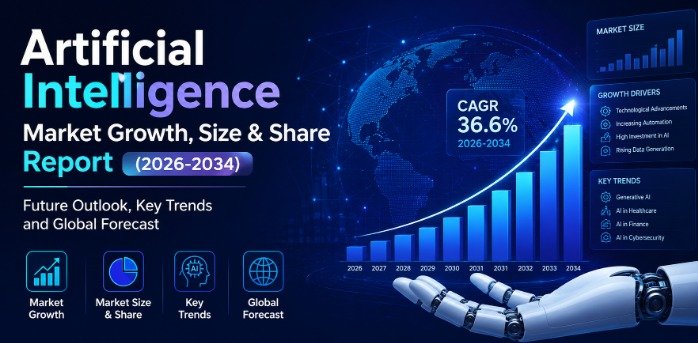
Artificial intelligence is becoming an important part of modern business, technology, and everyday communication. From automated customer service to advanced healthcare systems, AI is changing how organizations manage tasks, serve customers, and make decisions. The artificial intelligence market size is attracting attention from investors, technology companies, and businesses planning their next stage of development. According to Grand View Research, the global market is expected to expand considerably between 2026 and 2033. This AI market report examines the industry’s financial outlook, major technologies, regional opportunities, business applications, and important developments shaping the future of artificial intelligence.
This article covers market valuation, industry share, investment opportunities, emerging technologies, regional performance, and the future outlook through 2033.
Artificial Intelligence Market Valuation and Financial Outlook
The global artificial intelligence industry is moving beyond experimental projects. Companies are now incorporating AI into regular business operations, customer communication, product development, and internal management.
According to the global market, it was valued at USD 390.9 billion in 2025. Its estimated valuation for 2026 is USD 539.5 billion, while the forecast for 2033 stands at approximately USD 3,497.3 billion.
The report projects a compound annual growth rate (CAGR) of 30.6% between 2026 and 2033. These figures demonstrate the scale of investment and commercial adoption expected during the forecast period.
The artificial intelligence market size reflects growing demand for intelligent software, computing infrastructure, and automated services. Similarly, the global AI market size is receiving attention from companies looking for new revenue opportunities.
Major Technologies Changing the Industry’s Direction
Artificial intelligence consists of several technologies that support different business and consumer requirements. Machine learning, deep learning, natural language processing, and computer vision are among the important areas contributing to industry expansion.
Each technology addresses a different challenge, although many modern applications combine multiple systems to deliver better results.
Key technologies influencing artificial intelligence market growth include:
- Machine learning: Helps computer systems identify patterns, process information, and improve predictions using available data.
- Deep learning: Supports advanced applications involving speech recognition, image processing, and complex data interpretation.
- Natural language processing: Allows software to interpret human language and generate relevant responses.
- Computer vision: Helps machines analyze photographs, videos, and visual information.
- Generative AI: Produces text, images, videos, audio, and other digital material through trained AI models.
These developments are shaping artificial intelligence market trends across several industries. Generative AI, in particular, is creating new opportunities for content production, software development, and digital communication.
Likewise, artificial intelligence market analysis shows why businesses are increasingly interested in combining AI technologies rather than depending on a single solution. The global AI market size is closely connected to the commercial adoption of these systems.
Industry Segments Driving Revenue and Market Share
The artificial intelligence industry is divided into several segments according to technology, component, business function, end use, and geographical presence. Each segment contributes to the overall artificial intelligence size and creates different opportunities for technology providers.
Grand View Research identifies services as the largest component segment, accounting for 36.3% of revenue in 2025. Deep learning held the leading position among technology segments, while operations represented the largest functional segment.
Healthcare also accounted for the largest revenue share among end-use segments. These findings provide useful information for artificial intelligence market research because they show where businesses are already spending money.
The major industry segments can be viewed through the following categories:
| Market category | Important segments |
| Components | Hardware, software, services |
| Technology | Machine learning, deep learning, NLP, machine vision, generative AI |
| Business functions | Operations, sales and marketing, finance |
| End-use industries | Healthcare, automotive, retail, manufacturing, finance |
| Deployment | Cloud-based and on-premises solutions |
Artificial intelligence market analysis across these categories helps companies identify areas with strong commercial demand. Meanwhile, the global AI market size is expected to benefit from wider adoption across industries.
Business Applications Creating New Commercial Opportunities
AI adoption is no longer limited to technology companies. Businesses across different sectors are investing in intelligent systems to improve their services and manage everyday operations.
Healthcare organizations use AI to support medical image analysis, patient communication, administrative processes, and clinical decision support. Similarly, financial institutions apply machine learning to fraud detection, risk assessment, and transaction monitoring.
Retail businesses use recommendation engines to understand shopping preferences and provide more relevant product suggestions. Manufacturing companies rely on predictive maintenance and automated quality inspection to reduce operational interruptions.
Other important applications include:
- Education: Personalized learning assistance and automated academic support.
- Automotive: Driver assistance, vehicle monitoring, and autonomous driving development.
- Customer service: Automated responses, virtual assistants, and personalized communication.
- Marketing: Content creation, audience segmentation, and campaign management.
- Entertainment: AI-generated characters, interactive storytelling, AI generated reels and personalized digital experiences.
These applications are influencing artificial intelligence market trends because organizations want practical solutions that address specific business problems.
The expansion of conversational AI is also creating opportunities in consumer-facing services. For instance, an AI girlfriend application can provide personalized conversations and interactive entertainment.
Brands such as Secrets AI are part of this growing consumer-facing category, where personalized characters and conversational experiences attract interest from digitally connected audiences.
Regional Opportunities Across the Global AI Industry
The artificial intelligence industry is expanding across different regions, with each market contributing through technology investment, digital infrastructure, business automation, and consumer adoption. Some countries are focusing on advanced AI development, while others are prioritizing practical applications across healthcare, finance, education, and manufacturing.
According to Grand View Research, North America accounted for 35.5% of global artificial intelligence market revenue in 2025, making it the largest regional market. Meanwhile, Asia Pacific is expected to record the fastest growth between 2026 and 2033.
North America: Leading AI Investment and Innovation
North America continues to hold a strong position because of its established technology companies, research institutions, cloud infrastructure, and enterprise investment. The United States is a major contributor, with businesses adopting AI across financial services, healthcare, retail, and software development.
Canada is also developing its AI ecosystem through research, skilled professionals, and technology startups. Similarly, businesses across the region are investing in generative AI, autonomous systems, and advanced computing infrastructure.
Important opportunities include:
- AI-powered enterprise software and automation.
- Healthcare applications and medical data processing.
- Cloud computing and AI infrastructure.
- Autonomous vehicles and intelligent manufacturing.
Asia Pacific: The Fastest-Growing Regional Opportunity
Asia Pacific is expected to experience the fastest artificial intelligence market growth during the forecast period. Countries including China, India, Japan, and South Korea are increasing their focus on digital infrastructure, automation, and AI development.
China has a strong technology manufacturing base and an expanding AI ecosystem. India is seeing growing adoption across IT services, banking, education, customer support, and digital businesses.
Japan and South Korea are investing in robotics, semiconductor technologies, smart manufacturing, and advanced automation.
The region also presents opportunities for businesses developing multilingual AI applications. Local languages, mobile-first services, and different consumer preferences are encouraging companies to build products suited to regional audiences.
Europe: Progress Through Industrial AI Adoption
Europe is developing its AI market through investments in research, manufacturing, healthcare, automotive technology, and financial services.
Germany has strong opportunities in industrial automation and smart manufacturing. France and the United Kingdom are supporting AI development through technology research, startup activity, and enterprise adoption.
Data protection and responsible AI practices are particularly important across European markets. The EU AI Act also establishes a regulatory framework that businesses must consider when developing or deploying AI systems.
Consequently, companies offering secure, transparent, and industry-specific solutions may find opportunities across the region.
Latin America: Growing Demand for Practical AI Solutions
Latin America is gradually increasing its adoption of AI across banking, retail, agriculture, healthcare, and public services.
Brazil and Mexico are important markets because of their expanding digital economies and growing interest in business automation.
Financial institutions can use AI for fraud detection, customer support, and credit assessment. Similarly, agricultural businesses can apply intelligent systems to crop monitoring, resource management, and production planning.
However, infrastructure limitations, investment costs, and shortages of specialized technical professionals remain challenges in some markets. Addressing these requirements will be important for sustainable regional development.
Middle East and Africa: New Digital Infrastructure Opportunities
Countries across the Middle East are investing in digital transformation, smart cities, cloud infrastructure, and AI-powered public services.
The UAE and Saudi Arabia are particularly active in developing national AI strategies and supporting technology investment. Healthcare, energy, transportation, and government services are important application areas.
Across Africa, AI adoption is creating opportunities in agricultural technology, mobile financial services, education, and healthcare access.
However, reliable internet connectivity, computing resources, funding, and technical training remain important requirements. Partnerships between governments, technology providers, and local businesses can help address these gaps.
Emerging Developments Influencing Future Market Demand
The next stage of artificial intelligence market growth will depend on how effectively businesses convert technological developments into practical services.
Generative AI is already changing how organizations create digital content, communicate with customers, and manage information. However, agentic AI is also receiving attention because these systems can perform connected tasks with greater autonomy under defined instructions and permissions.
Multimodal technology represents another important development. It allows AI systems to process different information formats, including text, images, voice, and video.
Consequently, future artificial intelligence market trends may be shaped by several developments:
- Agentic AI adoption: Businesses are testing systems that can coordinate tasks and support multi-step workflows.
- Personalized digital services: AI products are becoming more responsive to individual preferences and communication styles.
- Enterprise automation: Organizations are integrating AI into regular operational processes.
- Multimodal systems: Text, voice, and visual communication are increasingly combined.
- AI infrastructure investment: Demand for computing power, specialized chips, and cloud services continues to influence industry spending.
Artificial intelligence market prediction also depends on the ability of companies to manage infrastructure costs, data quality, privacy, and implementation challenges.
I see practical business adoption as an important factor in determining which AI products will achieve lasting commercial demand.
Investment Opportunities and Challenges for Technology Companies
The expanding artificial intelligence market size is creating opportunities for software developers, cloud service providers, semiconductor manufacturers, and businesses building industry-specific solutions.
However, market expansion does not guarantee success for every company. Technology providers must demonstrate that their products solve real problems and offer measurable value.
Artificial intelligence market research helps investors evaluate these opportunities through company performance, technology adoption, competitive positioning, and customer demand.
Some important considerations are:
- Infrastructure costs: Developing and operating advanced AI systems requires significant computing resources.
- Data protection: Businesses must establish responsible data collection, storage, and processing practices.
- Technical expertise: Skilled professionals are necessary for developing, maintaining, and monitoring AI solutions.
- Market competition: Established technology companies and emerging startups are competing for customers.
- Regulatory requirements: Businesses need to consider applicable AI, privacy, and consumer protection regulations.
Artificial Intelligence Market Prediction Through 2033
The future artificial intelligence market size will depend on enterprise spending, technological improvements, consumer adoption, and the availability of reliable computing infrastructure.
The 2026–2033 forecast indicates substantial expansion, although actual results may differ depending on economic conditions and the pace of technology adoption. Artificial intelligence market prediction should therefore consider both commercial opportunities and implementation challenges.
The following chart presents the financial estimates published in the Grand View Research AI market report.
The forecast suggests that the global AI market size could become considerably larger as businesses increase spending on intelligent software, automation, and computing infrastructure.
The following diagram shows how major industry developments connect with commercial adoption and market expansion.
How AI Companies Can Prepare for the Next Growth Phase
Technology companies need more than advanced software to compete successfully. Their products must offer reliability, practical functionality, and a clear purpose.
We can expect stronger competition across AI infrastructure, enterprise software, and consumer applications. They will also need to address customer expectations around transparency, data security, and responsible automation.
Businesses planning investments should pay attention to:
- Developing products that solve specific customer problems.
- Building secure and scalable AI infrastructure.
- Improving the accuracy and reliability of AI-generated results.
- Training employees to work effectively with AI systems.
- Monitoring artificial intelligence market trends and customer demand.
- Evaluating long-term operating costs before expanding AI projects.
A balanced artificial intelligence market analysis can help organizations distinguish sustainable opportunities from short-term market excitement. In addition, an AI market report can provide useful information about regional performance, industry competition, and projected demand.
As the artificial intelligence market size expands, businesses that combine technical development with practical customer requirements may find stronger opportunities for long-term growth.
AI Companion Market: A Growing Consumer-Facing Opportunity
Recent AI market growth insights reach approximately USD 3.49 trillion by 2033, highlighting the rapid expansion of artificial intelligence adoption, with platforms like Secrets AI contributing to the rise of personalized AI experiences, intelligent conversations, and advanced digital solutions.
According to the report:
- The global AI companion market was valued at USD 36.8 billion in 2025.
- Its estimated valuation for 2026 is USD 48 billion.
- The market is projected to reach USD 318 billion by 2033.
- The expected CAGR is 31.0% between 2026 and 2033.
- Text-based companions held a 42.7% share in 2025.
- Social interaction and companionship accounted for 29.4% of application revenue in 2025.
These figures show how personalized conversations and interactive digital experiences are becoming commercially important. Companies including Secrets AI participate in this consumer-facing space through AI character interactions and personalized communication experiences.
The segment also demonstrates how specialized applications can contribute to the wider adoption of artificial intelligence across consumer markets. However, AI companion figures should be evaluated separately from the overall artificial intelligence industry valuation.
Conclusion
The artificial intelligence industry is entering a major period of commercial expansion. Market forecasts point to rising demand across enterprise software, healthcare, automation, and personalized digital services. However, lasting success will depend on useful applications, reliable infrastructure, responsible data practices, and customer trust. Businesses should assess regional opportunities, technology costs, and changing regulations before making long-term investments.
As adoption spreads, companies that connect innovation with real customer needs may be better prepared to compete and build sustainable growth through 2033, rather than following short-lived trends or speculative market expectations alone.