








Virtual events have a reputation for feeling flat compared to their in-person counterparts, and it’s rarely because the content itself is worse. It’s because most virtual formats reduce attendees to passive viewers, watching a screen rather than participating in something. Online games offer a way to flip that dynamic, giving attendees an actual role to play rather than a stream to watch, and that shift alone can make a virtual event feel dramatically more alive.
Why Most Virtual Events Struggle to Feel Engaging
Watching Isn’t the Same as Participating
A livestream, a webinar, or a virtual conference session typically asks attendees to sit and absorb content, which is a fundamentally passive experience. Even well-produced virtual content struggles to compete with the energy of something attendees actually get to do, rather than simply observe.
Chat Alone Doesn’t Create Real Interaction
Many virtual events lean on a chat window as their main interactive element, but chat participation tends to be uneven, with a small number of vocal attendees dominating while most people watch silently. Chat gives the appearance of interactivity without necessarily giving most attendees a meaningful way to actually engage.
What Games Add to a Virtual Event
A Concrete Reason to Actively Participate
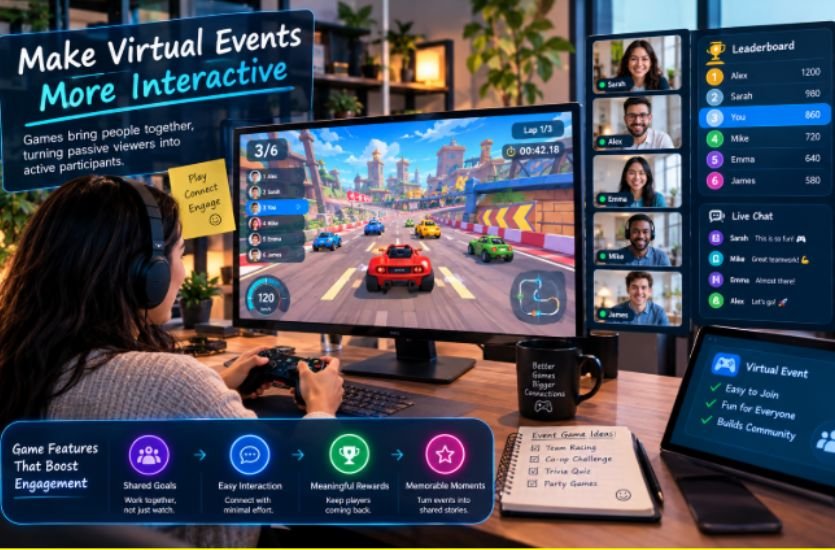
A game gives attendees something specific to do, rather than something to watch or occasionally comment on. That shift from passive viewer to active participant changes how engaged people feel throughout an event, even if the game itself is simple.
Shared Moments That Attendees Experience Together
Games built around a shared challenge or competition give a virtual audience a common experience to react to in real time, similar to how a live crowd reacts together to something happening in front of them. This shared moment is hard to replicate through a standard presentation format alone.
A Natural Icebreaker for Remote Audiences
Virtual events often struggle with the kind of organic mingling that happens naturally at in-person gatherings. A light, easy-to-understand game gives attendees a shared, low-pressure activity to bond over, functioning as a social icebreaker in a format that otherwise makes casual connection difficult.
Designing a Game That Fits Into an Event
Keep It Simple Enough for a Mixed Audience
Event attendees typically have a wide range of gaming experience, from people who play regularly to people who rarely touch games at all. A game built for a virtual event needs a low barrier to entry so nobody feels excluded or overwhelmed trying to participate.
Match the Game’s Length to the Event’s Format
A game embedded in a short break between sessions needs to be quick and easy to jump into and out of, while a game meant to anchor a longer portion of an event can afford a bit more depth. Matching scope to the actual time available keeps the activity feeling like a natural part of the event rather than a disruption to its pacing.
Give the Game a Clear Connection to the Event Itself
A game that feels randomly inserted into an event can come across as a gimmick rather than a meaningful part of the experience. Tying the theme, branding, or content of the game to what the event is actually about helps it feel like a natural extension rather than an unrelated distraction.
Building and Testing an Event Game Quickly
Events often come together on tight timelines, which makes speed a real practical concern when it comes to building something interactive for them.
Why Fast Turnaround Matters for Event Games
Unlike a standalone game with an open-ended development timeline, an event game usually needs to be ready by a fixed date that isn’t moving. Being able to build, test, and adjust a game quickly matters enormously when the deadline is set by the event itself rather than by the project’s own pace.
A Platform That Supports Quick Turnaround
Astrocade makes it easier to create a game fast enough to fit realistically into an event planning timeline, letting organizers describe a simple interactive concept and get it into a testable, playable state without needing a long traditional development cycle.
Seeing a Simple, Accessible Concept in Practice
Aero Auto Transporter is a good example of a straightforward, easy-to-grasp concept that a broad audience could pick up quickly with little explanation. This kind of accessible, low-barrier design is exactly what tends to work best for a virtual event audience that includes people with very different levels of gaming familiarity.
What Event Organizers Still Need to Plan For
Deciding Where the Game Fits in the Schedule
A game can add real energy to an event, but only if it’s placed at a point in the schedule where attendees actually have the bandwidth to participate. Squeezing an interactive activity into an already packed agenda can make it feel rushed rather than genuinely engaging.
Making Sure Technical Access Isn’t a Barrier
Not every attendee will have the same device, connection quality, or comfort level with new tools. Organizers need to consider how easily people can actually join and play before assuming an interactive element will work smoothly for the entire audience.
Balancing Fun With the Event’s Actual Purpose
An engaging game still needs to support the event’s broader goals rather than distract from them entirely. Finding the right balance between a genuinely fun activity and staying connected to the event’s actual purpose is a judgment call organizers need to make deliberately.
Common Mistakes When Adding Games to Virtual Events
Choosing a Game That’s Too Complex for the Setting
An event audience typically doesn’t have time to learn a complicated set of rules before participating. Overly complex games tend to lose people before they even get started, undermining the interactivity the game was meant to add.
Treating the Game as an Afterthought
A game added at the last minute without real integration into the event’s flow often feels disconnected rather than additive. Planning the interactive element alongside the rest of the event, rather than bolting it on separately, tends to produce a much smoother experience.
Ignoring How the Game Will Actually Be Explained Live
Even a simple game needs a clear, quick explanation for attendees joining in real time. Underestimating how much guidance people need to get started can undercut an otherwise well-designed interactive moment.
A Practical Approach to Adding Games to Virtual Events
A reasonable process looks like this. Choose a simple, low-barrier concept that fits the technical comfort level of the widest possible portion of the audience. Match the game’s length and complexity to where it fits in the event schedule, keeping quick activities quick and reserving anything more involved for a longer dedicated segment. Build and test the game with enough lead time to make adjustments before the event, and plan a clear, brief explanation for how attendees can jump in without confusion.
Final Thoughts
Online games give virtual events something that passive formats structurally can’t offer, an actual reason for attendees to participate rather than simply watch. Keeping the game simple, well-timed, and genuinely connected to the event itself tends to matter more than the complexity of the game itself, and it’s often the difference between an event that people remember and one that quietly blends into every other virtual gathering they’ve sat through.