








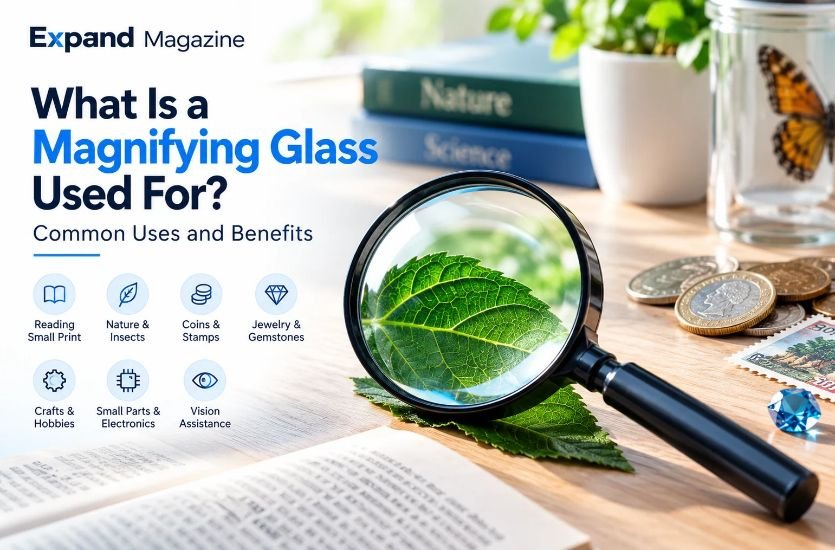
A magnifying glass is a simple optical tool that makes small objects, printed text, and fine details appear larger and easier to see. It is commonly used for reading small print, examining plants and insects, inspecting jewelry, collecting coins and stamps, completing crafts, and working with small mechanical or electronic components. Its versatility makes it useful at home, in schools, in laboratories, and in professional workplaces.
The main purpose of a magnifying glass is to help people observe details that may be difficult to see clearly with the naked eye. By using a curved lens to enlarge the appearance of nearby objects, it provides a convenient way to examine small features without requiring a complex instrument. According to educational optics resources, a traditional magnifying glass uses a convex lens to produce an enlarged image when an object is positioned within the lens’s focal length.
Quick Answer: Magnifying Glass Uses at a Glance
| Feature | Details |
|---|---|
| Main purpose | Makes small objects and details appear larger |
| Lens type | Usually a convex lens |
| Reading | Helps examine small print, labels, and instructions |
| Science | Supports the observation of plants, insects, and specimens |
| Hobbies | Useful for coins, stamps, jewelry, crafts, and model making |
| Professional work | Helps inspect small components and surface details |
| Vision assistance | Can support certain close-up tasks for people with low vision |
| Important precaution | Never look directly at the Sun through a magnifying glass |
What Is a Magnifying Glass?
A magnifying glass is an optical instrument designed to enlarge the appearance of small objects. It usually consists of a convex lens fitted into a frame, often with a handle that makes it easy to hold and position. Some models also include built-in lighting, adjustable stands, or multiple lenses for more detailed viewing.
The lens is thicker in the middle than at the edges, allowing it to bend light as it passes through. This optical property helps the viewer see an enlarged image of an object when the lens and object are positioned correctly. Magnifying glasses are available in different sizes and magnification strengths, making them suitable for a variety of everyday and specialized tasks.
Unlike a microscope, which is designed for much greater magnification and detailed examination of tiny specimens, a basic magnifying glass is convenient for quick, close-up observation. Its simple design makes it accessible to students, hobbyists, professionals, and people who need help reading small text.
How Does a Magnifying Glass Work?
A magnifying glass works through the process of refraction, which occurs when light changes direction as it passes through a lens. The curved surface of a convex lens bends incoming light rays and changes how the object appears to the viewer.
When an object is placed closer to the lens than its focal length, the magnifying glass produces an enlarged, upright virtual image. This image appears larger than the object viewed without the lens, making small features easier to distinguish.
The amount of magnification depends on the lens’s optical properties and how the user positions the object and the magnifying glass. Stronger magnification can help reveal finer details, but it may also reduce the visible area and require more careful positioning.
Lighting is another important factor. Good illumination helps reveal surface details and improves visibility, particularly when examining printed material, small components, or objects with subtle patterns.
Common Uses of a Magnifying Glass in Everyday Life
1. Reading Small Print
One of the most familiar uses of a magnifying glass is reading text that is too small to see comfortably. Product packaging, medicine labels, instruction manuals, maps, receipts, and newspaper print can contain details that are difficult to read without assistance.
A magnifying glass enlarges the letters, making them easier to distinguish. Models with built-in lights can be particularly useful when reading in dim environments. The best choice depends on the size of the text, the available lighting, and the user’s preferred viewing distance.
2. Examining Coins and Stamps
Coin and stamp collectors use magnifying glasses to examine small details that can help them understand the condition and characteristics of their collections. Coins may contain tiny inscriptions, dates, mint marks, decorative patterns, and signs of wear.
Stamp collectors can inspect printing details, perforations, paper texture, and possible damage. Magnification allows collectors to examine these features more closely than ordinary eyesight may permit.
Although a magnifying glass can assist with identification and condition assessment, it does not independently establish the authenticity or monetary value of a collectible.
3. Inspecting Jewelry and Gemstones
Jewelry professionals and enthusiasts use magnifying glasses to examine gemstones, metalwork, settings, and small markings. Close inspection can reveal surface scratches, tiny inclusions, worn areas, or details in a piece’s construction.
A jeweler may use a specialized magnifier, such as a jeweler’s loupe, to examine a diamond or another gemstone. These instruments are designed for close inspection and may provide greater magnification than an ordinary handheld glass.
However, visual inspection alone cannot always determine a gemstone’s identity, quality, or authenticity. Professional testing may be necessary for a reliable assessment.
4. Observing Plants and Insects
A magnifying glass can make outdoor exploration more interesting by helping people examine the small features of living things. Students and nature enthusiasts can use it to observe leaf veins, flower structures, seeds, insect legs, wings, and other visible characteristics.
Gardeners may also use magnification to examine plant surfaces for signs of damage or tiny insects. These close observations can help them notice details that are difficult to recognize from a normal viewing distance.
A magnifying glass is particularly useful for introductory nature study because it is portable and easy to operate. However, it does not provide the same level of detail as a microscope, and living organisms should be handled carefully during observation.
Uses of a Magnifying Glass in Science and Education
Supporting Classroom Learning
Teachers use magnifying glasses to introduce students to observation, light, lenses, and basic optical principles. Students can examine everyday materials, compare surface textures, and investigate how small objects look when viewed through a lens.
These activities encourage curiosity and help learners understand that careful observation is an important part of scientific investigation. A magnifying glass also provides a practical way to demonstrate how a convex lens changes the appearance of an object.
Conducting Simple Scientific Observations
In science activities, magnifying glasses help users inspect small specimens, including seeds, rocks, minerals, leaves, and fibers. They can be useful when the purpose is to observe surface characteristics rather than examine microscopic structures.
Researchers and students may use magnifiers during preliminary inspections before selecting more advanced equipment. The tool is most effective when the specimen is well illuminated and positioned at a suitable distance from the lens.
Uses in Electronics, Repair, and Manufacturing
Examining Small Electronic Components
Electronic repair technicians may use magnifying glasses to inspect circuit boards, solder joints, connectors, and small component markings. Enlarging these areas can help reveal visible defects or make identification labels easier to read.
For detailed repair work, a hands-free magnifier or a magnifying lamp may be more practical than a handheld model because the technician needs both hands available. More advanced inspection may require a microscope or specialized optical equipment.
Inspecting Watches and Mechanical Parts
Watchmakers and repair professionals work with components that can be difficult to examine without magnification. Small screws, gears, springs, and connecting parts may require careful visual inspection during maintenance or assembly.
A magnifying glass helps make these components easier to see, allowing the worker to examine their placement and visible condition. Similar benefits apply to miniature machinery, precision crafts, and other work involving small mechanical parts.
Checking Materials and Surface Defects
Magnifiers can also assist with basic quality inspection. Workers may use them to examine scratches, cracks, fibers, printing errors, and surface imperfections in manufactured products.
The usefulness of a magnifier depends on the size and type of defect being investigated. Very small defects may require specialized measurement instruments or microscopes rather than an ordinary magnifying glass.
Magnifying Glass Uses in Arts, Crafts, and Hobbies
Sewing and Needlework
People who sew, embroider, knit, or perform other detailed textile work may use magnifying glasses to examine fine threads, fabric patterns, and small stitches. Magnification can also make threading a needle easier for some users.
A stand-mounted or wearable magnifier can be helpful when a task requires both hands. Proper lighting and a comfortable working position are equally important during extended craft sessions.
Model Making and Miniature Painting
Model makers often work with tiny parts, delicate patterns, and small painted surfaces. A magnifying glass helps them inspect details, align components, and identify areas that need additional work.
Miniature painters may use magnification to check fine lines and small decorative features. It can improve visibility during detailed work, although the final result still depends on the user’s technique, lighting, and control.
Examining Artwork and Photographs
A magnifying glass can help viewers examine brushwork, printed patterns, paper texture, and small details in photographs or illustrations. Collectors and conservators may use specialized optical tools to inspect artwork more closely.
However, delicate or valuable items should be handled appropriately. Magnification alone is not enough to determine the age, authenticity, or condition of an artwork.
Can a Magnifying Glass Help People With Low Vision?
Yes. Magnifying devices can help some people with low vision read printed material, view photographs, and complete close-up activities. Handheld magnifiers, illuminated magnifiers, and stand magnifiers are available in different designs to suit different tasks.
The most appropriate option depends on a person’s vision, working distance, lighting needs, and intended activity. A magnifier may improve access to certain details, but it does not correct every vision problem or replace a comprehensive eye examination.
People who regularly struggle to read or see nearby objects may benefit from advice from an eye-care professional or low-vision specialist. Specialized guidance can help them choose an appropriate device and learn how to use it effectively.
Different Types of Magnifying Glasses
Magnifying glasses come in several designs, each suited to particular needs.
Handheld magnifying glass: A portable option for reading, examining collectibles, and performing quick inspections.
Illuminated magnifier: Includes a light source to improve visibility when examining small details or working in dim conditions.
Stand magnifier: Rests on a surface or support, making it useful for reading, crafts, and activities that require a stable viewing position.
Jeweler’s loupe: A compact magnifier commonly used to examine gemstones, jewelry, and small markings.
Hands-free magnifier: May be worn around the neck, attached to a headband, or positioned on a stand to support detailed work while leaving both hands free.
Choosing the right type requires considering the intended task, lens quality, magnification strength, lighting, and comfort. Higher magnification is not automatically better for every situation.
Benefits and Limitations of a Magnifying Glass
A magnifying glass is useful because it is simple, portable, and generally easy to operate. It can make small details more visible without requiring electricity in a traditional non-illuminated model. Its versatility allows it to support reading, education, hobbies, and professional inspection.
However, a magnifying glass also has limitations. It provides a restricted viewing area, and stronger magnification can make it more difficult to keep an object in focus. Ordinary models cannot reveal every microscopic feature or replace specialized instruments.
The lens’s quality and cleanliness also affect the viewing experience. Scratches, distortion, poor lighting, and unsuitable positioning can reduce clarity. Selecting a magnifier that matches the task is usually more useful than choosing the highest magnification available.
Safety Precautions When Using a Magnifying Glass
A magnifying glass should be handled carefully, especially outdoors. A convex lens can concentrate sunlight into a small, intense spot that may cause burns or ignite combustible materials. Never look directly at the Sun through a magnifying glass, as this can cause severe eye injury.
Keep the lens away from dry leaves, paper, fabric, and other flammable materials when sunlight is present. Store the magnifier safely when it is not in use, and supervise children during activities involving lenses and direct sunlight.
For ordinary inspection tasks, use adequate lighting and avoid touching delicate objects unnecessarily. When examining electronic equipment, jewelry, or mechanical components, follow the appropriate safety procedures for that task.
Frequently Asked Questions
What is the main purpose of a magnifying glass?
The main purpose of a magnifying glass is to make small objects, text, and details appear larger so they are easier to see and examine.
What type of lens is used in a magnifying glass?
A traditional magnifying glass uses a convex lens, which bends light and produces an enlarged virtual image when an object is positioned within its focal length.
What is a magnifying glass used for in science?
In science, it is used to observe small specimens, examine surface features, study plants and insects, and demonstrate basic principles of light and optics.
Can a magnifying glass be used to read small letters?
Yes. It can enlarge small letters on labels, packaging, maps, books, and instruction manuals, making them easier to distinguish.
Is a magnifying glass the same as a microscope?
No. A basic magnifying glass is generally used for quick close-up observation, while a microscope provides greater magnification and is designed to reveal much smaller structures.
Can a magnifying glass start a fire?
Yes. A convex lens can concentrate sunlight into a small area and potentially ignite combustible material. It should never be left where focused sunlight could create a fire hazard.
Conclusion
A magnifying glass is a practical optical instrument used to make small objects and fine details easier to see. Its applications range from reading small print and examining collectibles to observing nature, supporting education, completing crafts, and inspecting electronic or mechanical components.
Its usefulness comes from a straightforward optical principle: a convex lens can produce an enlarged image when an object is positioned appropriately. Although it cannot replace a microscope or specialized inspection equipment, a suitable magnifying glass remains a convenient tool for many everyday and professional activities.
Understanding what a magnifying glass is used for helps people choose the right type for their needs and use it effectively. With appropriate lighting, careful positioning, and basic safety precautions, this simple tool can make close-up observation easier and more accessible.
If You Want More Informative Articles With Different Categories, Visit Expand Magazine.