








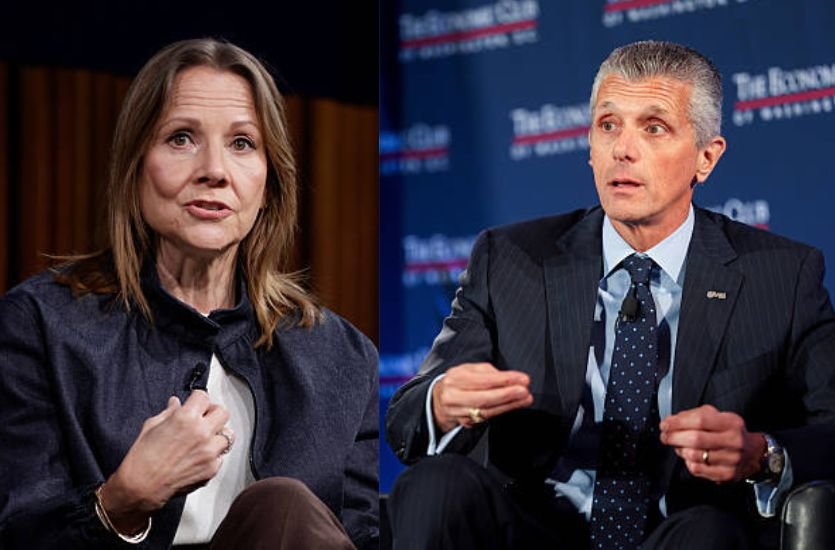
Mary Barra and David Cordani are two prominent American business executives whose careers have developed in very different industries. Barra has spent her professional life at General Motors, rising from an engineering and manufacturing role to become Chair and Chief Executive Officer of one of the world’s best-known automotive companies. Cordani built his career in the healthcare industry and spent more than three decades with Cigna, eventually becoming its President and Chief Executive Officer before transitioning to the role of Executive Chair in 2026.
Although there is no established business partnership or major joint venture connecting Mary Barra and David Cordani, their careers provide an interesting comparison of corporate leadership. Barra’s professional background is strongly connected to engineering, manufacturing, automotive technology and organizational transformation, while Cordani’s career has focused on healthcare services, customer relationships, business operations and the changing healthcare landscape.
Their stories also demonstrate two different approaches to reaching the highest levels of corporate leadership. Barra progressed through numerous technical and operational positions inside General Motors, while Cordani moved through several leadership roles at Cigna before becoming its chief executive. Their experiences offer insight into how long-term careers, industry knowledge and executive responsibility can shape the leadership of major corporations.
Read Bouncemediagroup.com Social Stats: Reach & Growth
Quick Bio of Mary Barra and David Cordani
| Detail | Mary Barra | David Cordani |
|---|---|---|
| Full Name | Mary Teresa Barra | David M. Cordani |
| Known For | General Motors leadership | Cigna leadership |
| Current Role | Chair and CEO, General Motors | Executive Chair, The Cigna Group |
| CEO Role | General Motors CEO since 2014 | Cigna CEO from 2009 to July 1, 2026 |
| Industry | Automotive | Healthcare Services |
| Education | Electrical Engineering, MBA | Accounting, MBA |
| Undergraduate Education | General Motors Institute/Kettering University | Texas A&M University |
| Graduate Education | Stanford Graduate School of Business | University of Hartford |
| Major Career Focus | Automotive technology, manufacturing, product development and corporate strategy | Healthcare services, operations, customer engagement and business transformation |
Mary Barra’s Early Career and Rise at General Motors
Mary Barra’s career at General Motors is notable because she did not enter the company as an outside executive and later become its leader. Instead, she spent decades moving through different areas of the organization. She began working at General Motors as a co-op student in 1980, giving her an unusually long connection with the company before becoming CEO.
Her educational background also helped establish the technical foundation of her career. Barra studied electrical engineering at General Motors Institute, now known as Kettering University, before earning an MBA from Stanford Graduate School of Business. Her combination of engineering education and business training became an important part of her professional development.
Before becoming CEO, Barra held several significant positions across GM. Her responsibilities included engineering, manufacturing, human resources, purchasing, supply chain and global product development. This broad experience gave her exposure to both the technical and managerial sides of the automotive business.
General Motors appointed Barra CEO in 2014, making her the first woman to lead one of the major American automobile manufacturers. She later became Chair of the GM Board of Directors in 2016. GM continues to identify her as both Chair and CEO.
Her appointment came at a difficult moment for General Motors. Early in her tenure, the company faced a major ignition-switch recall crisis involving millions of vehicles. The episode became an important part of the early story of Barra’s leadership and contributed to discussions about corporate safety, accountability and organizational culture.
In subsequent years, Barra’s leadership at GM became increasingly associated with technological change. GM has highlighted areas including vehicle electrification, software and autonomous-driving technology as important elements of its long-term strategy.
David Cordani’s Career at Cigna
David Cordani followed a different professional route. Rather than working in the automotive industry, he developed his career in healthcare services and spent most of his professional life at Cigna.
Cordani joined Cigna in 1991 and gradually moved through increasingly senior positions. His career included responsibilities connected with customer segments, marketing, Cigna Healthcare, operations and executive management. This progression eventually led to his appointment as President and Chief Executive Officer in 2009.
His educational background included a bachelor’s degree from Texas A&M University and an MBA from the University of Hartford. His experience combined business management with extensive exposure to the healthcare services sector.
Cordani became one of the central figures in Cigna’s transformation over a period when healthcare companies were increasingly expanding beyond traditional insurance models. His tenure involved changes in the company’s operations, services and broader business structure.
One of the most significant developments associated with Cigna during his leadership was the company’s acquisition of Express Scripts. The transaction helped create the foundation for Evernorth, Cigna’s health services business. The change reflected a broader shift toward combining insurance, pharmacy services and other healthcare capabilities within larger business platforms.
Cordani’s long tenure also coincided with significant changes in healthcare technology, data analytics, consumer expectations and healthcare delivery. These developments required large healthcare companies to consider not only insurance products but also services designed around broader healthcare needs.
David Cordani’s Transition From CEO to Executive Chair
A major point to understand when discussing David Cordani in 2026 is that his position changed during the year.
The Cigna Group announced in March 2026 that Cordani would retire as Chief Executive Officer effective July 1, 2026. Brian Evanko, who had been President and Chief Operating Officer, was selected to succeed him as CEO. Cordani was scheduled to continue his involvement with the company as Executive Chair of The Cigna Group’s Board of Directors.
This distinction is important for current articles because older biographies can still describe Cordani as Cigna’s CEO. For an article published in the second half of 2026, it is more accurate to identify him as the former CEO and current Executive Chair.
Cordani’s transition also represents a change in the type of responsibility he holds. A chief executive is primarily responsible for the company’s executive management and day-to-day strategic direction, while an executive chair can remain deeply involved in governance, strategic oversight and the board’s work.
His move to Executive Chair therefore does not represent an end to his relationship with The Cigna Group. Instead, it marks a transition from operational executive leadership to a board-level leadership role.
Mary Barra’s Leadership at General Motors
Barra’s leadership has taken place during a period of significant transformation in the automotive industry. Traditional automakers have faced changes involving electric vehicles, software, autonomous driving, connected vehicles, supply chains and changing consumer expectations.
GM’s own description of Barra’s strategy emphasizes electrification, software and autonomous-driving technologies. These areas require large investments and involve long-term changes to how vehicles are designed, manufactured, sold and maintained.
Barra’s engineering background is particularly relevant in this environment. Unlike an executive whose career was primarily built outside the automotive sector, she entered GM through a technical route and gained experience across multiple operational functions.
Her career also illustrates the importance of internal corporate experience. By the time she became CEO, Barra had worked in several different parts of GM, allowing her to develop knowledge of manufacturing, product development, purchasing, supply chains and personnel management.
More recently, Barra has continued to discuss long-term thinking and organizational problem-solving. In 2026, she described lessons she received from investor Warren Buffett, including the importance of focusing on the long-term development of a company rather than managing solely around quarterly results.
David Cordani’s Leadership in Healthcare
Cordani’s leadership environment was fundamentally different. Healthcare is highly regulated, complex and closely connected to employers, patients, providers, insurers, pharmacies and government programs.
During Cordani’s time as CEO, Cigna developed beyond the traditional image of an insurance company. The company’s combination of healthcare and health-services businesses created a broader corporate structure, with Evernorth becoming an important part of its business model.
Fortune reported in 2026 that Cigna’s annual revenue had grown dramatically during Cordani’s 17 years as CEO, with the company moving from approximately $18 billion in annual revenue to hundreds of billions. The publication also highlighted the Express Scripts transaction as an important part of the company’s transformation.
Cordani’s career therefore provides an example of leadership during structural change in an industry where companies increasingly compete through services, data, pharmacy capabilities, healthcare delivery and customer engagement rather than through a single traditional product.
Education and Professional Background
The educational backgrounds of Mary Barra and David Cordani reveal another interesting difference.
Barra studied electrical engineering before completing an MBA. Her education combined technical knowledge with business management. This background aligns closely with her long career in automotive engineering, manufacturing and product development.
Cordani studied accounting at Texas A&M University and later completed an MBA at the University of Hartford. His professional development took place largely within the healthcare and corporate-management environment.
Neither career can be explained by education alone. Their progression demonstrates the importance of experience, organizational knowledge and leadership responsibilities accumulated over many years.
Barra’s path was heavily connected to General Motors from the beginning, while Cordani’s path was similarly connected to Cigna. Both therefore developed deep institutional knowledge before reaching the top of their respective organizations.
Mary Barra and David Cordani: Similarities
Despite working in different industries, Mary Barra and David Cordani share several characteristics in their professional histories.
One similarity is the length of their relationships with their respective companies. Barra joined GM in 1980, while Cordani joined Cigna in 1991. Both spent decades within the same corporate environments before reaching the highest executive positions.
Another similarity is that both held multiple leadership roles before becoming CEO. Barra worked across engineering, manufacturing, human resources, purchasing, supply chain and product development. Cordani held positions involving customer segments, marketing, healthcare operations and executive management.
Both careers also involved major corporate transformations. Barra’s tenure has included GM’s efforts to respond to electrification, software and advanced automotive technologies. Cordani’s tenure involved Cigna’s expansion into a broader health-services platform.
A further similarity is their continued connection with corporate governance after periods of executive leadership. Barra remains Chair and CEO of GM, while Cordani moved into the Executive Chair position at The Cigna Group after leaving the CEO role in 2026.
Mary Barra and David Cordani: Key Differences
The most obvious difference between Mary Barra and David Cordani is the industries they lead.
Barra operates in the automotive sector, where manufacturing, engineering, vehicle technology, consumer demand and supply chains are central concerns. Her company produces physical products that require extensive global manufacturing and distribution networks.
Cordani’s career has been centered on healthcare services. The challenges in his industry include healthcare costs, insurance, pharmacy services, data, customer relationships and complex regulatory requirements.
Their educational backgrounds also differ. Barra began with electrical engineering, while Cordani studied accounting. These different academic foundations were followed by business education through MBA programs.
Their current roles are also different in 2026. Barra continues to serve as General Motors’ Chair and CEO. Cordani, meanwhile, transitioned from CEO to Executive Chair of The Cigna Group on July 1, 2026.
The Importance of Long-Term Corporate Careers
The careers of Mary Barra and David Cordani demonstrate how senior corporate leadership can develop through long-term experience.
Neither executive reached the top of their organization immediately. Both spent many years learning different aspects of their companies and industries.
For Barra, that experience included technical and manufacturing functions before she eventually became responsible for the entire company. For Cordani, the progression included customer, healthcare and operational responsibilities before he assumed the CEO role.
This type of career development can provide executives with knowledge that extends beyond one department. It can also help leaders understand how different parts of a large corporation interact.
At the same time, the careers of Barra and Cordani show that there is no single professional route to senior leadership. Their educational backgrounds, industries and specific responsibilities were different, yet both ultimately reached the highest levels of their respective organizations.
What Their Careers Say About Modern Business Leadership
Mary Barra and David Cordani represent two different examples of leadership during periods of significant corporate change.
Barra’s career reflects the continuing evolution of the automotive industry. General Motors operates in a market where established manufacturing expertise increasingly intersects with software, electrification and advanced technologies.
Cordani’s career reflects changes within healthcare. Cigna’s development into a broader health-services organization demonstrates how traditional insurance businesses have expanded into additional areas of healthcare.
Both stories also demonstrate the value of understanding an industry over a long period. Barra’s decades at GM gave her experience across technical and managerial functions, while Cordani’s long career at Cigna gave him extensive exposure to healthcare operations and corporate strategy.
Their 2026 positions also provide an interesting final contrast. Barra remains directly responsible for GM as Chair and CEO, while Cordani has moved into a board leadership role following a planned CEO succession.
Mary Barra and David Cordani in 2026
As of 2026, Mary Barra remains Chair and Chief Executive Officer of General Motors. She has held the CEO position since 2014 and became Chair in 2016. Her continued leadership places her at the center of GM’s ongoing response to technological and structural changes in the automotive industry.
David Cordani’s role changed in July 2026. After serving as Cigna’s CEO since 2009, he became Executive Chair of The Cigna Group’s Board, while Brian Evanko assumed the CEO position.
These developments make 2026 an important point of comparison between the two executives. Barra continues in an active CEO role at GM, while Cordani has moved from operational leadership to an executive chair position at Cigna.
Conclusion
Mary Barra and David Cordani have built distinct leadership careers in two major industries. Barra’s journey from a General Motors co-op student to Chair and CEO illustrates a long internal career shaped by engineering, manufacturing, product development and corporate management. Cordani’s path from joining Cigna in 1991 to becoming CEO in 2009 and later Executive Chair in 2026 reflects a similarly long career in healthcare services and corporate leadership.
Their professional stories are different, but both demonstrate the role that extensive industry experience can play in reaching senior corporate positions. Barra’s work has been closely associated with the changing automotive landscape, while Cordani’s career has followed the transformation of healthcare services and Cigna’s business structure.
For anyone researching Mary Barra and David Cordani, the most useful point of comparison is not a supposed personal connection between them, but the way two executives from different industries developed long careers, assumed responsibility for major corporations and navigated periods of substantial business change.
Visit: Expand Magazine