







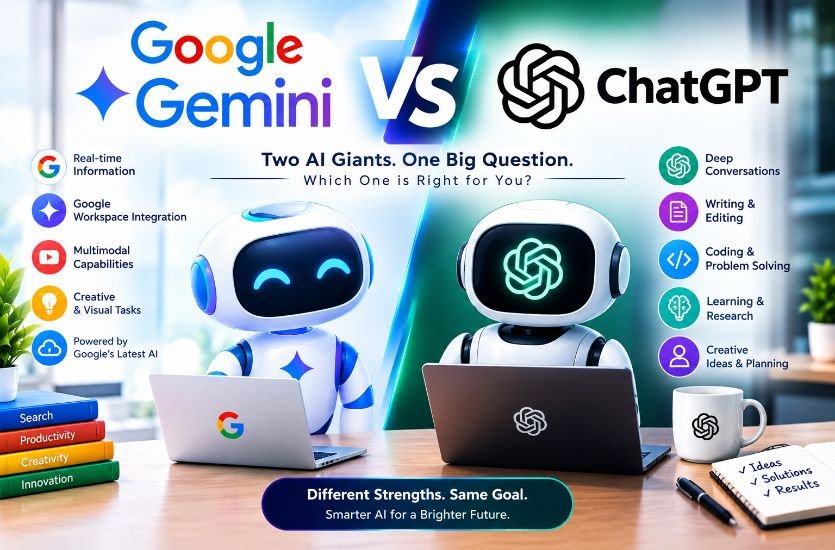
Artificial intelligence has moved far beyond simple question answering. In 2026, AI assistants can help users research complicated topics, analyze documents and spreadsheets, write business content, create presentations, support programming, organize information, and complete multi-step workflows. As these tools become more capable, the Google Gemini vs ChatGPT comparison has become increasingly important for students, professionals, creators, developers, and businesses.
Google Gemini and ChatGPT are both advanced AI platforms, but they are built around somewhat different ecosystems and workflows. Gemini is closely connected with Google’s products and services, while ChatGPT has developed into a broad AI workspace with research, coding, connected applications, agents, and other tools. Google introduced Gemini 3.5 in 2026 as an agent-focused model family designed for complex tasks and action, while OpenAI introduced GPT-5.6 as a newer generation focused on advanced AI work.
The Google Gemini vs ChatGPT decision therefore cannot be reduced to asking which chatbot is smarter. The more useful question is which platform fits a person’s existing tools, preferred workflow, type of work, and expectations from an AI assistant.
Read Domikyo.com: Technology, Smart Home & IoT Guide
Quick Comparison: Google Gemini vs ChatGPT
| Feature | Google Gemini | ChatGPT |
|---|---|---|
| Developer | OpenAI | |
| Main ecosystem | Google products and services | OpenAI products and connected apps |
| General use | Research, writing, productivity and multimodal tasks | Research, writing, coding, analysis and workflows |
| Business use | Strong Google-centered workflows | Broad team and cross-platform workflows |
| Research | Advanced research and search capabilities | Deep research and multi-step research |
| Coding | Strong coding and developer capabilities | Strong coding and Codex workflows |
| Productivity | Closely connected with Google’s ecosystem | Connected apps, Work and agentic workflows |
| Multimodal work | Text, images, audio, video and other media | Text, images, voice and other multimodal workflows |
| Agents | Increasingly agentic Gemini capabilities | ChatGPT agents and Workspace Agents |
| Best fit | Users heavily invested in Google services | Users wanting a broad AI workspace |
What Is Google Gemini?
Google Gemini is Google’s family of artificial intelligence models and its consumer and business AI ecosystem. It is designed to handle tasks involving text, images, code, documents, research, and other forms of information.
One of Gemini’s most important characteristics is its connection with Google’s wider ecosystem. Google has continued expanding Gemini into Search and other products, while also developing more agentic capabilities that allow the AI to move beyond simply generating responses. In 2026, Google announced Gemini features designed specifically for businesses, including connections with Google Business Profile and Business notebooks that can organize business information and provide more contextual assistance.
This ecosystem approach can be particularly useful for people who already spend much of their working day inside Google’s products. Instead of moving information between several separate applications, users can increasingly use AI within the same environment.
Gemini has also developed into more than a traditional chatbot. Google’s Gemini 3.5 announcement emphasized agentic workflows, reasoning, speed, richer graphics, and the ability to perform more complex actions.
What Is ChatGPT?
ChatGPT is OpenAI’s AI assistant and broader productivity platform. It can be used for conversations, writing, research, coding, data analysis, document work, brainstorming, and increasingly complex tasks involving connected applications and agents.
The platform has evolved substantially from its original chatbot experience. OpenAI’s current business offering includes ChatGPT, ChatGPT Work, Codex, company knowledge, applications, agents, and deep research capabilities, depending on the user’s plan and workspace configuration.
OpenAI has also introduced GPT-5.6 as a newer model generation, describing it as a model designed to scale advanced AI capabilities across different performance and cost levels.
For users who want one AI environment for writing, research, coding, analysis, and more complicated workflows, ChatGPT has developed into a broad platform rather than simply a question-and-answer chatbot.
Google Gemini vs ChatGPT for Everyday Use
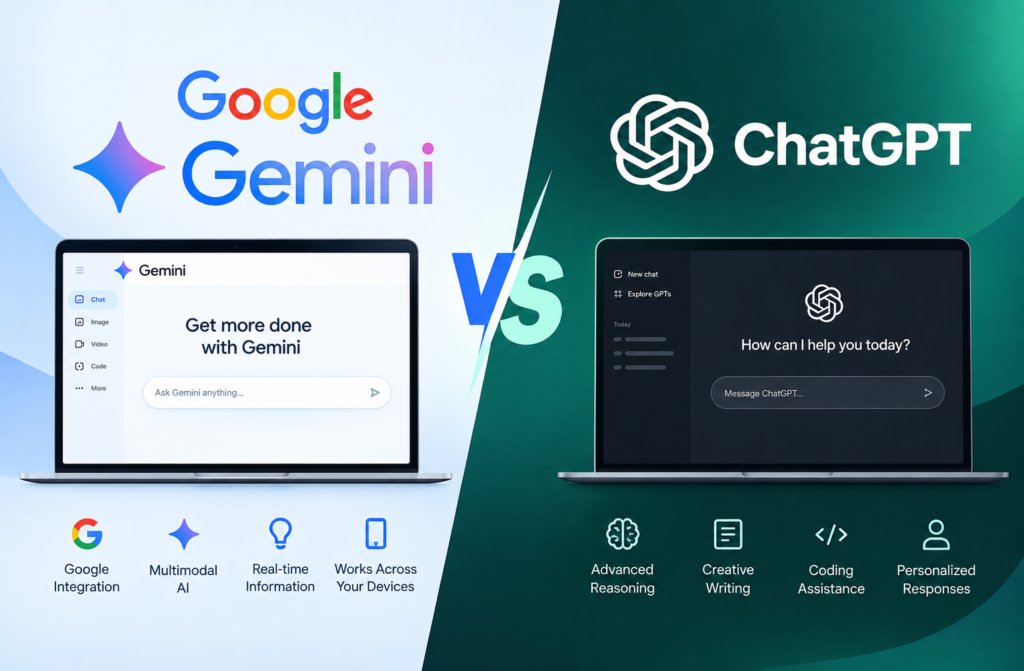
For everyday users, both Gemini and ChatGPT can handle many of the same basic tasks. A person can ask either assistant to explain a difficult concept, rewrite a paragraph, summarize information, brainstorm ideas, create an outline, or help solve a problem.
The differences become more noticeable when the user starts connecting AI with other parts of their digital life.
Gemini can be especially convenient for people who already use Google’s ecosystem extensively. Someone working with Google services may find it natural to combine AI assistance with information stored in Google’s products.
ChatGPT, meanwhile, is designed around a broader AI workspace. It can support research, coding, file analysis, connected applications, and longer projects. OpenAI’s ChatGPT Work is specifically designed for longer and more involved tasks, including research, analysis, connected apps and files, and the creation of documents, spreadsheets, presentations, reports, and Sites.
Google Gemini vs ChatGPT for Writing
Writing is one of the most common reasons people use AI assistants. Both Gemini and ChatGPT can help with emails, articles, reports, social media content, product descriptions, business documents, and creative writing.
Gemini can be particularly convenient when the user’s writing process is already based around Google’s ecosystem. For example, someone who regularly works with Google Docs and other Google services may prefer having AI assistance integrated into that environment.
ChatGPT is also highly capable for writing and editing. It can help users brainstorm topics, develop outlines, rewrite passages, change tone, improve clarity, and create long-form content.
The difference is often less about basic writing quality and more about workflow. If a writer’s entire process revolves around Google tools, Gemini can provide a connected experience. If the writer wants to combine writing with research, file analysis, coding, or custom workflows, ChatGPT can provide a broader environment.
Google Gemini vs ChatGPT for Research
Research has become one of the most important areas in the Google Gemini vs ChatGPT comparison.
Modern AI research tools can go beyond answering questions from existing model knowledge. They can search for information, examine multiple sources, organize findings, and produce structured research results.
Gemini benefits from Google’s search ecosystem and its broader information infrastructure. Google’s AI developments have increasingly connected advanced models with Search, allowing users to ask more complicated questions and receive AI-supported research experiences.
ChatGPT also has dedicated deep research capabilities designed for multi-step investigations. Users can use research tools to investigate subjects, analyze sources, and produce structured results.
For a researcher, the important issue is not simply which assistant can search the internet. Source quality, citations, freshness, research depth, and the ability to verify original information all matter.
For important financial, legal, scientific, medical, or business decisions, AI-generated research should still be checked against reliable original sources.
Google Gemini vs ChatGPT for Coding
Coding is another major area where the two platforms compete.
Gemini’s newer models are designed to handle complex reasoning and programming tasks, while Google’s wider AI developer ecosystem provides tools for people building applications with Gemini.
ChatGPT has also made coding a central part of its platform. OpenAI’s ChatGPT Business offering includes access to Codex, alongside ChatGPT Work and other business features. Standard and Premium Business seats both currently include ChatGPT, ChatGPT Work, and Codex, with Premium providing higher usage capacity.
Developers can use AI assistants for generating code, explaining unfamiliar code, debugging problems, creating tests, reviewing changes, and developing prototypes.
However, coding ability should be judged through real projects rather than general claims. A developer working primarily with Google’s ecosystem may have different requirements from someone working with repositories, multiple applications, and an AI coding workflow.
Google Gemini vs ChatGPT for Business
The business comparison is particularly interesting because both Google and OpenAI are expanding their AI platforms beyond basic chat.
Google has introduced business-oriented Gemini features that connect AI with business context. Its Business notebooks can organize chats and sources alongside a website and Google Business Profile, allowing Gemini to work with more information about a business.
ChatGPT Business provides a shared workspace for organizations, centralized billing, administrative controls, ChatGPT, ChatGPT Work, Codex, company knowledge, applications, and other capabilities depending on the workspace configuration.
OpenAI has also expanded business workflows through Workspace Agents. These agents can be created for repeatable tasks, shared within a workspace, used with connected applications, and scheduled for recurring workflows.
For businesses, the important question is therefore not simply which AI produces better text. Businesses should examine where their data is stored, which applications employees use, how much automation is required, and how much human oversight is necessary.
Google Gemini vs ChatGPT for Google Workspace Users
Google Workspace users have a natural reason to consider Gemini.
Businesses and individuals who spend much of their time working with Google services may benefit from an AI platform that is closely connected with that ecosystem. Gemini’s development has focused heavily on bringing AI into Google’s broader collection of productivity and business products.
This can reduce the need to repeatedly copy information from one application into another. It can also make AI adoption easier for teams that already understand Google’s interface and workflow.
For a company whose employees spend most of their time in Google-based applications, ecosystem integration can be an important consideration.
Google Gemini vs ChatGPT for Cross-Platform Work
ChatGPT can be attractive for users whose work is spread across several different platforms.
Modern businesses rarely keep every piece of information in one application. A company may use one service for email, another for communication, another for project management, another for code, and several cloud storage systems.
ChatGPT Business is designed to work with connected applications and company knowledge, allowing organizations to build workflows around information from supported sources. OpenAI’s current Business offering also includes ChatGPT Work and Codex.
This makes the Google Gemini vs ChatGPT comparison increasingly about interoperability. The ideal AI assistant is often the one that can work most naturally with the software a person or company already uses.
Google Gemini vs ChatGPT for Multimodal AI
AI is no longer limited to text. Modern assistants can work with images, documents, audio, code, screenshots, charts, and other forms of information.
Gemini has been developed as a multimodal AI system and Google’s newer Gemini developments continue expanding its ability to understand different forms of information and perform more complex actions.
ChatGPT also supports multimodal interactions, including images, voice, documents, and other types of input depending on the user’s plan and available features.
For users, multimodal capability means that an AI assistant can become useful for tasks such as explaining a chart, reviewing a document, analyzing an image, discussing an idea through voice, or working with information contained in several formats.
Google Gemini vs ChatGPT for AI Agents
AI agents are becoming one of the biggest developments in artificial intelligence.
A traditional chatbot waits for a question and provides an answer. An agent can potentially plan a task, use tools, interact with connected information, and complete several steps before returning the result.
Google has been moving Gemini toward more agentic capabilities. Google described Gemini 3.5 as a model family built around frontier intelligence with action and complex agentic workflows.
OpenAI has also expanded ChatGPT toward agentic work. ChatGPT Work can conduct longer tasks and work with connected applications and files, while Workspace Agents are designed for repeatable business workflows.
This means the future Google Gemini vs ChatGPT comparison will increasingly involve actions and workflows rather than simple text responses.
Google Gemini vs ChatGPT for Small Businesses
Small businesses need to consider cost, simplicity, integration, and productivity.
A company already using Google’s ecosystem may find Gemini attractive because its AI capabilities can fit naturally into an existing workflow. Google’s 2026 business-focused Gemini features also show a continued effort to give small-business owners more contextual AI assistance.
ChatGPT Business is designed specifically for team environments and currently offers Standard and Premium seats. Standard seats cost $20 per user per month with annual billing or $25 with monthly billing, while Premium seats cost $100 annually billed monthly or $125 when billed monthly. A Business workspace requires at least two paid seats.
Prices and features can change, so businesses should verify current pricing before purchasing.
Google Gemini vs ChatGPT for Students
Students can use both platforms for learning, research, writing assistance, brainstorming, coding, and explanations.
Gemini can be useful for students already working heavily within Google’s ecosystem, while ChatGPT can be useful for interactive explanations, structured learning, writing assistance, coding, and research workflows.
However, students should use AI as a learning tool rather than simply submitting AI-generated work. Asking an AI assistant to explain a concept, provide practice questions, identify mistakes, or guide problem-solving can encourage deeper understanding.
Google Gemini vs ChatGPT for Content Creation
Content creators can use both platforms for brainstorming, research, scripts, articles, social media content, product descriptions, and editing.
Gemini can be useful for creators already using Google’s services, while ChatGPT can support longer content workflows involving research, uploaded material, structured planning, and iterative editing.
Neither platform eliminates the need for human judgment. Content should be reviewed for factual accuracy, originality, tone, audience suitability, and potential repetition before publication.
Google Gemini vs ChatGPT for Productivity
Productivity may ultimately be one of the most important areas of comparison.
An AI assistant becomes more useful when it can help users move from an idea to a finished result. Instead of simply generating a paragraph, modern AI can potentially research a topic, analyze supporting information, prepare a report, organize data, and assist with follow-up tasks.
Google is moving Gemini toward more proactive assistance, including business-focused features and agentic workflows.
OpenAI is taking a similar direction through ChatGPT Work, Workspace Agents, connected applications, and scheduled tasks.
The result is a shift from conversational AI toward workflow-oriented AI.
Privacy and Business Data
Privacy is an important consideration when using AI for business information.
Organizations may provide AI assistants with internal documents, customer information, financial records, marketing plans, technical files, and other sensitive material. Businesses should therefore understand how each platform handles organizational data and what administrators can control.
OpenAI states that ChatGPT Business workspace data is not used to train its models, while Business workspaces also include centralized administration and security controls.
Google also provides business-oriented privacy and security controls through its Workspace ecosystem. Companies should review the latest terms, administrator controls, and data policies before connecting sensitive information.
Google Gemini vs ChatGPT: What Should You Choose?
There is no universal answer to the Google Gemini vs ChatGPT question because different users have different requirements.
Someone deeply invested in Google products may naturally benefit from Gemini’s ecosystem. A person who wants an extensive AI workspace for research, coding, connected applications, agents, and longer projects may find ChatGPT more suitable.
The right choice should be based on actual workflow rather than brand popularity. Users should consider which applications they use every day, where their important information is stored, what types of tasks they want AI to perform, and how much they are willing to spend.
How to Compare Google Gemini vs ChatGPT Yourself
The most practical comparison is to test both platforms using the same real-world tasks.
A writer could give both assistants the same article brief. A developer could provide the same coding problem. A business owner could ask both tools to analyze the same spreadsheet or research the same market. A student could use both platforms to explain the same difficult concept.
The results can then be compared for accuracy, usefulness, speed, clarity, ease of editing, and the amount of human correction required.
This approach is more meaningful than relying only on benchmark scores because an AI model that performs exceptionally well on a benchmark may not necessarily fit a particular person’s daily workflow.
The Future of Google Gemini vs ChatGPT
The competition between Gemini and ChatGPT is likely to become less about individual chatbot answers and more about AI ecosystems.
Google has significant advantages in Search, Workspace, Android, Maps, YouTube, and other widely used services. OpenAI has built a broad AI platform around ChatGPT, models, research, coding, applications, agents, and developer tools.
Both companies are moving toward systems that can perform tasks rather than simply answer questions. Gemini 3.5’s emphasis on agentic workflows and OpenAI’s development of ChatGPT Work and Workspace Agents demonstrate this broader direction.
As AI assistants become more capable, users may spend less time asking isolated questions and more time delegating complete projects.
Final Thoughts on Google Gemini vs ChatGPT
The Google Gemini vs ChatGPT comparison is no longer simply a competition between two AI chatbots. Both platforms are developing into broader AI ecosystems that can support research, writing, coding, analysis, productivity, business workflows, and increasingly autonomous tasks.
Gemini’s close relationship with Google’s ecosystem makes it particularly relevant for people and organizations that already depend heavily on Google products. ChatGPT provides a broad AI environment centered on research, coding, connected applications, company knowledge, agents, and longer multi-step work.
Neither platform is automatically the right choice for every user. The better fit depends on existing software, workflow requirements, budget, data needs, and the specific tasks that AI is expected to perform.
For that reason, the most useful way to evaluate Google Gemini vs ChatGPT is to test both platforms with real tasks. Compare the quality of their results, the amount of time they save, their integration with existing tools, and the level of human review required. As AI continues moving toward agentic workflows, the most valuable assistant will increasingly be the one that fits naturally into the way a person or business actually works.
Visit Expand Magazine for more informative article.