








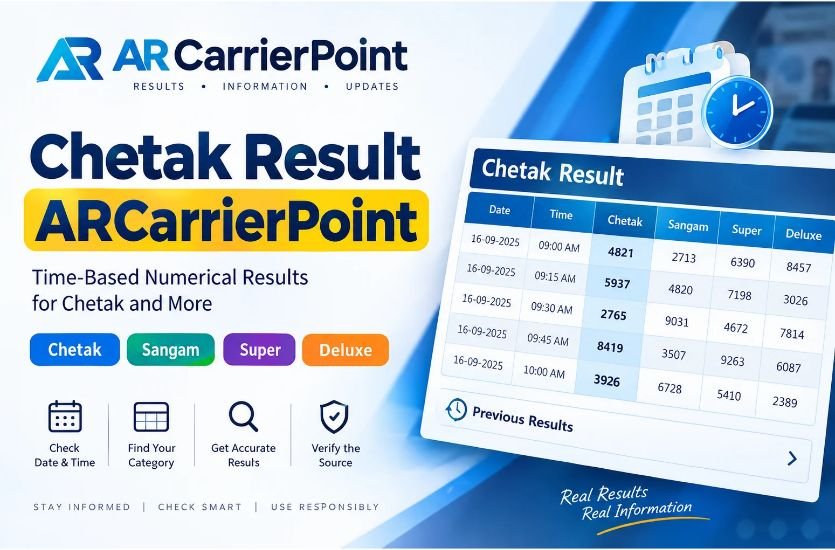
People searching for Chetak Result ARCarrierPoint are generally looking for information about Chetak results published through websites associated with the ARCarrierPoint name. The keyword has attracted attention because online pages using this term display numerical results organized according to specific times and categories.
Understanding this keyword can be confusing because different websites provide different descriptions of Chetak Result. Some articles describe it as an examination-related result, while the actual Chetak result pages reviewed for this topic display time-based numerical tables containing categories such as Chetak, Sangam, Super, and Deluxe.
For that reason, it is important to understand exactly what the result pages contain, how their tables are organized, how previous results are presented, and why readers should distinguish between verified result information and claims made by third-party blogs.
Quick Answer: Chetak Result ARCarrierPoint
| Topic | Information |
|---|---|
| Keyword | Chetak Result ARCarrierPoint |
| Main subject | Chetak numerical result information |
| Result format | Time-based numerical result tables |
| Common categories | Chetak, Sangam, Super, Deluxe |
| Information available | Current and previous result entries |
| Important details | Date, draw time, category, and displayed number |
| Academic examination | The available Chetak tables do not follow a conventional academic-result format |
| How to check | Select the relevant date and time, then check the Chetak column |
| Previous results | Useful as historical records |
| Future prediction | Previous results should not be treated as guaranteed predictions |
| Main source issue | Different websites using similar ARCarrierPoint names may publish different types of information |
| Best approach | Verify the exact page, date, time, category, and source before relying on the information |
What Is Chetak Result ARCarrierPoint?
Chetak Result ARCarrierPoint is a search phrase associated with online Chetak result tables. These pages generally organize numerical results according to particular times and categories. A typical table can contain columns for Sangam, Chetak, Super, and Deluxe.
The term ARCarrierPoint creates some additional confusion because websites using similar names also publish educational content. Some AR Carrier Point websites focus on education news, study materials, examination updates, recruitment information, and other academic topics. However, Chetak result pages use a different format based on numerical entries.
Therefore, the keyword should be understood according to the actual page being discussed rather than assuming that every website containing the ARCarrierPoint name provides the same service.
Understanding the Chetak Result Table
The easiest way to understand a Chetak result page is to look at the structure of its table. Instead of presenting a conventional student marksheet, the page generally organizes information according to draw times.
A row may contain a particular time followed by several numerical values. Each value belongs to a specific category. For example, the Chetak column contains the Chetak entry, while the Sangam, Super, and Deluxe columns contain their respective entries.
This means that readers should always look at the column heading before interpreting a number. A number displayed in the same row as Chetak may actually belong to Sangam, Super, or another category.
The table structure is therefore important for avoiding simple reading mistakes.
What Categories Appear in Chetak Results?
The Chetak result pages commonly use several category names. Chetak is the primary category associated with the keyword, while Sangam, Super, and Deluxe may appear alongside it.
Some result pages can contain additional categories depending on the particular table or website. Because layouts can change, readers should rely on the headings displayed on the specific result page they are examining.
The categories should not be treated as interchangeable. Each column represents a separate entry within the table, so selecting the correct column is essential when checking a particular result.
How to Read Chetak Result ARCarrierPoint
Reading the result table requires attention to four basic pieces of information: the date, time, category, and numerical result.
First, identify the date for which the result is being checked. This is important because a page may contain both current and previous results.
Next, locate the relevant draw time. Chetak result pages can contain multiple time slots throughout a day, meaning that several different entries may be listed for the same date.
After locating the correct time, find the Chetak column. The number displayed where the selected time and Chetak column intersect is the Chetak result shown in that table.
The same method can be used to read other categories, but the relevant column must be selected carefully.
Chetak Result Today
The phrase Chetak Result Today is commonly used by people searching for the latest available result information. However, the word “today” does not by itself establish that a page has been updated at the exact moment a person visits it.
A page may contain an older table, a previous-result section, or information that has not yet been updated. Search engines can also continue showing pages after newer information becomes available.
Therefore, users should examine the date and time shown on the result page instead of relying only on the title or search-result snippet.
Chetak Previous Results
Previous Chetak results are historical records of numbers displayed on earlier dates. They can be useful when someone wants to review past tables or understand how the result page is organized.
Historical results should, however, remain clearly separated from current results. An older result does not become a current result simply because it remains visible on a website.
When comparing previous results, readers should record the date and time alongside the number. This prevents different entries from different days or time slots from being mixed together.
Is Chetak Result ARCarrierPoint an Academic Result?
This is one of the biggest areas of confusion surrounding the keyword.
Some third-party articles describe Chetak Result ARCarrierPoint as an academic examination result and claim that users can check marks, roll numbers, subject performance, or qualification status. However, the Chetak result tables available online do not follow the normal structure of an academic examination result.
A conventional academic result normally includes information such as a candidate’s name, roll number, subjects, marks, grades, total marks, or pass and fail status. The Chetak tables instead display numerical entries according to times and categories.
Therefore, describing the Chetak numerical table as a conventional school, college, university, or board examination result can create confusion.
Readers should distinguish between claims made by individual blogs and the actual format of the result page they are discussing.
Why Is There Confusion Around ARCarrierPoint?
The confusion partly comes from the use of similar names across different websites.
AR Carrier Point is associated with educational information on some domains, including study materials, education news, examination information, recruitment updates, and results. At the same time, Chetak result pages can appear under websites using ARCarrierPoint-related branding.
Because of this overlap, a reader may encounter an article describing ARCarrierPoint as an education platform and then encounter another page showing Chetak numerical results.
The safest approach is to examine the exact domain and page rather than assuming that every website using a similar name has the same purpose or ownership.
Why Do Blogs Describe Chetak Result Differently?
Search-focused websites sometimes publish articles around unusual or highly searched keywords. As a result, several websites can write about the same keyword while interpreting it differently.
One article may describe the term as an educational result, another may describe it as a numerical result, and another may simply reproduce a table.
This does not mean that every explanation is equally supported by evidence. Readers should compare the claims in an article with the actual information displayed on the relevant page.
For Chetak Result ARCarrierPoint, the numerical table format provides a particularly important clue because it differs substantially from the structure of a normal academic scorecard.
Why Date and Time Matter
Date and time are essential when checking any time-based result.
A single day can contain several result entries, meaning that two numbers displayed on different rows may both be legitimate historical entries but correspond to different times.
For example, if a table contains entries for 9:00 AM, 9:15 AM, and 9:30 AM, the Chetak number at 9:00 AM should not be confused with the Chetak number at 9:30 AM.
This is why simply searching for a number is not enough. The number should always be considered together with its date and time.
Can Previous Chetak Results Predict Future Results?
Previous results can be examined as historical information, but they should not be presented as a reliable method for predicting future numbers.
A historical result tells readers what appeared previously. It does not establish that the same number will appear again or that another number is guaranteed to appear next.
Claims about fixed numbers, guaranteed results, sure-shot numbers, or certain future outcomes should therefore be approached cautiously.
Historical frequency may appear interesting when reviewing old tables, but it does not by itself establish a dependable future prediction.
How to Verify Chetak Result Information
The first step in verification is checking the exact page where the result is published. The date and time should then be identified clearly.
Next, the reader should verify the category. If the requested information is the Chetak result, the Chetak column should be checked rather than simply selecting the first number shown on a row.
If two websites display different numbers for the same date and time, the discrepancy should be investigated instead of assuming that one number is correct without further evidence.
Readers should also distinguish between original result information and commentary published by other blogs.
Current Results vs Historical Results
Current and historical results serve different purposes.
A current result is intended to provide information about the latest available entry. A historical result records what appeared at an earlier date or time.
When an article contains both types of information, clear headings and dates are important. Without them, readers may mistake an older result for the latest one.
This is especially relevant for pages that continuously retain previous-result tables beneath newer results.
What Does “Latest Result” Mean?
The term “latest result” normally refers to the most recently available result at the time a page was updated. It does not necessarily mean that every number visible on the page is from the latest draw.
Some pages retain historical tables for reference. Consequently, readers should locate the most recent date and relevant time before treating an entry as the latest information.
The timestamp or update information on a page can also help determine whether the displayed information is current.
Common Mistakes When Checking Chetak Results
One common mistake is reading the wrong column. Since several categories can appear beside each other, a reader may accidentally interpret a Sangam or Super number as the Chetak number.
Another mistake is ignoring the time. Several result entries can be available on one date, so the time is necessary to identify the intended result.
A third mistake is confusing historical results with current results. Previous tables can remain visible even after new information has been added.
Another issue is trusting unsupported claims about future results. A website can publish a prediction, but that does not turn the prediction into verified result information.
Is Every ARCarrierPoint Website the Same?
No assumption should be made that websites with similar ARCarrierPoint or AR Carrier Point names are identical.
Different domains can have different publishers, purposes, content strategies, and levels of reliability. Some may focus on education while others may publish numerical result information.
Readers should therefore check the actual domain, page title, publisher information, and content before deciding that two websites are operated by the same organization.
Chetak Result and Online Search Trends
The keyword Chetak Result ARCarrierPoint demonstrates how online search behavior can create confusion around specialized terms.
When a particular phrase becomes popular, multiple publishers may create pages targeting the same search query. Some pages may reproduce information from other sources, while others may create explanatory content around the phrase.
This can result in a large number of pages discussing the keyword without necessarily providing the same interpretation.
For users, the most useful strategy is to separate factual result-table information from assumptions, predictions, and SEO-oriented descriptions.
Safety and Responsible Information Use
Readers should be careful when interacting with websites or individuals offering result-related services.
A result page should not require users to provide unnecessary sensitive information simply to view publicly available information. Passwords, one-time passwords, banking credentials, card details, and other private information should not be shared with unknown parties.
Where Chetak results are associated with chance-based or money-related activities, readers should also consider the laws and restrictions applicable to their location.
Information about previous results should be treated as historical data rather than a promise of future outcomes.
Why a Clear Result Table Is Important
A clear result table allows readers to identify information quickly without interpreting complicated paragraphs.
A useful table should distinguish the date, draw time, and individual categories. It should also make it obvious whether the displayed data is current or historical.
This structure is particularly important for Chetak results because multiple numerical entries can appear on the same row.
Clear formatting reduces the possibility of readers selecting the wrong number or confusing one category with another.
What Information Should a Chetak Result Article Provide?
An informative article targeting Chetak Result ARCarrierPoint should explain the meaning of the keyword, describe the result-table format, explain the major categories, and show readers how to identify a particular result.
It should also address the confusion surrounding ARCarrierPoint and explain the difference between Chetak numerical tables and conventional academic examination results.
A useful article should distinguish current results from previous results and explain why date and time matter. It should also avoid presenting historical numbers as guaranteed predictions.
This approach gives readers context instead of simply repeating numbers without explanation.
Frequently Asked Questions
What is Chetak Result ARCarrierPoint?
Chetak Result ARCarrierPoint is a search term associated with online Chetak numerical result tables. These tables commonly organize information according to times and categories such as Chetak, Sangam, Super, and Deluxe.
How can I read the Chetak result?
Find the correct date and draw time first. Then locate the Chetak column and read the number displayed in that row.
Is Chetak Result an academic examination?
The Chetak tables reviewed for this topic do not have the usual format of an academic examination result. They display time-based numerical entries rather than student names, roll numbers, subjects, and marks.
What categories are shown in Chetak results?
Common categories include Chetak, Sangam, Super, and Deluxe. Other categories may appear on particular pages or tables.
Are previous Chetak results available?
Many Chetak result pages maintain previous-result tables. These provide historical information about earlier dates and times.
Can previous results predict future numbers?
Previous results should not be treated as guaranteed predictions of future numbers. Historical data describes what happened previously and does not establish a certain future outcome.
Why do different websites provide different information?
Different websites may update at different times, reproduce older information, or interpret the keyword differently. Similar website names also do not necessarily mean that the sites are operated by the same organization.
What should I check before trusting a result?
Check the exact website, date, draw time, category, and displayed number. Also distinguish current results from historical tables and be cautious with claims of guaranteed or fixed future numbers.
What is the difference between Chetak and Sangam results?
They are separate categories within the result table. The number under the Chetak heading should not be confused with the number displayed under Sangam or another category.
Why is the keyword called ARCarrierPoint?
The keyword combines the Chetak Result search term with the ARCarrierPoint name used by websites publishing or discussing this type of information. Because several similarly named websites exist, the exact domain should be checked.
Final Thoughts on Chetak Result ARCarrierPoint
Chetak Result ARCarrierPoint is primarily associated with online Chetak numerical result information presented in time-based tables. The tables can contain categories such as Chetak, Sangam, Super, and Deluxe, making the date, time, and column heading important when checking a particular entry.
The keyword is surrounded by some online confusion because certain third-party articles describe it as an academic examination result, while the actual Chetak tables use a numerical format that differs from conventional educational scorecards.
The most reliable way to understand the keyword is therefore to examine the actual result format, identify the correct date and time, and distinguish current information from historical results.
Previous numbers can be useful for historical reference, but they should not be presented as guaranteed predictions of future results. Likewise, readers should verify the exact website and avoid assuming that every ARCarrierPoint-branded domain represents the same organization.
For anyone researching or writing about Chetak Result ARCarrierPoint, accuracy depends on separating the actual displayed result information from unsupported claims, predictions, and assumptions. This provides readers with a clearer and more useful understanding of what the keyword represents.
Also Read: Magfusehub Com: Exploring a Multi-Category Digital Publishing Platform