








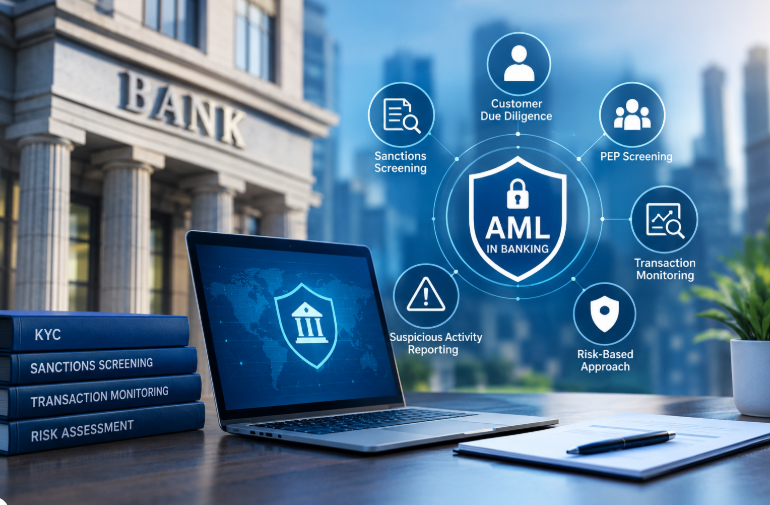
Banks manage large volumes of customers, payments, accounts, and cross-border transactions every day. This creates a wide financial crime exposure that cannot be managed through manual checks alone. AML in banking has therefore become closely connected with technology. Banks need to screen customers, monitor transactions, identify suspicious activity, and respond when risk changes during a customer relationship. The challenge is not simply finding more suspicious activity. Too many alerts can create another problem for compliance teams. Analysts need relevant information and enough context to decide which cases require deeper review. This is where modern aml banking technology can support daily operations. The right systems can connect different risk signals and help banks manage compliance at scale.
Why AML in Banking Needs More Than Customer Screening
While customer screening is a key element of banking compliance, it is just one source of risk information. During the onboarding process, a customer could pass the sanctions check and PEP checks, and then exhibit unusual transaction activity afterwards. Insurers can also be brought into a relationship with higher-risk counterparties or jurisdictions once a relationship has begun. This is why it is essential for banks to be constantly monitored. Compliance teams require more than just the initial customer check. AML Watcher enables this holistic approach through sanctions, PEP, adverse media, watchlist, and continuous monitoring. It serves over 235 countries and states and has over 100,000+ data sources and 3,500+ watchlists. In retail, commercial, and digital banking, broader coverage may help unify risk signals into a single compliance framework.
How AML Software for Banks Supports Daily Operations
The banking sector poses unique compliance issues in each of the following areas – retail, commercial, corporate, and correspondent banking. A retail bank might require rapid screening of a lot of customers. A commercial bank might require knowledge about beneficial ownership and corporate structures. In the case of correspondent banks, there could be some additional risks because of cross-border transactions and nested relationships. That is the reason why AML software solutions designed specifically for banks should include more than name screening. It is also important to perform transaction monitoring, continuous screening, risk-based screening, and investigations. AML Watcher offers a unique set of AML solutions for retail, commercial, corporate, digital, and correspondent banks. It includes transaction monitoring, screening of corporations and beneficial ownership, sanctions checking, and continuous monitoring. This integrated approach will help compliance officers avoid switching between various systems while examining customers or transactions.
Connecting AML Banking With Transaction Monitoring
Transaction activity can sometimes fill the gap that customer screening lacks. A client may be considered to be low-risk at the stage of onboarding. Further, the account might get several unusual transactions, quickly move funds across jurisdictions, or demonstrate some activities which do not match its expected behaviour pattern. The need for good transaction monitoring is evident here in AML banking operations. While some rules will detect the known patterns, the behavioural and anomaly detections will help to identify such activities which do not conform to the expected behaviour patterns. The transaction monitoring platform of AML Watcher offers more than 150 pre-crafted AML typologies and 10,000+ customizable risk rules. Besides, it offers real-time monitoring and API integration possibilities. For big banks which deal with a huge number of payment transactions, this is very important. The compliance team will have an opportunity to change the way of monitoring depending on the product, the client group, jurisdiction, etc.
Choosing Technology That Fits Modern Banking Risk
Different banks have different technology environments. Larger banks may be working with legacy systems that are quite complex in nature, while digital banks may require an API-first technology environment that allows scaling in terms of both customers and transactions. Integration, data quality, matching precision, monitoring capabilities, and deployment options can all influence the usefulness of the compliance technology. The AML Watcher is compatible with REST API integrations as well as cloud, on-premises, and in-country deployments. It offers a platform for integrating screening, monitoring, and risk intelligence into the processes of a bank. This is especially important for those banks that want to bring the process of AML to a new level of efficiency without rebuilding all of the infrastructure they already have. The technology can also reduce the workload of analysts. According to AML Watcher, TruRisk technology allows cutting false alerts by 80% through the use of explainable AI.
Building a More Connected AML Banking Environment
Financial crime does not follow the boundaries between compliance systems. A sanctions match, an adverse media signal, and unusual transaction activity can all relate to the same customer. When these signals remain separated, analysts spend more time collecting context before they can assess risk. A connected approach can make that process more efficient. AML Watcher brings screening, ongoing monitoring, transaction monitoring, adverse media, PEP, sanctions, and watchlist capabilities into one platform. This gives banks a broader view of customer and transaction risk while supporting different banking models. For banks, the goal is not simply to increase the number of alerts. It is to identify meaningful risk, investigate it with better context, and keep compliance operations manageable as transaction volumes grow. Explore AML Watcher to strengthen AML in banking with connected screening, transaction monitoring, and risk intelligence built for modern financial institutions.