








Businesses investing in event sponsorship want more than brand visibility. They want meaningful conversations with decision-makers, qualified sales opportunities, and connections that can lead to long-term business relationships. This is where the concept of Quartz Events Sponsor Matching Companies becomes relevant. It describes a B2B event approach associated with Quartz Network, which connects solution providers with senior business executives through curated events and scheduled meetings.
Unlike traditional conferences that depend heavily on exhibition booths and spontaneous networking, Quartz Network focuses on connecting businesses with executives whose professional responsibilities and business priorities may align with their products or services. This approach can help sponsors use event participation more strategically, particularly when selling enterprise software, consulting, technology, and other business-to-business solutions.
Quick Answer: Quartz Events Sponsor Matching Companies
| Detail | Information |
|---|---|
| Main organization | Quartz Network |
| Business model | B2B executive events and solution-provider matching |
| Main purpose | Connect relevant solution providers with business decision-makers |
| Target audience | Senior managers, directors, vice presidents and C-suite executives |
| Meeting format | Curated, scheduled one-to-one meetings |
| Industries served | Technology, finance, marketing, HR, supply chain and data |
| Event formats | In-person and virtual |
| Potential benefit | More targeted business conversations and sales opportunities |
What Are Quartz Events Sponsor Matching Companies?
Quartz Events Sponsor Matching Companies is a search phrase associated with a sponsorship model that emphasizes relevant business introductions rather than general event exposure. The term does not appear to represent a formal industry category or a public directory of independent sponsor-matching agencies. Instead, it primarily relates to the event and solution-matching activities associated with Quartz Network.
Quartz Network organizes business events designed to bring senior executives together with companies offering products and services that address corporate challenges. These solution providers may include enterprise software vendors, cybersecurity firms, consulting agencies, marketing technology companies, financial technology providers, and other B2B businesses.
The central idea is relevance. A company selling complex business software, for example, may receive greater value from a conversation with an executive responsible for purchasing that software than from meeting dozens of attendees who have no involvement in the buying process. Structured sponsor matching attempts to make those conversations more purposeful.
This distinction is important when researching Quartz Events Sponsor Matching Companies. The model is not simply about finding businesses willing to finance an event in exchange for a logo placement. It focuses on creating opportunities for solution providers to meet potential buyers whose roles and business requirements may fit their offerings.
How Quartz Network’s Sponsor-Matching Process Works
1. Identifying Relevant Business Executives
The process begins with identifying executives and professionals who fit the focus of a particular event. Quartz Network runs programs aimed at specific corporate functions, including information technology, marketing, finance, human resources, and supply chain management.
These professionals may be responsible for selecting vendors, evaluating software, improving internal operations, managing budgets, or developing business strategies. Their responsibilities make them relevant to companies offering solutions in those areas.
Quartz describes its events as invitation-based experiences with qualified executive attendees. However, sponsors should still review the attendee criteria for each individual program rather than assume every participant has the same budget authority or purchasing timeline.
2. Understanding Business Requirements
Effective matching depends on more than job titles. A chief information officer researching cybersecurity solutions may have very different requirements from another executive focused on cloud infrastructure or IT cost reduction.
Information about projects, priorities, and operational challenges can help determine whether a provider is relevant to a particular executive. This makes it easier for sponsors to prepare for meetings and present information that addresses a genuine business concern.
The precise qualification criteria and information supplied to sponsors can vary by program and agreement. Businesses should therefore confirm what prospect information is included before committing to a sponsorship package.
3. Connecting Solution Providers With Prospective Buyers
Once relevant needs and offerings have been identified, the matching process brings potential buyers and solution providers together. Quartz Network describes a model in which sponsors can receive information about prospective attendees and select executives they would like to meet.
For example, a company selling human resources software may want to meet a human resources director who is evaluating employee-management systems. A cybersecurity vendor may prefer discussions with IT leaders responsible for security infrastructure. A supply chain technology provider may prioritize executives working on inventory management, procurement, or logistics.
These examples illustrate how the model can work; they do not establish that a particular company has participated in a specific Quartz event.
4. Arranging Structured One-to-One Meetings
Scheduled meetings are a central part of Quartz Network’s sponsorship proposition. Instead of depending entirely on booth traffic or unplanned introductions, participating companies can have organized conversations with selected executives.
Quartz’s published sponsorship materials advertise packages offering between 15 and 120 qualified meetings, depending on the package and event. Prospective sponsors should verify the current meeting commitment, qualification definitions, scheduling conditions, and any remedies specified in the contract.
A scheduled meeting is an opportunity to discuss business needs, not a guaranteed sale. The outcome depends on factors such as product suitability, available budgets, purchasing schedules, competition, and the quality of the conversation.
5. Following Up on Business Opportunities
The value of a matched meeting often becomes clearer after the event. Sales teams can assess whether a prospect has a relevant project, identify the next steps, provide demonstrations, and determine whether a genuine commercial opportunity exists.
A consistent follow-up process helps companies distinguish productive conversations from contacts that are unlikely to progress. Recording meeting outcomes in a customer relationship management system can also help sponsors evaluate the effectiveness of their event investment.
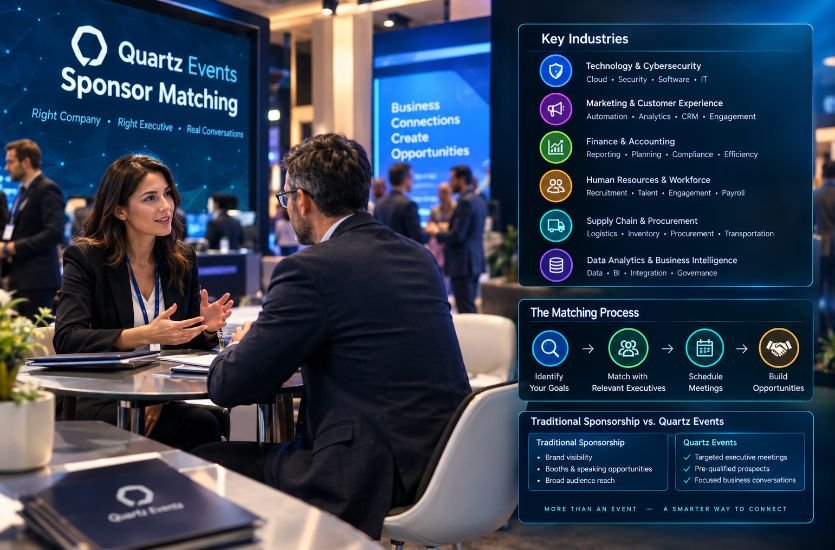
Industries That Can Benefit From Quartz Events Sponsor Matching Companies
Technology and Cybersecurity
Technology companies are potential participants in executive events focused on IT leadership, cybersecurity, and digital transformation. Their solutions may include cloud infrastructure, data protection, enterprise software, network security, and IT management platforms.
These businesses often sell products that require detailed discussions with technical and financial decision-makers. Targeted meetings can help vendors understand organizational requirements and explain how their solutions address specific challenges.
Marketing and Customer Experience
Marketing technology companies may benefit from events involving chief marketing officers and other senior marketing professionals. Their offerings can include marketing automation, customer analytics, advertising technology, customer relationship management, and digital engagement platforms.
Meeting executives with responsibility for marketing strategy can help solution providers discuss campaign performance, customer acquisition, retention, and measurement. The strongest opportunities arise when the executive’s current priorities align with the vendor’s capabilities.
Finance and Accounting
Financial technology companies, accounting software providers, and financial consulting firms may find value in events focused on finance leadership. Chief financial officers and other finance executives frequently evaluate ways to improve reporting, financial planning, compliance, and operational efficiency.
A structured meeting can give a provider the opportunity to understand existing processes and explain potential improvements. However, a conversation with a finance executive should not automatically be treated as evidence of an active purchasing opportunity.
Human Resources and Workforce Management
Human resources technology providers may use executive networking events to reach leaders responsible for recruitment, workforce planning, employee engagement, payroll, and talent development.
Companies selling HR software or related services can use relevant meetings to explore organizational challenges and demonstrate their products. Successful matching depends on whether the executive’s responsibilities and current priorities fit the solution being offered.
Supply Chain and Procurement
Supply chain technology businesses may offer inventory management software, logistics platforms, warehouse systems, procurement tools, and transportation management solutions.
Executives working in these functions often need to evaluate costs, reliability, operational performance, and integration with existing systems. Focused meetings can help providers explain their offerings in the context of these requirements.
Data Analytics and Business Intelligence
Companies offering analytics platforms, data integration, business intelligence, and data governance services may also fit the model. Their prospective buyers can include executives responsible for reporting, business performance, technology strategy, and data management.
For these providers, the relevance of a meeting depends on the organization’s existing data infrastructure, business objectives, technical requirements, and readiness to invest.
Quartz Network Compared With Traditional Event Sponsorship
Traditional event sponsorship generally emphasizes visibility. Companies may pay for exhibition space, branding, speaking opportunities, promotional materials, or access to networking sessions. These arrangements can be useful when the objective is broad brand awareness or reaching a large audience.
Quartz Network’s advertised approach places greater emphasis on structured meetings between solution providers and executives. This can be attractive to companies that prioritize direct business conversations over general event exposure.
| Comparison factor | Traditional sponsorship | Quartz Network’s meeting-based model |
|---|---|---|
| Main emphasis | Brand visibility and audience exposure | Targeted executive conversations |
| Networking | Often informal or attendee-led | Structured, scheduled meetings |
| Prospect selection | May depend on booth traffic and outreach | Sponsors may select relevant prospective attendees |
| Lead quality | Varies with audience and engagement | Depends on matching criteria and actual prospect fit |
| Sales outcome | Not guaranteed | Not guaranteed |
| Best potential fit | Broad awareness and market visibility | Focused B2B sales and executive access |
Neither approach is universally better. A company launching a new consumer brand may value broad exposure, while a business selling high-value enterprise software may prefer opportunities to speak directly with relevant decision-makers.
Benefits of Quartz Events Sponsor Matching Companies
More Relevant Business Conversations
The principal potential benefit is the opportunity to engage with executives whose professional responsibilities relate to the sponsor’s offering. This can make conversations more focused than networking with an entirely general audience.
Relevance still needs to be assessed carefully. A senior title alone does not establish purchasing authority, budget availability, or an immediate need for a particular solution.
Better Meeting Preparation
Advance prospect information, when included in a sponsorship arrangement, can help sales teams prepare questions, research organizations, and tailor presentations. This preparation can make meetings more productive and reduce time spent explaining solutions that do not fit the prospect’s needs.
Access to Specialized Executive Communities
Events organized around particular business functions allow companies to focus on audiences related to their products. A finance software provider, for example, may benefit more from a finance-focused program than a general business exhibition.
A More Structured Sales Process
Scheduled meetings provide a defined starting point for sales conversations. Companies can document each discussion, assess the prospect’s requirements, and organize follow-up activities after the event.
This structure can improve sales-team accountability, although the quality of the resulting opportunities still depends on execution.
Potential Challenges and Limitations
Quartz Events Sponsor Matching Companies should be evaluated on commercial value rather than meeting volume alone. A large number of meetings can appear attractive, but the real question is whether those meetings involve suitable prospects.
Sponsorship costs are another important consideration. Businesses should compare the complete package price with expected customer value, sales conversion rates, and the resources required to attend and follow up. Current package prices should be requested directly because costs may differ by event, package, and contractual terms.
Companies should also examine how qualified meetings are defined. A meeting may involve a senior executive without involving an active purchasing project. Asking about job seniority, business needs, meeting acceptance, cancellation policies, and any contractual guarantees can help sponsors assess what they are actually purchasing.
Finally, companies should avoid assuming that advertised performance statistics represent independently verified results. Marketing figures can be useful starting points, but prospective sponsors should request relevant evidence, definitions, and examples that apply to the particular event they are considering.
How to Evaluate a Quartz Network Sponsorship Opportunity
Before making a decision, businesses should establish a clear ideal customer profile. This includes the industries they serve, the size of organizations they target, the executive roles involved in purchasing, and the problems their products solve.
They should then assess the event audience against those criteria and ask what information is available before meetings. The number of scheduled meetings matters, but so do the quality of the introductions, the relevance of each attendee, and the practical terms of the sponsorship agreement.
A useful evaluation also includes a realistic return-on-investment calculation. Companies can estimate the value of the sponsorship by considering qualified opportunities generated, conversion rates, average contract value, sales-cycle length, and the total cost of participation.
After the event, tracking meetings, follow-ups, sales-qualified opportunities, and closed revenue helps determine whether the investment delivered value. This approach is more reliable than judging success through attendance figures or meeting counts alone.
Frequently Asked Questions
What are Quartz Events Sponsor Matching Companies?
The phrase generally refers to the sponsor-matching and qualified-meeting model associated with Quartz Network. It describes a B2B event approach that connects solution providers with potentially relevant senior business executives.
Is Quartz Events the same as Quartz Network?
Quartz Events is the historical name associated with the business, while Quartz Network is the brand used for its current event and solution-provider programs.
What types of companies can participate?
Potentially suitable businesses include technology vendors, software companies, cybersecurity providers, marketing technology firms, HR solution providers, financial software companies, data analytics businesses, and supply chain technology providers. Actual eligibility depends on the event and sponsorship arrangements.
How many meetings can a sponsor receive?
Quartz Network’s published sponsorship materials advertise packages with 15 to 120 qualified meetings, depending on the package and event. Companies should confirm the current offer and contractual conditions directly.
Does sponsor matching guarantee new customers?
No. Matching can create relevant introductions and sales opportunities, but it does not guarantee that executives will purchase a product or service.
Is Quartz Network suitable for small businesses?
It may be suitable for a smaller B2B company if its target customers match the event audience and the expected commercial value justifies the sponsorship cost. Businesses should assess the complete package price and potential return before committing.
How can companies measure sponsorship success?
Companies can track the relevance of meetings, follow-up engagement, sales-qualified opportunities, proposals, conversions, and revenue attributable to the event. These indicators provide a more meaningful assessment than the number of meetings alone.
Conclusion
Quartz Events Sponsor Matching Companies is a search phrase most closely associated with Quartz Network’s approach to B2B event sponsorship and executive matchmaking. Its model emphasizes connecting solution providers with senior business leaders through curated events and scheduled one-to-one meetings rather than relying exclusively on traditional exhibition exposure.
The approach may be valuable for businesses selling enterprise technology, financial solutions, marketing services, HR software, data platforms, and supply chain products. Its effectiveness depends on the relevance of the audience, the quality of the matching process, sponsorship costs, and the sponsor’s ability to turn conversations into genuine opportunities.
Companies considering participation should examine event-specific details, verify meeting guarantees, and evaluate potential returns realistically. Ultimately, the best sponsorship is not necessarily the one offering the most meetings, but the one that creates the strongest opportunities to reach the right buyers.