

Introduction: The Digital Backbone of UK Education
In the complex ecosystem of British education and vocational training, one digital platform stands as an indispensable gateway to legitimacy and opportunity. The UK Register of Learning Providers official website represents far more than a simple database—it is the foundational infrastructure upon which much of the United Kingdom’s education funding and provider verification rests. Whether you are an established university, a fledgling private training centre, or an employer seeking to deliver apprenticeship programmes, understanding this register is not merely advisable; it is essential for operational success.
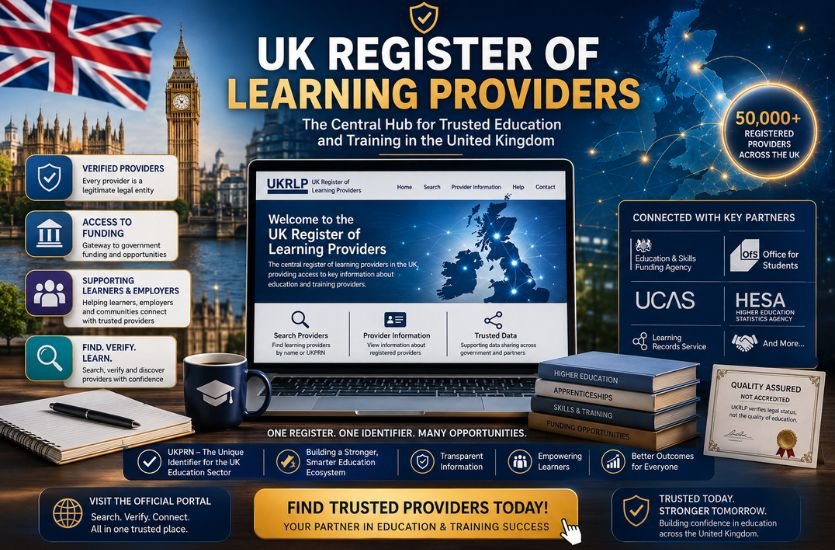
Since its launch on 1 August 2005, the UK Register of Learning Providers has grown to encompass over 50,000 verified providers across the United Kingdom . This remarkable expansion reflects the register’s central role in the education sector’s digital transformation, creating a unified, authoritative source of provider information that serves government agencies, learners, employers, and educational institutions alike.
What makes the UK Register of Learning Providers official website so crucial? At its heart, it solves a fundamental problem that plagued the education sector for decades: the fragmentation of provider data across multiple government departments and agencies. Before this unified register existed, educational institutions had to maintain separate registrations with various bodies, each with its own identifier, verification process, and update requirements. The UKRLP streamlined this chaos into a single, efficient system.
Understanding the UK Register of Learning Providers: More Than Just a Database
The UK Register of Learning Providers official website, accessible at ukrlp.co.uk, functions as the central portal for government departments, agencies, learners, and employers to share and access key information about learning providers . It represents a significant achievement in public sector digital infrastructure, demonstrating how technology can reduce administrative burden while increasing transparency.
When an organisation registers with the UKRLP, they receive a unique UK Provider Reference Number (UKPRN)—an eight-digit identifier that serves as their digital fingerprint across the entire education sector. This number has become the standard identifier used by major bodies including the Education and Skills Funding Agency (ESFA), the Higher Education Statistics Agency (HESA), the Office for Students (OfS), and UCAS . The UKPRN has effectively replaced the plethora of different provider identifiers that previously caused confusion and administrative inefficiency.
The registration process itself involves verification against a recognised external source, ensuring that every organisation on the register is a genuine legal entity operating within the UK. This verification step provides crucial assurance to those searching the register, confirming that the provider exists as a legitimate organisation—though it is important to understand the limits of this verification.
The Critical Distinction: Verification vs. Accreditation
One of the most frequently misunderstood aspects of the UK Register of Learning Providers official website is what registration actually signifies. The UKRLP explicitly states that it “does not quality assure or accredit the learning provision of the registered providers in any way” . This distinction is fundamental and worth emphasising.
Registration on the UKRLP confirms that an organisation is a recognised legal entity—a registered company, charity, school, or body created by statute. It verifies that the provider exists in the eyes of the law and has been checked against official sources. However, being on the register should never be interpreted as an endorsement of the quality of education or training that provider delivers.
The UKRLP is not an accreditation scheme and serves no purpose other than to verify that a learning provider is a legal entity . Any suggestion that UKRLP registration indicates endorsement or quality assurance is strictly forbidden by the register’s terms and conditions. For learners and employers using the register to find training providers, this distinction is crucial—the register tells you that a provider exists and is legitimate, but it does not tell you whether they deliver high-quality education.
This separation of functions makes sense when considering the register’s primary purpose: enabling efficient data sharing between providers and government agencies. Quality assurance remains the responsibility of other bodies, such as Ofqual for regulated qualifications, while the UKRLP handles the administrative foundation.
The Gateway to Government Funding and Opportunities
For many educational organisations, the most compelling reason to engage with the UK Register of Learning Providers official website is access to government funding. The register serves as a prerequisite for numerous funding streams and procurement processes across the education sector.
Any organisation wishing to access government funding for apprenticeship programmes must first appear on the register . This requirement extends beyond apprenticeships to various other funding routes managed by the Education and Skills Funding Agency and other government bodies. The UKRLP enables providers to update their information in one place and share this across agencies, streamlining the administrative processes that accompany funding applications .
The register’s role in funding access is so significant that it features explicitly in government contracts and procurement documentation. Tenderers for government education contracts are frequently required to be included in the UK Register of Learning Providers and possess a valid UKPRN . This requirement ensures that government bodies only engage with verified, legitimate organisations when commissioning education and training services.
For apprenticeships specifically, training providers who wish to appear on the Register of Apprenticeship Training Providers—necessary to access funding from the Apprenticeship Levy introduced in May 2017—must first be registered with the UKRLP . This cascading requirement demonstrates how the register serves as the foundation for other, more specific registers and funding mechanisms.
The UKRLP and Its Partner Agencies: A Connected Ecosystem
The UK Register of Learning Providers official website is not an isolated system but rather the hub of a connected ecosystem of education sector bodies. The register was developed as part of the Learning Records Service (formerly the MIAP programme), with the long-term ambition of creating a single, unified provider identifier that would replace the various identifiers used by different organisations .
This vision has largely been realised. The UKPRN is now the standard identifier used by:
- The Education and Skills Funding Agency (ESFA) : The primary funding body for education and training in England, which owns and operates the UKRLP .
- The Higher Education Statistics Agency (HESA) : Which uses the UKPRN to identify source records and for all statutory reporting requirements .
- The Office for Students (OfS) : The regulator for higher education in England.
- UCAS: The Universities and Colleges Admissions Service.
- The Learning Records Service: Which manages learner records and achievement data.
This interoperability means that when an organisation updates its information on the UK Register of Learning Providers official website, those updates can flow through to all partner agencies, maintaining data consistency across the sector. For registered providers, this represents a significant administrative saving—updating information once rather than multiple times with different bodies.
The Provider Experience: Registration and Beyond
For organisations considering registration on the UK Register of Learning Providers official website, understanding the process and requirements is essential. The register is open to any organisation or establishment—whether public, voluntary, charitable, or private—that provides learning, advice, or guidance from any UK location, either directly or through sub-contracted providers .
Applicants must be a recognised legal entity—a registered company, charity, school, or body created by statute. However, the UKRLP also permits registration of sole traders or partners within organisations that lack registered company status, subject to its verification procedures . This inclusivity ensures that a wide range of training providers, from large corporations to individual trainers, can access the benefits of registration.
The registration process itself is free—an important consideration for smaller providers operating on limited budgets. Once registered, providers are expected to keep their details up to date, ensuring that the information available to government agencies, learners, and employers remains accurate and current.
Searching the register is equally straightforward. Members of the public, employers, and learners can visit the UK Register of Learning Providers official website and use the provider search function to find organisations by name or UKPRN . This transparency serves the dual purpose of helping individuals find legitimate training providers while allowing employers to verify the credentials of potential training partners.
The Register’s Impact on Learners and Employers
While much of the discussion around the UKRLP focuses on provider benefits, the register serves equally important functions for learners and employers. For individuals seeking education or training, the register offers a verified source of information about potential providers—though, as discussed, verification should not be confused with quality endorsement.
The register allows learners and employers to find out about educational information related to providers, such as institution profiles and reports, from one central location . This centralisation makes it easier to compare options and verify that a provider is legitimate before committing time and money to a course.
For employers, particularly those investing in staff training or apprenticeship programmes, the ability to verify a provider’s registration status offers reassurance that they are engaging with a legitimate organisation. The UKRLP also helps employers find training providers that offer specific training in their industry or subject area .
However, both learners and employers should supplement their use of the register with additional research into quality and performance indicators. The UKRLP provides confirmation of existence and legitimacy, but it does not replace the need for due diligence on educational quality, learner outcomes, and provider reputation.
The Evolution of the Register: Past, Present, and Future
Since its establishment in 2005, the UK Register of Learning Providers has undergone significant evolution. Initially launched with just a few thousand providers, the register now lists over 50,000 organisations across the United Kingdom . This growth reflects both the expansion of the education and training sector and the increasing recognition of the register’s value.
The register’s technical infrastructure has also evolved to meet changing needs and technologies. The shift to a fully digital portal accessible via the UK Register of Learning Providers official website has made the register more accessible than ever, with improved search capabilities and user interfaces.
Looking to the future, the UKRLP continues to develop in response to sector needs. The register’s role in supporting apprenticeship programmes is likely to grow as the government continues to emphasise vocational training as a pathway to employment. Similarly, the register’s integration with other government digital services, such as Get Information About Schools, points toward an increasingly connected education data infrastructure .
For providers, staying registered and ensuring their information remains current will be essential as the register’s influence continues to expand. Those who fail to maintain their registration risk losing access to funding opportunities and being overlooked by employers and learners searching for training partners.
Common Misconceptions About the UK Register of Learning Providers
Given the register’s importance, it is unsurprising that misconceptions about its purpose and function persist. Addressing these misunderstandings is essential for providers, learners, and employers to use the register effectively.
Misconception 1: UKRLP registration indicates quality. As emphasised throughout this article, the UKRLP explicitly states that it conducts no quality checks on the education or provision an organisation may provide. Registration is not an endorsement or accreditation and should never be used for assurance purposes . This misconception can lead learners to assume that all registered providers offer high-quality education, which is not necessarily the case.
Misconception 2: UKRLP registration is optional and unimportant. While registration is not mandatory for all providers, it is required to access many government funding streams and to appear on specific registers like the Register of Apprenticeship Training Providers . For many organisations, registration is effectively essential to their business model.
Misconception 3: The UKRLP is a marketing tool. The register serves administrative and verification functions rather than promotional ones. While being on the register may enhance visibility, its primary purpose is data sharing between providers and government agencies.
Misconception 4: Registration is complex and time-consuming. In fact, the registration process is designed to be straightforward and is free. Eligible organisations can complete the process without excessive administrative burden.
Understanding these distinctions helps all stakeholders use the UK Register of Learning Providers official website more effectively and avoid the pitfalls of over-reliance on registration as a proxy for quality.
Practical Guidance for Prospective Registrants
For organisations considering registration on the UK Register of Learning Providers official website, the following practical guidance may prove helpful.
Before applying, ensure that your organisation meets the eligibility criteria. You must be a recognised legal entity providing learning, advice, or guidance in the UK. If you operate as a sole trader or partnership without registered company status, confirm that the UKRLP permits registration for your structure.
During the application, provide accurate and complete information. The verification process checks your details against recognised external sources, so any discrepancies may cause delays or rejection.
After registration, keep your details current. The UK Register of Learning Providers official website relies on providers to update their information, ensuring accuracy for all stakeholders who access the register.
For funded providers, monitor the register’s requirements carefully. Changes to funding eligibility or compliance obligations may affect your registration status.
For non-funded providers, consider the strategic benefits of registration even if you do not currently access government funding. Being on the register may enhance your credibility with employers and learners who use it to verify provider legitimacy.
Conclusion: The Foundation of UK Education Infrastructure
The UK Register of Learning Providers official website stands as a testament to the power of digital infrastructure in transforming education administration. By creating a single, verified source of provider information, the register has streamlined processes for thousands of organisations and millions of learners across the United Kingdom.
The register’s value lies not in what it claims to do—quality assurance or accreditation—but in what it actually delivers: a reliable, efficient mechanism for verifying the existence and legitimacy of learning providers. This verification, combined with the UKPRN’s role as a unique identifier, supports everything from government funding to learner decision-making.
For providers, understanding and effectively using the UK Register of Learning Providers is increasingly essential. Whether seeking access to apprenticeship funding, bidding for government contracts, or simply ensuring that learners and employers can verify your legitimacy, the register should be a key component of your administrative and compliance strategy.
For learners and employers, the register offers a valuable tool for verifying provider credentials—provided that its limitations are understood. Use the register to confirm that a provider exists and is legitimate, then conduct additional research into quality and outcomes.
As the education sector continues to evolve, the UK Register of Learning Providers official website will undoubtedly adapt to meet new challenges and opportunities. Its core function, however, remains constant: providing the verified, authoritative data that supports the United Kingdom’s education and training infrastructure.