

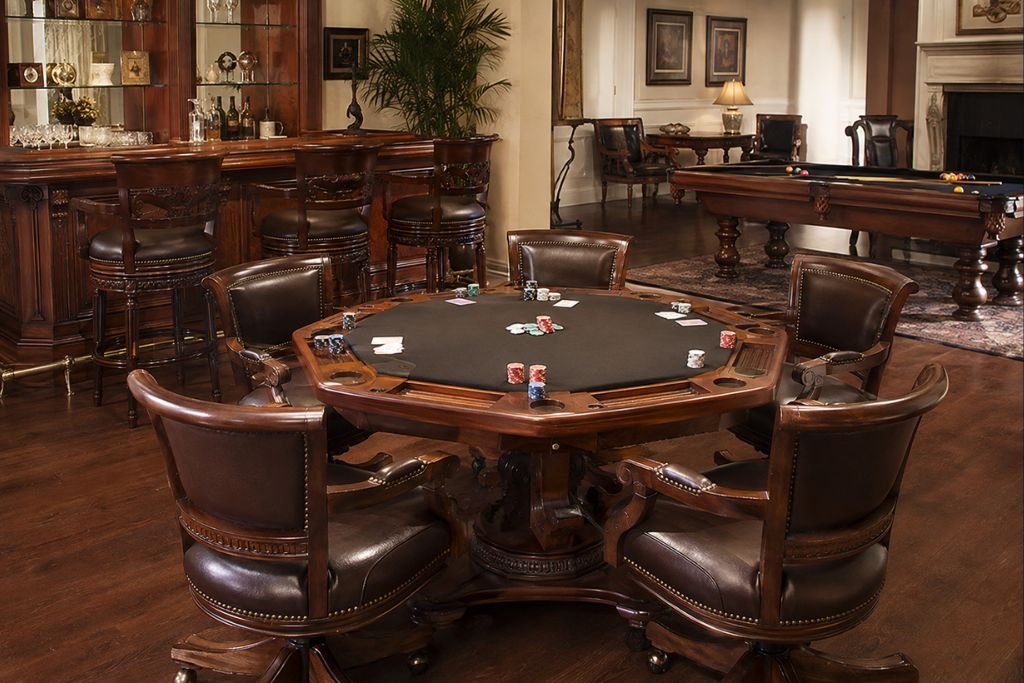
A name that appears on an old game chair, bar stool or poker table can sometimes tell a much bigger story than the piece of furniture itself. For collectors and buyers searching for Mikhail Darafeev, the name opens the door to a distinctly American furniture story built around hardwood craftsmanship, custom design and game-room furniture.
Darafeev began in 1959, when Mikhail and Antonina Darafeev established the business in a small East Los Angeles garage. Over the decades, the company developed from a hardwood furniture-frame operation into a specialist manufacturer associated with bar stools, chairs, game tables and bars. Today, the Darafeev name still appears on contemporary furniture as well as vintage pieces circulating through the secondary market.
But that raises a more interesting question: what exactly does the name Mikhail Darafeev mean to someone who discovers it on a piece of furniture today?
The answer depends on whether you are looking at the history of the founder, the modern Darafeev company, or a vintage piece whose value is determined by age, condition, design and provenance.
Who Was Mikhail Darafeev?
Mikhail Darafeev is best understood through the furniture company that carries his name.
According to company and dealer histories, Darafeev was founded by Mikhail and Antonina Darafeev in 1959 in East Los Angeles. The business initially concentrated on hardwood furniture frames and components before developing its own distinctive product range. The company’s own profile describes its origins in a small garage and its later expansion into manufacturing facilities in Southern California.
Some dealer histories provide additional background, describing Mikhail as a Russian immigrant who arrived in America with limited English and began producing hardwood furniture frames using traditional craftsmanship. Those accounts also say that the business expanded rapidly as demand for its work grew.
The distinction matters more than it first appears. Mikhail Darafeev was not simply the name attached to a furniture collection. He was the founder behind a manufacturing tradition that later became closely associated with specialist recreational furniture.
From Hardwood Frames to Game-Room Furniture
The early story is about woodworking rather than poker tables.
Darafeev’s reputation developed around hardwood furniture components and chair frames. According to historical company descriptions, the second generation of the family moved into its own proprietary furniture line during the 1970s, beginning with a bar stool and eventually expanding into game chairs, tables and bars.
That change helped define what the Darafeev name would become.
Instead of competing primarily as a mass-market furniture manufacturer, the company developed a niche around highly configurable pieces. Customers could choose different wood finishes, upholstery and decorative details, allowing furniture to be made for individual interiors rather than simply taken from a standard catalogue.
This approach also explains why the name continues to attract attention decades later. A Darafeev piece may look like ordinary furniture at first glance, but its construction, finish and customisation can make it quite different from mass-produced alternatives.
What Kind of Furniture Did Mikhail Darafeev Become Known For?
The Darafeev name is particularly associated with four categories: bar stools, chairs, game tables and bars.
Modern Darafeev dealers describe extensive choices in wood finishes and upholstery, while historical descriptions point to the company’s development of specialised game-room furniture from the 1970s onwards.
Mikhail Darafeev Bar Stools
Bar stools are an important part of the company’s story.
The historical development of Darafeev’s proprietary product line reportedly began with a single bar stool before expanding into a broader collection. Modern examples include swivel stools and counter-height designs made with hardwood frames and a range of upholstery and finish options.
For someone searching for a Mikhail Darafeev bar stool, the most important detail is that not every piece will have identical specifications. Finish, height, upholstery, model and condition can all affect what a particular stool is worth.
That is why identifying the exact model is more useful than relying on the Darafeev name alone.
Mikhail Darafeev Game Chairs
Game chairs occupy another important place in the company’s catalogue.
Darafeev dealers currently list multiple game-chair designs, with options involving different hardwood finishes, upholstery and decorative treatments. The furniture is designed to work alongside game tables but can also function as general seating in a home or hospitality environment.
For owners of older pieces, upholstery can be especially significant. Historical dealer information notes that Darafeev has continued to service furniture bought decades earlier, including pieces requiring updated upholstery.
That longevity is part of the reason vintage Darafeev furniture remains interesting to collectors.
Mikhail Darafeev Poker Tables
Few products capture the company’s identity better than the game table.
Vintage Mikhail Darafeev tables can combine dining and gaming functions, allowing a table to serve an ordinary household purpose before being converted for cards or other games. A 2026 resale listing, for example, describes a 54-inch octagonal Darafeev table with a reversible top designed for poker, dining and bumper pool, accompanied by four upholstered gaming chairs. The seller listed the table and chairs separately and described the table as having a historical retail price of $5,580.
A separate current dealer listing for a Darafeev flip-top pub table illustrates the same philosophy: one side is intended for everyday dining, while the other can be used as a poker surface.
The detail many readers overlook is that a game table is not automatically valuable simply because it carries the Darafeev name. Condition, completeness, originality, construction, size and market demand all matter.
The Fascinating Story of Darafeev Bumper Pool Tables
Bumper pool tables provide one of the clearest examples of how the Mikhail Darafeev name crossed from specialist furniture into popular culture.
Archived records from The Price Is Right show Mikhail Darafeev bumper pool tables appearing as prizes during the 1990s. Several episodes recorded the retail price at $1,595, while an April 1993 episode listed a Mikhail Darafeev bumper pool table at $1,525.
That gives today’s researchers something unusual: historical price evidence rather than a modern seller’s estimate.
It should not, however, be confused with today’s resale value. A bumper pool table that retailed for $1,595 decades ago is not necessarily worth the same amount now, either adjusted for inflation or on the vintage market.
This is where the story becomes more complicated.
Current Darafeev-related listings show that multifunctional bumper-pool furniture can command substantially higher prices when it is newly manufactured or heavily customised. One dealer, for example, lists the Darafeev Treviso rectangular bumper pool table with a two-piece dining top at $6,800, reduced from $8,000, while noting that the model was discontinued in 2023 but might still be available as a custom order.
The modern and vintage markets therefore need to be treated separately.
How Much Is Mikhail Darafeev Furniture Worth?
This is probably one of the most common reasons people search for Mikhail Darafeev price or Mikhail Darafeev furniture value.
There is no universal price.
A vintage Darafeev chair could have a very different value from a complete poker-table set. A rare or desirable design in excellent original condition may attract more interest than a heavily modified piece, while a large table can be difficult to sell simply because transportation becomes a major consideration.
Recent marketplace examples illustrate the range. One Craigslist listing in California offered a Darafeev poker, bumper-pool and dining table with four chairs for $5,200, while another 2026 listing advertised a multifunctional table and chairs at substantially less. These are asking prices, not independently verified sale prices, so they should be treated as market signals rather than formal valuations.
For anyone trying to establish the value of an inherited or second-hand piece, photographs, dimensions, model information, condition and provenance are more useful than the name alone.
How to Identify Vintage Mikhail Darafeev Furniture
Identification can be surprisingly difficult.
The strongest starting point is documentation. Look for manufacturer labels, stamps, model information, receipts or original paperwork. Then photograph the entire piece, including its underside, hardware, joinery and any markings.
Next, record the dimensions and identify the function of the furniture. A swivel bar stool, game chair, poker table and bumper-pool table belong to very different parts of the Darafeev catalogue.
Construction is also important. Darafeev’s reputation has historically centred on hardwood furniture and custom finishing, so the wood species, finish, upholstery and hardware can help distinguish one piece from another. Dealers describe options including oak, cherry and maple finishes, alongside extensive upholstery choices.
If a seller gives you a very specific valuation without examining the furniture, some caution is sensible.
Is Mikhail Darafeev Furniture Still Made?
Yes, the Darafeev brand continues to appear in the contemporary furniture market.
Current business information describes Darafeev as a family-owned manufacturer operating in Southern California, while the Better Business Bureau identifies the business under the alternate name Mikhail Darafeev, Inc. and categorises it among furniture manufacturers and game-table businesses.
Modern dealer listings also show Darafeev products in categories including game tables, chairs and bar stools. Some pieces are built to order, with custom finishes and upholstery, which means contemporary pricing can be considerably different from the price of a used vintage item.
For buyers, this distinction is essential: vintage Darafeev and contemporary Darafeev are related, but they are not the same market.
Why People Still Search for Mikhail Darafeev
The continued interest in Mikhail Darafeev is partly about furniture and partly about provenance.
Someone searching the name may have inherited a chair, discovered a stamped table at an estate sale, found a vintage bumper-pool table online or simply encountered the name while researching an unusual game-room piece.
The search can therefore lead in several directions: history, identification, restoration, pricing or buying.
And that is what makes the Darafeev story more interesting than a simple furniture-brand biography. The name sits at the intersection of American manufacturing, family business, recreational furniture and the increasingly active market for vintage interiors.
The Lasting Appeal of the Darafeev Name
Mikhail Darafeev’s most significant legacy may not be any single table or chair. It is the idea that recreational furniture could be treated as serious furniture.
A poker table could also be a dining table. A bumper-pool table could become part of a family room. A bar stool could be built as carefully as a conventional dining chair.
That philosophy helped Darafeev occupy a distinctive space between furniture manufacturing and the world of home entertainment.
For modern buyers and collectors, the lesson is straightforward. A Darafeev piece should not be judged by its name alone, but neither should the name be dismissed as just another old furniture label. Its history, construction, customisation and continuing production give the brand a provenance that helps explain why its vintage pieces still attract attention.
Ultimately, Mikhail Darafeev is a story about craftsmanship that survived by remaining useful. From a small East Los Angeles garage in 1959 to specialist game-room furniture sold across generations, the name has become attached to pieces designed not merely to furnish a room, but to be used, enjoyed and, ideally, kept for a very long time.