









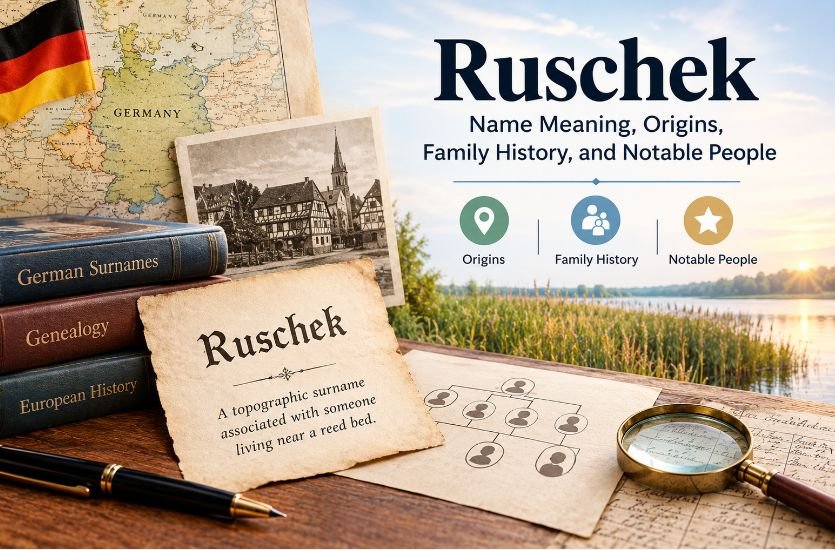
The surname Ruschek has a distinctive history associated with German-language naming traditions and European family records. Although it is not among the most widely recognized surnames, it offers an interesting subject for exploring surname meanings, geographical origins, historical documentation, and the lives of people who share the name. Understanding Ruschek requires examining its linguistic background alongside historical records, rather than assuming that everyone with this surname belongs to the same family.
As with many uncommon surnames, the available information about Ruschek comes from a combination of surname dictionaries, genealogy resources, historical catalogs, and records of individuals. These sources can help explain the name’s possible origins and document its use across different periods and places.
Quick Answer: Ruschek
| Detail | Information |
|---|---|
| Name | Ruschek |
| Name type | Surname or family name |
| Linguistic association | German |
| Reported meaning | A topographic surname associated with someone living near a reed bed |
| Historical connections | German-speaking and Central European records |
| Research areas | Genealogy, surname etymology, and historical biographies |
| Notable namesakes | Antal Ruschek, Wolfgang Ruschek, and Anke Ruschek |
What Does the Ruschek Surname Mean?
The surname Ruschek is identified in a published surname reference as German, with a topographic meaning connected to someone who lived near a reed bed. This interpretation appears in the Dictionary of American Family Names, cited by FamilySearch. Topographic surnames traditionally described people by their surroundings, helping communities distinguish individuals who lived in different locations.
A reed bed is an area of wetland or waterside vegetation where reeds grow in shallow water or damp soil. In historical communities, natural landmarks such as wetlands, rivers, hills, and forests often helped identify where people lived. A surname based on such a feature could eventually become a hereditary family name passed from one generation to the next.
The published interpretation offers a useful starting point for understanding Ruschek, but it does not establish the exact origin of every family carrying the name. Individual family histories may require records from specific towns, regions, or historical periods.
Read Fonvira: Features, Uses and Benefits of the Online Colour Tool
German Origins and European Connections
Ruschek has a documented association with German naming traditions, although the surname also appears in records connected with other European countries. Historical migration, changing political borders, and the movement of families across regions have contributed to the distribution of many Central European surnames.
Genealogical databases list Ruschek in historical records from Germany and other locations, including Austria and Hungary. These records demonstrate that the surname has appeared in different geographical settings over time. However, the presence of the name in several countries does not prove that all its bearers originated in the same place.
The history of Central Europe makes surname research particularly interesting. Families sometimes moved for employment, education, religious reasons, or changing political circumstances. During these movements, names could be recorded differently depending on the language used by local officials or the spelling conventions of a particular period.
For that reason, researchers investigating Ruschek should examine historical evidence rather than relying exclusively on modern nationality or geographical distribution.
Historical Records and Family Genealogy
Historical records are essential for understanding how the Ruschek surname developed and where particular family branches lived. Genealogy databases contain records associated with births, baptisms, marriages, deaths, immigration, and other important life events.
These documents can help establish relationships between generations. For example, a baptismal register may identify a child’s parents, while a marriage record may provide information about a person’s birthplace or family background. When several documents support the same relationship, researchers can gradually construct a more reliable family history.
The surname also appears in older European records, including German church registers. Such records can be especially valuable when civil registration documents are unavailable or incomplete. Their usefulness depends on the survival of the original documents, the accuracy of transcription, and the amount of information recorded.
People researching their own Ruschek ancestry should begin with relatives whose identities and dates are already known. Working backward through documented relationships reduces the risk of confusing unrelated individuals who happen to share the surname.
Notable People Named Ruschek
Although Ruschek is not associated exclusively with one famous individual, several people bearing the surname appear in historical and professional records. Their documented activities illustrate the different contexts in which the name has been used.
Antal Ruschek: Hungarian Religious Writer
Antal Ruschek (1851–1914) is a historical figure associated with Hungarian religious literature. Library catalogs record publications connected with his name, providing evidence of his literary activity and historical presence.
His work represents one documented connection between the Ruschek surname and the intellectual and religious life of Central Europe during the late nineteenth and early twentieth centuries. Historical publications and library records offer a useful way to investigate his contributions without relying on unsupported biographical claims.
Wolfgang Ruschek: German Footballer
Wolfgang Ruschek appears in the German Football Association’s player database, which documents his association with German football. Records connect him with VfR Wormatia 08 Worms during the 1979–80 season.
Sports databases are valuable sources for researching athletes because they can provide details about clubs, competitions, and recorded appearances. In Wolfgang Ruschek’s case, institutional records establish a connection with German football, although they should not be used to infer a relationship with other people bearing the same surname.
Anke Ruschek: German Lawyer
Anke Ruschek is identified as a lawyer practising in Weimar, Germany. Her professional information includes work involving tenancy and residential property law, social law, and contract law.
Her career demonstrates the surname’s presence in contemporary professional life. As with other modern namesakes, details about her qualifications and areas of practice should be based on reliable professional information rather than assumptions drawn from the surname itself.
These individuals have distinct biographies. No family relationship between them should be assumed without supporting genealogical evidence.
The Difference Between a Surname and a Family History
A surname’s linguistic meaning and a family’s documented history are related but separate subjects. Etymology examines how a name may have developed from words, places, or descriptions. Genealogy investigates relationships between specific individuals across generations.
In the case of Ruschek, the published topographic interpretation provides a possible explanation for the name’s meaning. It does not identify the first person to use the surname, establish a single ancestral village, or demonstrate that all Ruschek families descend from one individual.
A reliable family history requires evidence such as birth certificates, church registers, marriage records, immigration documents, and other historical materials. These records can help connect people who lived in different places and periods.
Distinguishing between general surname origins and individual ancestry is important because uncommon names can create misleading connections in online searches. Two people may share an unusual surname without having any known relationship.
How to Research the Ruschek Family Name
Researching Ruschek begins with collecting verified information about a particular family. Full names, approximate birth dates, known locations, and relatives’ names can help narrow searches and distinguish between people with similar identities.
Historical church registers may provide information about earlier generations, especially where civil records are limited. Census documents, immigration lists, and local archives can also reveal how families moved between countries or settled in new communities.
Spelling variations should be considered carefully when searching older documents. Handwritten records, translation practices, and differences between languages can make names difficult to identify. However, a similar spelling alone is not proof that two surnames share the same origin.
Researchers should compare multiple records whenever possible and distinguish confirmed facts from possible interpretations. This method creates a more accurate account of family history and reduces the likelihood of repeating errors found in unsourced online biographies.
Frequently Asked Questions About Ruschek
Is Ruschek a German surname?
Yes. A published surname reference classifies Ruschek as German and associates it with a topographic description. Historical records also document the surname in other European locations.
What is the meaning of Ruschek?
Its published interpretation describes a person who lived near a reed bed. This is a geographical description rather than a confirmed account of the origins of every family with the surname.
Is Ruschek a common surname?
Ruschek appears to be uncommon compared with widely used European surnames. Genealogy databases contain historical records for the name, but their record totals should not be interpreted as an exact count of people currently living with it.
Who are the notable people named Ruschek?
Documented namesakes include Antal Ruschek, associated with Hungarian religious literature; Wolfgang Ruschek, listed in German football records; and Anke Ruschek, a German legal professional.
Are all Ruschek families connected?
There is insufficient evidence to conclude that every person with the surname belongs to one family. Establishing a relationship requires historical documents linking specific individuals and generations.
How can someone discover their Ruschek ancestry?
The most effective approach is to start with known relatives and search historical birth, marriage, death, church, and immigration records. Comparing information across multiple documents can help establish a credible family tree.
Conclusion
Ruschek is an uncommon surname with a documented German linguistic association and a historical presence in several European settings. Its published meaning connects it with a person who lived near a reed bed, while historical and professional records identify individuals who have carried the name in different periods and occupations.
The surname’s history is best understood through a combination of linguistic research and documentary evidence. Although its general meaning provides an interesting starting point, the ancestry of a particular Ruschek family can only be established through reliable historical records.