









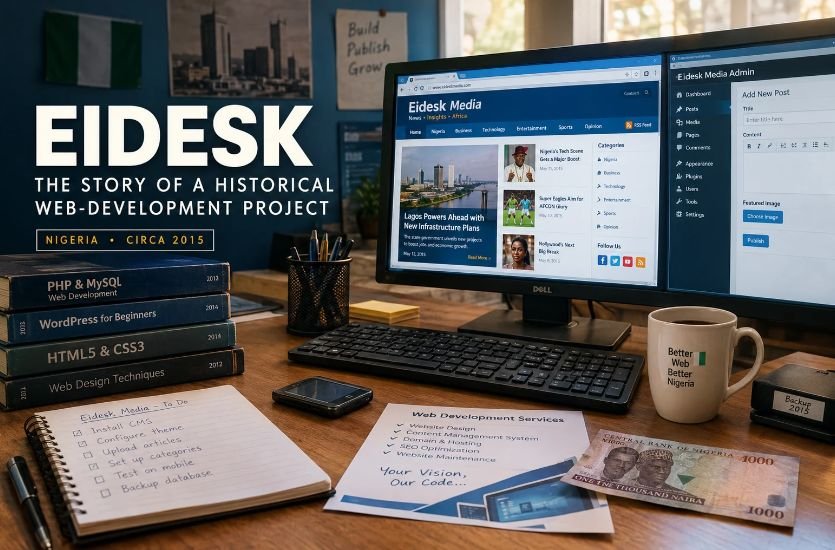
Quick Bio — Eidesk at a Glance
| Attribute | Detail |
|---|---|
| Name | Eidesk (also promoted as “Eidesk Media”) |
| Type | Historical web-development identity / project brand |
| Associated with | Nigeria’s mid-2010s web-development community |
| Documented product | A news-publishing and blog system with RSS/Atom aggregation, image lazy loading, and backup features |
| Documented period | Primarily around 2015 |
| Current status | Original platform not verified as active; domain parked and listed for sale |
| Relationship to eDesk or AnyDesk | None established; entirely separate |
Introduction
The name Eidesk circulates online with far less clarity than most software brands, and that ambiguity is precisely why it deserves a careful, factual examination. Unlike products with maintained documentation, active support channels, and visible customer bases, Eidesk survives mainly in scattered forum posts and expired domain listings. Understanding what it was, what it claimed to offer, and why it faded from view provides a useful case study in how early online projects can leave a fragmentary digital footprint. Equally important is separating Eidesk from the active commercial products whose similar names cause frequent confusion.
What Eidesk Was
The clearest evidence of Eidesk’s existence comes from Nigeria’s online developer community, particularly the Nairaland forum, where activity under the Eidesk name appeared around 2015. Posts from that period advertised web-development services, including blog design work priced in Nigerian Naira, positioning Eidesk as a small-scale provider serving local clients. This suggests an individual developer or a very small team operating through community channels rather than a formally structured company.
The most concrete product description available comes from a 2015 advertisement for “Eidesk Media,” which presented the offering as a website-building or content-management system aimed at news publishers. The advertised feature set was ambitious for its time and context, including news aggregation through RSS and Atom feeds, image lazy loading to improve page performance, and built-in backup functionality. These features were marketed as practical advantages for bloggers and small news outlets seeking an affordable publishing solution.
What the public record does not establish is equally important. There is no verified information confirming that Eidesk was a registered business, and details such as founders, ownership, staff size, and office location remain undocumented. The most defensible characterization is that Eidesk was a project, brand, or online development identity connected to Nigeria’s web-development community, rather than an established corporate entity with a formal corporate history.
The Advertised Product: Eidesk Media
Eidesk Media appears to have been the flagship offering associated with the Eidesk name. Its pitch centered on helping publishers launch and manage news-oriented websites without extensive technical resources. The aggregation features would have allowed site owners to pull in content feeds from multiple sources, while lazy loading addressed a genuine pain point for audiences browsing on slower connections. Backup functionality spoke to a real concern for small publishers who could not afford to lose content.
However, advertising claims are not the same as verified adoption. No independent reviews, case studies, usage statistics, or customer testimonials from the Eidesk Media era have surfaced in the public record. There is no evidence that the system achieved widespread adoption, and no documentation of how it performed in real-world publishing environments. For anyone researching Eidesk today, this distinction matters: the product was advertised, but its reach and reliability were never independently confirmed.
Current Status and Domain History
Eidesk does not appear to operate as an active software service today. No current official documentation, maintained product, support team, or live customer dashboard has been identified. The domain eidesk.com, once the likely home of the platform, is now reported by domain-checking services as resolving to a parked or aftermarket page and being offered for sale. It no longer hosts the historical Eidesk Media platform.
Domain records add a further wrinkle. The current registration of eidesk.com shows a 2021 creation date, but this reflects a new registration cycle after the domain expired and changed hands. It does not mean Eidesk began in 2021. Historical forum listings show the domain was already being offered for sale as early as December 2015, indicating that its role was shifting even near the time Eidesk Media was being actively promoted. Taken together, the evidence points to a project that wound down rather than one that scaled into a lasting business.
Why Eidesk Is Frequently Confused with Other Products
The most significant research pitfall surrounding Eidesk is name collision. The active e-commerce customer support platform eDesk, with a capital D, is an entirely separate commercial product used to consolidate customer messages from marketplaces such as Amazon, eBay, and Shopify. No evidence connects the two, and treating them as related would misrepresent both.
Eidesk is likewise unrelated to AnyDesk, the remote desktop software, and to iDesk. This matters beyond academic accuracy. Because the historical Eidesk has no verified official download source, any file or service currently marketed under the Eidesk name should be treated with caution. Users searching for legitimate software could be misdirected toward unverified sources if the names are conflated, creating real security and procurement risks.
Lessons from a Fragmentary Digital Footprint
Eidesk illustrates how quickly small web projects can become difficult to research. A project promoted through forum posts and a single product advertisement can leave behind just enough evidence to confirm it existed, but not enough to reconstruct its history in detail. The absence of maintained documentation, archived support pages, and independent reviews makes verification hard even a decade later.
For researchers and writers, the Eidesk case reinforces a simple discipline: confirm what a keyword actually refers to before describing it. The verified facts are modest but solid. Eidesk was an online development identity active around 2015 in Nigeria’s web community, it advertised a news-publishing system called Eidesk Media with specific technical features, its domain was already being resold in late 2015, and it is not verified as operational today. Everything beyond those points should be presented as unconfirmed rather than assumed.
This article is part of Expand Magazine’s coverage of technology history and early web projects. For broader content on professional growth, leadership, and business trends, visit the Expand Magazine.