









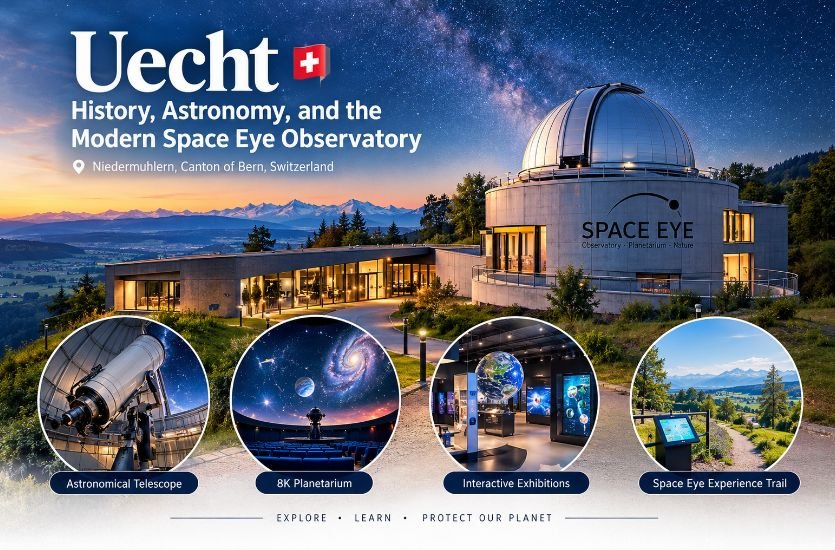
Uecht is a location in the Canton of Bern, Switzerland, known for its connection to astronomy and the development of the Space Eye Observatory. Situated near Niedermuhlern on the Längenberg, the area has a history of astronomical observation dating back to 1951. Today, Uecht combines its historical scientific heritage with modern facilities dedicated to space exploration, environmental awareness, and public education.
Quick Answer: What Is Uecht?
Uecht is a location near Niedermuhlern in the Bern region of Switzerland. It is best known for the historic Uecht Observatory, established by Willy Schaerer in 1951, and its connection to Space Eye, a modern observatory and educational center that opened in 2023. The site offers visitors opportunities to explore astronomy, the universe, and environmental science.
Where Is Uecht Located?
Uecht is situated on the Längenberg, a geographical area in the Canton of Bern, south of the Swiss capital. Its surroundings provide a setting for astronomical observation away from some of the light pollution and weather conditions associated with urban areas. The location is closely connected with Niedermuhlern, a municipality in the Bern region.
The area’s geographical setting has played an important role in its scientific development. Astronomical facilities benefit from suitable observing conditions, particularly when studying celestial objects in the night sky. Uecht’s elevation and rural surroundings helped make it an attractive location for an astronomical observation station.
The History of Uecht Observatory
The Beginning in 1951
The modern history of Uecht’s astronomical activities began in 1951, when Swiss engineer and industrialist Willy Schaerer established a private astronomical observation station at the site. His interest in astronomy helped create a facility dedicated to observing celestial objects and supporting scientific activities.
The original observatory was an important development for the local astronomy community. Over time, its role expanded beyond private observation, and the site became associated with scientific cooperation and educational activities. Its location also supported its long-term use for astronomical observation.
Development of the Observatory
In 1965, a second observatory building was constructed to replace the original facility. This development marked an important stage in the site’s evolution, allowing its astronomical activities to continue with improved infrastructure.
In 1974, astronomer Wilhelmine Burgat discovered the supernova SN 1974G while working at the observatory. The discovery became a notable part of Uecht’s scientific history and demonstrated the role that smaller observatories can play in astronomical research.
The site continued to receive technical improvements over subsequent decades. In 1982, the Uecht Observatory Foundation was established to support the observatory and its future development. Public guided visits began in 1993, helping introduce astronomy to a wider audience.
What Is Space Eye?
Space Eye is a modern observatory and visitor center focused on space and the environment. It continues the astronomical tradition established at Uecht while presenting scientific subjects through contemporary educational facilities and interactive experiences.
The center officially opened in September 2023. Its development represented a major step in transforming the historic astronomical location into a destination where visitors can explore the universe, learn about scientific research, and understand environmental issues.
Space Eye was designed by Swiss architect Mario Botta. Its facilities combine astronomy with public education, making scientific concepts accessible to visitors with different levels of knowledge. Rather than focusing exclusively on professional research, the center also aims to encourage curiosity and interest in science.
Main Attractions at Uecht
The Astronomical Telescope
One of the main attractions associated with Space Eye is its large public telescope. It provides opportunities to observe celestial objects and learn more about astronomical phenomena. Depending on observing conditions and the scheduled program, visitors can gain a closer view of objects in the night sky.
Telescopes are important tools in astronomy because they collect light from distant objects and help observers study details that are difficult or impossible to see with the unaided eye. At Uecht, telescope-based experiences help connect scientific knowledge with direct observation.
The 8K Planetarium
Space Eye also features an 8K planetarium designed to present immersive visual experiences about the universe. Planetariums use projected imagery to explain the movements of celestial objects, the structure of the solar system, and the wider universe.
The high-resolution presentation allows visitors to explore astronomical subjects in a visual format. Planetarium programs can be especially helpful for explaining distant galaxies, planetary systems, and cosmic events that cannot easily be observed directly during a visit.
Interactive Exhibitions
Interactive exhibitions introduce visitors to space science, astronomy, Earth observation, and environmental topics. These experiences help explain how scientists study the universe and how space-related technologies contribute to everyday life.
Exhibitions can also introduce subjects such as satellites, space exploration, and the challenges created by orbital debris. By combining visual displays with educational explanations, Space Eye encourages visitors to engage with scientific information in a practical way.
The Space Eye Experience Trail
The surrounding area includes an experience trail connected with Space Eye. It features virtual learning stations that introduce subjects related to space and the environment through a mobile device.
This outdoor element adds another dimension to a visit by connecting scientific education with the natural surroundings. It also encourages visitors to consider the relationship between Earth, the wider universe, and environmental responsibility.
Why Is Uecht Important for Astronomy?
Uecht is significant because it demonstrates how a historical observation station can develop into a modern science education destination. Its history connects individual scientific initiative with organized research, public outreach, and technological development.
The discovery of SN 1974G is one example of the scientific work associated with the observatory. Astronomical discoveries help researchers understand how stars evolve, how stellar explosions occur, and how galaxies change over time. A supernova observation can contribute to wider scientific knowledge even when it originates from a relatively small observatory.
The site’s continuing connection with astronomy also highlights the value of accessible scientific facilities. Public observatories can encourage interest in space, help students understand scientific methods, and create opportunities for people to learn about research beyond textbooks and classrooms.
Uecht and Environmental Education
Although astronomy remains central to Uecht’s identity, the modern Space Eye facility also emphasizes environmental awareness. Understanding the universe involves studying Earth as well as distant celestial objects, and satellite technology plays an important role in observing the planet.
Earth-observation satellites help scientists monitor weather patterns, land use, vegetation, oceans, and environmental changes. These technologies provide information that supports research into climate, ecosystems, and natural hazards.
Space Eye connects such subjects with broader questions about sustainability and humanity’s relationship with the natural world. This approach helps demonstrate that space science is not limited to distant planets and stars. It can also contribute to understanding the environment in which people live.
Visiting Uecht and Space Eye
Uecht may interest astronomy enthusiasts, families, students, and travelers looking for an educational experience in the Bern region. The combination of a historic observatory, modern planetarium, telescope facilities, and interactive exhibitions offers several ways to explore scientific subjects.
Visitors should distinguish between the historic observatory and the modern Space Eye visitor facilities. Although they are closely connected through their history and organization, they represent different stages in the development of astronomy at the site.
Planning a visit in advance is important because Space Eye does not operate as a continuously accessible visitor center. Entry is available through scheduled public events, guided tours, and booked group visits. The available experiences may depend on the program and the type of booking.
The surrounding landscape also adds to the location’s appeal. Its setting near Niedermuhlern offers an opportunity to combine an interest in science with time spent in the countryside of the Bern region.
The Future of Uecht
The future of Uecht is closely connected with the continued development of Space Eye as a center for astronomy, space science, and environmental education. Its modern facilities build on the work that began with the original observation station in 1951.
As scientific technology advances, public education centers can help explain discoveries and make complex research easier to understand. Planetarium presentations, telescope observations, and interactive exhibitions provide different ways to introduce new generations to scientific questions.
The preservation of historical facilities is also an important part of this development. Maintaining the connection between the original observatory and the modern center helps visitors understand how astronomical observation has changed over time.
Uecht’s history illustrates how a location established for private astronomical observation can grow into a wider educational resource. Its continuing role depends on preserving that scientific heritage while making astronomy and environmental knowledge accessible to the public.
Conclusion
Uecht is a location in Switzerland with a distinctive connection to astronomy and scientific education. Its history began with Willy Schaerer’s private observation station in 1951 and developed through decades of astronomical activity, technical improvements, and public outreach.
The opening of Space Eye in 2023 brought this heritage into a modern setting featuring a public telescope, an 8K planetarium, and interactive educational experiences. By combining astronomy, space exploration, and environmental awareness, Uecht remains an example of how historical scientific sites can serve contemporary educational needs.
For visitors interested in the universe, the history of astronomy, or the relationship between space and Earth, Uecht offers a meaningful connection between Switzerland’s scientific heritage and modern public learning.
If you want more informative articles with different categories, visit Expand Magazine.