








Introduction
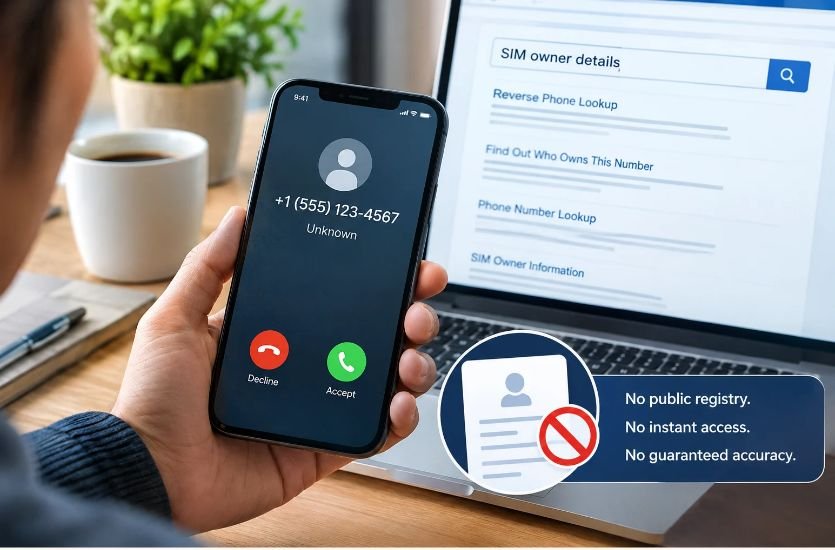
The phrase “SIM owner details” describes a desire, not a service. People type it into search engines hoping to connect a phone number to a human being: a missed call from an unfamiliar mobile, a suspicious text, a used handset that arrived with someone else’s SIM still in the tray. The phrasing suggests something official and retrievable, like a registry lookup or a database query. In reality, no such public registry exists in the United States or in most other countries. What exists instead is a patchwork of caller identification technologies, commercial data aggregators, and a great deal of misleading marketing. This article explains what the term actually refers to, what the available tools genuinely deliver, and why the most confident promises are usually the least reliable.
Quick Bio: Author Context
| Field | Detail |
|---|---|
| Author | Consumer Telecom & Privacy Desk |
| Expertise | Caller identification systems, data broker practices, consumer privacy regulation |
| Research Focus | CNAM technology, people-search accuracy, regulatory enforcement actions |
| Purpose | To clarify what “SIM owner details” means in practice and set realistic expectations |
What the Term Actually Refers To
“SIM owner details” is not a technical term with a fixed definition. In search behavior, it describes a request for information about the person or entity associated with a mobile number. The underlying assumption is that a SIM card is registered to an identity, and that this registration is retrievable by anyone who knows the number. That assumption is partly true and partly false in ways that matter enormously.
Every mobile number is associated with a subscriber account held by a carrier. That account contains billing information, a name, an address, and often identity verification documents. The account exists. The record is real. But access to that record is restricted by law and by carrier policy. In the United States, subscriber information is protected as Customer Proprietary Network Information, and carriers face penalties for disclosing it without authorization. Law enforcement can obtain it through subpoenas or warrants. Ordinary members of the public cannot.
The gap between the existence of the record and the impossibility of public access is where the entire “SIM owner details” industry operates. Apps and websites fill that gap with promises, and the promises rarely survive scrutiny.
The One Legitimate Technology: Caller ID Name
The only technology that routinely displays a name alongside a phone number is Caller ID Name, or CNAM. When a call arrives, the receiving network queries a database for the name associated with the calling number and transmits that name to the recipient’s device. This is the “John Smith” or “ABC Plumbing” that appears on your screen before you answer.
CNAM has limitations that consumers rarely understand. Its coverage is inconsistent for mobile numbers; many wireless calls display only the number or a generic label. The name returned is whatever the carrier has on file for billing purposes, which may be a business name, a family plan holder, or an outdated registration. And the technology is designed for incoming calls, not for reverse lookups. You cannot type a number into a CNAM system and retrieve a name; the lookup happens during call routing, and only if the receiving carrier supports it.
For someone trying to identify a number that has already called them, CNAM may have already provided the answer on the screen. For someone trying to look up a number proactively, CNAM offers nothing directly.
The People-Search Industry: Aggregation, Not Verification
The websites that dominate search results for “SIM owner details” are not telecom services. They are data brokers and people-search platforms that compile public records, commercial data, and historical information into profiles searchable by phone number. Whitepages, Spokeo, BeenVerified, and similar sites market themselves as reverse lookup tools and claim access to hundreds of millions of identity records.
What these platforms actually sell is aggregation, not verification. They pull from public records, marketing databases, and other data brokers, then assemble the pieces into a profile. The phone number is one input among many. The output may include a name, an address, relatives, and age, but none of it is confirmed with the carrier that issued the number.
The accuracy problem is structural. Phone numbers are reassigned constantly. A number that belonged to one person three years ago may now belong to someone else entirely, yet the data broker’s record may still display the old association because its source data was never updated. One analysis of people-search accuracy notes that a single profile can blend a fresh address with a phone number that is years out of date. The Federal Trade Commission has taken enforcement action against people-search companies for misrepresenting the accuracy of their reports. In 2023, TruthFinder and Instant Checkmate paid $5.8 million to settle allegations that they deceived consumers about the accuracy of their background reports and marketed them in ways that suggested they could be used for employment decisions, which they are not legally permitted to support.
The business model itself deserves scrutiny. These sites collect information about millions of people, display it publicly, and charge for full access or removal. The person searching for someone else’s details is participating in an ecosystem built on the exposure of everyone’s personal data.
What “SIM Owner Details” Apps Actually Promise
Mobile app stores host numerous applications with names like “Sim Owner Details” and “Reverse Phone Lookup” that promise to reveal the owner of any number. Their descriptions are often carefully worded to suggest capabilities they do not possess. One app description states that it can “identify the owner of a phone number” and retrieve “the name, address, and other relevant information,” while also noting that it relies on “phone directory data” rather than a carrier database.
The disclaimers tell the real story. Some apps explicitly state that they do not provide CNIC records or personal identity information, do not access private telecom databases, and are not affiliated with any government authority. Others omit such clarity and allow users to infer that they are accessing official records. The gap between the marketing and the fine print is where disappointment and sometimes fraud occur.
The technical reality is that no third-party app possesses a live connection to carrier subscriber systems. The data such apps circulate is either compiled from public sources, scraped from other aggregators, or in some cases fabricated. A “fresh” database is not possible without live carrier access, which no consumer app has.
Legal Boundaries and Practical Alternatives
In the United States, obtaining someone else’s phone records or subscriber information without authorization can violate federal law, including the Telephone Records and Privacy Protection Act. The FTC has warned about scams that exploit the desire for phone number information, including impostors who spoof numbers to appear legitimate and then pressure victims for payment or personal data.
For consumers dealing with an unknown number, the practical options are unglamorous but effective. Blocking the number through the phone’s built-in settings is immediate. Reporting unwanted calls to the FTC helps regulators track patterns. For persistent harassment or threats, local law enforcement can obtain subscriber records through legal process when a criminal investigation justifies it. For businesses verifying customers, legitimate phone intelligence services return carrier information, line type, and risk scores without claiming to reveal personal identity.
The used-phone scenario has a straightforward resolution. If a handset arrives with a SIM card, the buyer should not attempt to identify the seller through the number. The seller should prove ownership through purchase documentation or by meeting at a carrier store to transfer the line properly. The SIM card is the seller’s property until the transfer is complete.
Conclusion
“SIM owner details” describes a real desire in search of a service that does not exist. The subscriber record behind every mobile number is held by a carrier, protected by law, and accessible to the account holder and to law enforcement acting through legal process. The caller ID system displays names during incoming calls, but it is not a reverse lookup tool. The people-search industry sells aggregated data of uncertain accuracy, built on the collection of personal information that most people never consciously shared. The apps that promise instant identification from any number are selling a fantasy, and the most aggressive among them are the least likely to deliver anything real. The honest answer to the search query is simple: you can block, report, and verify what is in front of you, but you cannot lawfully or reliably look up a stranger from a phone number alone.