







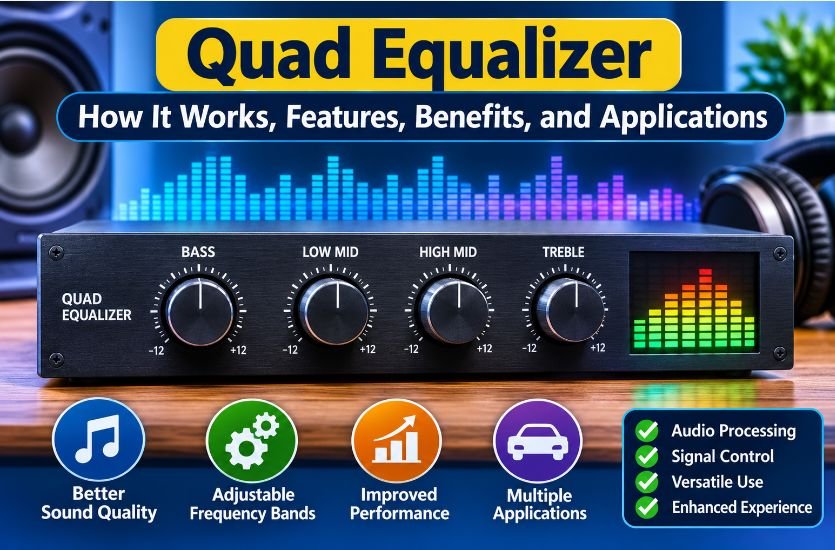
A Quad Equalizer is a term associated with audio processing and electronic signal management. Depending on its design, it can refer to an equalizer that controls four different audio frequency ranges or a four-channel electronic component that improves the quality of signals during transmission. Both applications focus on controlling and improving signal performance, although they serve different purposes.
In audio systems, a four-band equalizer helps users adjust bass, midrange, and treble characteristics to achieve a more balanced listening experience. In digital electronics, a quad equalizer works with multiple signal channels to compensate for signal loss and maintain reliable communication. Understanding these differences helps users identify the right equipment for their particular needs.
Quick Answer: What Is a Quad Equalizer?
| Feature | Explanation |
|---|---|
| Term | Quad Equalizer |
| Main purpose | Audio frequency adjustment or multi-channel signal conditioning |
| Audio configuration | Four adjustable frequency bands |
| Electronic configuration | Four independent signal channels |
| Common applications | Car audio, home entertainment, music production, and digital electronics |
| Main benefits | Improved sound balance, signal quality, and processing control |
| Related technologies | Graphic EQ, parametric EQ, and digital signal processing |
What Does Quad Equalizer Mean?
The term Quad Equalizer describes an equalization system involving four bands or four separate processing channels. Its exact meaning depends on the product, technology, and environment in which it is used. In everyday audio discussions, it generally refers to a four-band equalizer that provides control over different sections of the sound spectrum.
An equalizer is a device or software feature that changes the level of selected frequencies within an audio signal. By increasing or reducing specific frequency ranges, users can customize the sound according to their preferences and equipment requirements. A quad equalizer provides a relatively simple way to manage several important frequency sections without requiring the extensive controls found in professional audio equipment. Understanding equalization and audio frequency control also helps explain how different frequency adjustments influence the overall sound.
However, the word quad does not always mean four frequency bands. In professional electronics, it can describe a component that processes four separate signals. This distinction is particularly important when researching hardware specifications because a four-channel signal equalizer performs a different task from a four-band audio equalizer.
How Does a Quad Equalizer Work?
A Quad Equalizer works by controlling selected parts of an audio signal or by compensating for signal degradation in an electronic system. Its operation depends on whether it is designed for audio processing or digital communication.
In audio applications, the equalizer receives an audio signal and separates its frequency content into different adjustable sections. Each section has controls that allow users to increase or decrease the corresponding frequency range. These adjustments change the overall tonal balance without necessarily changing the entire volume of the recording.
For example, someone listening to music through headphones might want stronger bass but clearer vocals. A quad equalizer allows that listener to adjust the low-frequency and midrange sections independently. Similarly, reducing excessive treble can make certain recordings sound less harsh.
In digital electronics, equalization addresses a different problem. Electrical signals can lose quality when they travel through cables, connectors, and circuit-board pathways. A four-channel equalizer can compensate for certain signal distortions and help maintain reliable data transmission.
Four Main Frequency Sections in a Quad Equalizer
A typical four-band audio equalizer divides sound into four adjustable frequency sections. The exact frequency ranges depend on the equipment, but each section has a particular influence on the listening experience.
1. Bass Frequencies
Bass controls the lower-frequency portion of an audio signal. These frequencies contribute to the depth and weight of music, including bass guitars, kick drums, and other low-pitched instruments.
Increasing bass can make music sound fuller and more powerful. However, excessive bass may create a muddy listening experience, particularly when speakers are unable to reproduce low frequencies accurately.
A quad equalizer gives users an opportunity to adjust the bass level according to their speakers, listening environment, and personal preferences.
2. Low-Midrange Frequencies
The low-midrange section contributes to the body and warmth of many musical instruments and vocals. It plays an important role in making recordings sound full rather than thin.
Too much energy in this frequency area can make music sound crowded or muddy. Reducing certain frequencies may improve separation between instruments and make the overall recording easier to understand.
The correct adjustment depends on the original recording and the characteristics of the audio equipment.
3. High-Midrange Frequencies
High-midrange frequencies influence vocal presence, instrument definition, and overall clarity. They help listeners distinguish important details in music, including speech and the sounds of guitars, keyboards, and other instruments.
Increasing this section slightly can make vocals appear more prominent. However, excessive boosting may introduce harshness or listening fatigue.
A properly adjusted high-midrange section can contribute to a clearer and more balanced audio experience.
4. Treble Frequencies
Treble controls the higher-frequency content of an audio signal. These frequencies contribute to brightness, detail, and the perception of clarity.
Increasing treble can make certain recordings sound more open and detailed. On the other hand, excessive treble may create sharp or uncomfortable sounds, particularly when listening through bright-sounding headphones or speakers.
A quad equalizer allows users to reduce or increase treble according to their equipment and listening preferences.
Different Types of Quad Equalizers
Quad equalizers are not limited to one specific design. Different configurations are available depending on the level of control required and the intended application.
Four-Band Graphic Equalizer
A four-band graphic equalizer provides separate controls for four frequency ranges. Its frequency positions are generally fixed, making it relatively straightforward to operate.
This design is suitable for users who want basic tonal adjustments without dealing with complicated audio settings. It can be used in certain car audio systems, home entertainment equipment, and other sound applications.
Four-Band Parametric Equalizer
A four-band parametric equalizer offers more control than a basic graphic design. Depending on the model, users can adjust the center frequency, gain, and bandwidth of each band.
This flexibility makes parametric equalizers useful for audio engineers and experienced users who need more precise sound adjustments. They can help address specific frequency problems that cannot be controlled easily through fixed-frequency settings.
Four-Channel Equalizer
A four-channel equalizer processes four independent signal paths rather than dividing one audio signal into four frequency bands.
This configuration is found in professional audio equipment and electronic components designed for high-speed signal processing. Each channel can handle a separate signal, depending on the hardware design.
Digital Quad Equalizer
A digital quad equalizer uses digital signal processing techniques to control or compensate for signals. In audio equipment, digital processing can provide flexible frequency adjustments and programmable settings.
In electronic applications, digital equalization can help compensate for transmission-related signal degradation. Its capabilities depend on the supported signal format, processing architecture, and technical specifications.
Applications of Quad Equalizer Technology
Quad equalization has applications in different industries, particularly in modern audio technology, where sound processing and signal management play important roles. Audio-based systems focus on improving sound characteristics, while electronic signal equalizers help maintain communication quality.
Car Audio Systems
Car audio is one of the practical environments where four-band equalization can be useful. Vehicle interiors have different acoustic characteristics because of their size, materials, seating positions, and speaker placement.
A quad equalizer allows drivers to adjust bass, midrange, and treble characteristics to achieve a more enjoyable listening experience. These adjustments can help compensate for certain tonal imbalances in the vehicle.
The best settings depend on the speakers, amplifier, music type, and interior acoustics.
Home Entertainment Systems
Home entertainment systems use equalization to customize sound from televisions, speakers, amplifiers, and other audio devices.
A four-band equalizer can help users adjust audio according to room conditions and listening preferences. For example, reducing excessive low-frequency energy may help control bass buildup in a small room.
These adjustments can make movies, television programs, and music more comfortable to listen to.
Music Production and Recording Studios
Professional audio production requires careful control over different frequency ranges. Sound engineers use equalization to improve the balance of vocals and instruments during recording, mixing, and mastering.
A four-band equalizer can provide basic tonal adjustments, while more advanced parametric and digital equalizers offer additional precision.
Equalization is particularly useful when different instruments compete for similar frequency space. Appropriate adjustments can improve separation and make a recording sound more organized.
Live Sound Applications
Live performances require audio equipment that can handle changing acoustic conditions. Sound engineers use equalizers to adjust the tonal characteristics of microphones, instruments, and speaker systems.
A suitable equalizer can help reduce unwanted frequencies and improve clarity for audiences. Professional systems may use more advanced equalization tools when dealing with larger venues and complicated sound environments.
Digital Communication Systems
In digital electronics, quad equalizers are used to process multiple high-speed signals. They can compensate for signal degradation caused by transmission through cables and other electrical connections.
This technology is relevant to certain networking, display, and communication applications. Unlike audio equalizers, these components are designed to preserve the quality and reliability of electronic data signals rather than modify the sound of music.
Benefits of Using a Quad Equalizer
One of the main advantages of a Quad Equalizer is the ability to manage different frequency sections or signal channels through a single system. Its practical benefits depend on the type of equalizer being used.
For audio enthusiasts, a four-band design offers convenient sound customization. Users can adjust bass, midrange, and treble characteristics without requiring a complicated professional setup. This makes it useful for people who want more control than basic volume settings provide.
Another advantage is improved tonal balance. Certain recordings may contain excessive bass, weak vocals, or sharp high frequencies. Equalization allows users to make controlled adjustments that can improve the overall listening experience.
Quad equalizers can also provide flexibility across different environments. Depending on the design, they can be integrated into car audio systems, home entertainment equipment, recording setups, and professional sound systems.
In digital electronics, four-channel equalization offers another important benefit. It can help compensate for transmission losses and support more reliable high-speed signal communication.
Quad Equalizer vs. Other Equalizer Types
Different equalizers provide different levels of control. Understanding their characteristics makes it easier to select equipment that matches a particular requirement.
A two-band equalizer generally provides basic bass and treble controls. It is suitable for simple adjustments but offers limited control over the middle frequencies.
A four-band equalizer provides additional frequency sections, giving users greater flexibility when adjusting sound. It offers a practical balance between simplicity and control.
A graphic equalizer can contain several frequency bands with fixed center frequencies. It is useful when more detailed frequency adjustments are required.
A parametric equalizer provides more advanced control because users can adjust specific frequency points and bandwidth. It is commonly used in professional audio production.
A four-channel equalizer is different from these frequency-based configurations because it processes separate signal paths. Therefore, its specifications should be evaluated according to its intended electronic application.
Understanding Professional Quad EQ Equipment
The term Quad EQ also appears in professional audio equipment. One example is the Mackie Quad EQ, a professional digital graphic equalizer associated with four processing channels and 30-band equalization.
Its configuration demonstrates an important distinction between the number of channels and the number of frequency bands. Four channels refer to the separate processing paths, while 30 bands describe the available frequency adjustments within each channel.
This type of equipment is intended for more advanced audio applications than a simple four-band equalizer. It illustrates how the word quad can describe the number of channels rather than the number of frequency controls.
When researching professional equipment, users should examine the manufacturer’s specifications carefully. Product names alone may not provide enough information to determine the actual processing capabilities.
Quad Equalizer in Digital Electronics
Quad equalizers also have an important role in high-speed electronic communication. In these applications, the main objective is to maintain signal integrity rather than improve audio quality.
For example, the Texas Instruments DS32EV400 quad equalizer is a four-channel DisplayPort component designed to compensate for signal degradation in high-speed data transmission. It helps address transmission-related problems that can affect signal quality over electrical connections.
Similarly, the Semtech GN2402 is associated with four-channel high-speed data equalization and signal-processing applications.
These technologies demonstrate that quad equalization is not exclusively an audio concept. The same general principle of compensating for signal-related problems can be applied to different electronic systems.
However, audio equipment and digital signal-conditioning components are not interchangeable. They have different operating requirements, specifications, and intended applications.
How to Choose the Right Quad Equalizer
Choosing the right quad equalizer begins with identifying its intended purpose. Someone looking to improve music playback requires a different product from an engineer working with high-speed electronic signals.
For audio applications, users should consider the number of frequency bands, available adjustment options, and compatibility with existing equipment. A basic four-band equalizer may be sufficient for everyday listening, while professional applications may require parametric controls and more advanced processing capabilities.
Compatibility is another important consideration. An equalizer must work properly with the relevant speakers, amplifiers, receivers, or audio interfaces. Users should also consider signal levels and connection types before purchasing equipment.
For electronic applications, technical specifications are especially important. Supported data rates, interfaces, channel configurations, and signal-conditioning capabilities should match the requirements of the system.
Ease of operation, reliability, and overall performance are also important factors. Comparing technical documentation instead of relying entirely on product descriptions can help users make a more informed decision.
Common Quad Equalizer Mistakes to Avoid
One common mistake is assuming that increasing every frequency improves sound quality. Excessive boosting can make audio unbalanced and may introduce distortion. A more effective approach is to make small adjustments and compare the results with the original sound.
Another mistake is using identical equalizer settings for every speaker or listening environment. Different rooms, headphones, and vehicle interiors have different acoustic characteristics. Settings that work well with one system may not produce the same results with another.
Some users also confuse four-band equalizers with four-channel equalizers. Although the terminology sounds similar, the two configurations perform different functions. Understanding the product specifications is essential before making a purchase.
Finally, equalization should not be treated as a replacement for properly functioning equipment. An equalizer cannot fully correct damaged speakers, poor connections, or serious acoustic problems. Good-quality audio equipment and suitable installation remain important.
Future of Quad Equalizer Technology
Equalization technology continues to develop alongside improvements in audio processing and electronic communication. Digital signal processing has made it possible to create more flexible equalizers with programmable controls and advanced adjustment capabilities.
In consumer audio, software-based equalization allows users to customize sound through computers, smartphones, headphones, and entertainment systems. These features make audio adjustments more accessible without requiring separate physical equipment.
Professional audio systems are also benefiting from increasingly advanced digital processing. Engineers can use sophisticated equalization tools to manage complex sound environments and achieve more precise results.
In digital electronics, signal equalization remains important as communication systems demand higher data rates and more reliable transmission. Improvements in signal-conditioning technology help electronic devices manage the challenges associated with high-speed connections.
Although the specific designs may change, the underlying purpose of equalization remains consistent: controlling or compensating for signals to achieve the required performance.
Conclusion
A Quad Equalizer is a versatile term that describes different types of equalization technology. In audio applications, it commonly refers to a four-band system that allows users to adjust frequency ranges and improve tonal balance. In digital electronics, it can describe a four-channel component designed to compensate for signal degradation and support reliable data transmission.
Understanding the difference between these applications is essential when researching or selecting an equalizer. Whether used in car audio, home entertainment, music production, or electronic communication, the appropriate system depends on its design and technical capabilities.
With the right configuration and careful adjustments, quad equalization can provide useful control over sound quality or electronic signal performance.