








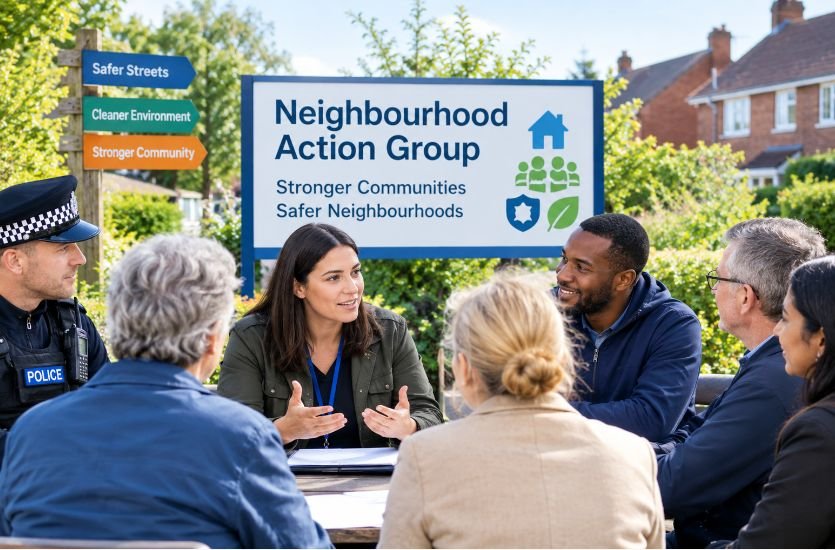
A Neighbourhood Action Group brings residents and local organisations together to address problems that affect everyday life in their community. In the United Kingdom, these groups often work with neighbourhood police teams, local councils, businesses and other community representatives to identify local concerns and coordinate practical responses. Their work can focus on crime prevention, antisocial behaviour, environmental problems, traffic management and improving the overall quality of neighbourhood life.
The main purpose of a Neighbourhood Action Group is to give local people a meaningful voice in decisions affecting their area. Instead of treating every concern as an isolated complaint, the group helps identify shared priorities, connect residents with the appropriate authorities and encourage cooperation between organisations that can make a difference.
Quick Answer: Neighbourhood Action Group
| Detail | Information |
|---|---|
| Meaning | A community-based group that works to address local problems |
| Common abbreviation | NAG |
| Main purpose | Improve community safety and neighbourhood conditions |
| Typical members | Residents, police representatives, council officials, businesses and community organisations |
| Common issues | Crime, antisocial behaviour, graffiti, fly-tipping, speeding and parking |
| Working approach | Consultation, cooperation, action planning and follow-up |
| Common location | United Kingdom, although similar community groups operate elsewhere |
What Is a Neighbourhood Action Group?
A Neighbourhood Action Group is generally a volunteer-led or community-based initiative established to address issues identified by people living or working in a particular area. In many UK communities, these groups have a close relationship with neighbourhood policing and local government. They provide a structured way for residents to communicate concerns and work with organisations responsible for public services and community safety.
The exact structure of a Neighbourhood Action Group varies by location. Some operate primarily as community safety partnerships, while others focus on environmental improvements, traffic concerns or broader neighbourhood development. The name does not necessarily refer to one national organisation, and individual groups may have different responsibilities, membership arrangements and meeting schedules.
For example, Swallowfield Parish Council describes the Fields Neighbourhood Action Group as a community initiative addressing concerns such as burglaries, vandalism, graffiti, fly-tipping, speeding and inappropriate parking. Finchampstead Parish Council describes a NAG as a multi-agency problem-solving group involving local residents, partner organisations and other stakeholders. These examples demonstrate how the same general concept can be adapted to the needs of different communities.
How Does a Neighbourhood Action Group Work?
The work of a Neighbourhood Action Group usually begins with identifying the problems residents consider most important. Community members may raise concerns through public meetings, discussions with representatives, consultations or other communication channels. The group then considers which issues require collective attention and which organisations are best placed to respond.
Once priorities have been established, members can coordinate with police officers, council departments, housing providers, schools, local businesses and voluntary organisations. Responsibilities may be divided among participants according to their expertise and authority. For instance, police representatives may address relevant crime and safety concerns, while council departments may handle environmental issues or parking enforcement within their remit.
Progress depends on communication, clearly assigned responsibilities and regular follow-up. A group may review whether reported problems have improved, identify obstacles and revise its priorities when circumstances change. This approach helps turn community discussions into practical work rather than allowing meetings to become conversations without clear outcomes.
Not every Neighbourhood Action Group follows the same process. Its arrangements depend on local needs, available resources, participating organisations and the relationship between the group and public authorities.
Main Responsibilities of a Neighbourhood Action Group
Improving Community Safety
Community safety is a major focus for many neighbourhood action groups, particularly those associated with local policing. Residents may raise concerns about burglary, vandalism, threatening behaviour, disorder or repeated incidents in public spaces. By bringing these concerns together, the group can help authorities understand patterns and identify locations that require attention.
A Neighbourhood Action Group does not replace the police. Instead, it provides a channel for communication and cooperation. Members can encourage residents to report incidents through the appropriate official channels and help communicate recurring concerns to relevant authorities. Immediate threats, emergencies and crimes should still be reported directly to the appropriate services rather than waiting for a group meeting.
Addressing Antisocial Behaviour
Antisocial behaviour can affect residents’ comfort, confidence and quality of life. Persistent noise, intimidation, vandalism, misuse of shared spaces and other disruptive activities may become major concerns when they repeatedly affect the same neighbourhood.
A Neighbourhood Action Group can help bring together the residents and agencies involved in addressing these problems. Depending on the circumstances, this may include police representatives, housing associations, council officers, youth services or community organisations.
Effective responses require accurate information and proportionate action. Groups should distinguish verified incidents from rumours and avoid blaming individuals without evidence. Their role is to communicate concerns responsibly and support appropriate solutions, not to encourage confrontation or public accusations.
Maintaining a Cleaner Environment
Environmental problems can influence how residents feel about their neighbourhood. Litter, graffiti, abandoned waste, fly-tipping and neglected public spaces may create frustration and reduce confidence in local services.
A Neighbourhood Action Group can help residents identify recurring problems, report them to the responsible authority and coordinate suitable community initiatives. Depending on local arrangements, this may include organised clean-ups, awareness campaigns or cooperation with council environmental teams.
Some problems require enforcement or specialist services rather than volunteer activity alone. For example, the removal of illegally dumped waste may involve the local authority, while hazardous materials require an appropriate professional response. Identifying the responsible organisation is therefore an important part of effective community action.
Supporting Safer Roads and Better Parking
Traffic problems are another common concern. Excessive speeding, unsafe road layouts, obstructed pavements, inappropriate parking and vehicles using restricted routes can affect pedestrians, cyclists, residents and other road users.
A Neighbourhood Action Group can collect residents’ concerns and communicate them to the appropriate council or transport authority. Where relevant, it can work with neighbourhood policing teams to highlight traffic-related safety issues.
The group cannot automatically introduce speed limits, issue parking penalties or change road layouts. Those decisions belong to the relevant authorities under applicable rules. Its contribution is to help identify problems, communicate evidence and encourage the responsible organisations to consider appropriate measures.
Who Can Join a Neighbourhood Action Group?
Membership commonly includes local residents and representatives from organisations with an interest in community wellbeing. Depending on the area, participants may include parish or borough councillors, neighbourhood police officers, council staff, housing association representatives, school representatives, business owners and volunteers involved in community safety.
Young people can also contribute valuable perspectives, especially when discussions concern public spaces, school routes, recreation facilities and antisocial behaviour affecting younger residents. Finchampstead Parish Council specifically identifies young people and underrepresented community members as potential participants in its NAG arrangements.
A diverse membership helps ensure that the group does not represent only the views of a small number of residents. People with different experiences may identify problems that others overlook, while representatives of public agencies can explain which solutions are realistic and what procedures must be followed.
Members do not necessarily need professional qualifications. Communication, reliability, local knowledge, cooperation and a willingness to contribute constructively are often more useful than specialised experience. However, each group may have its own membership requirements and expectations.
Real Examples of Neighbourhood Action Groups in the UK
Fields Neighbourhood Action Group in Berkshire
The Fields Neighbourhood Action Group provides an example of a community safety initiative covering multiple settlements in Berkshire. Information published by Swallowfield Parish Council identifies concerns including burglary, vandalism, graffiti, fly-tipping, dangerous dogs, speeding and parking violations.
The example illustrates how one group can address a broad range of issues rather than concentrating on a single problem. It also demonstrates the importance of coordinating concerns across neighbouring communities that may share roads, public services and other local facilities.
Safer Langley Neighbourhood Action Group in Slough
Slough Borough Council describes the Safer Langley Neighbourhood Action Group as part of its wider community safety work. Its stated areas of focus include environmental concerns, highways and parking, antisocial behaviour, violence against women and girls, and serious violence.
The group also places importance on communication, including helping residents understand how to report concerns and contact relevant representatives. This example shows how a Neighbourhood Action Group can connect community safety with environmental management and local public services.
Finchampstead Neighbourhood Action Group
Finchampstead Parish Council describes its Neighbourhood Action Group as a multi-agency initiative in which volunteers and partner organisations work around priorities identified through community consultation. Its published information discusses participation by residents, councillors, police representatives, businesses, schools and other relevant organisations.
The council’s information also highlights the value of practical skills, community representation and cooperation. It notes that participation can allow residents to influence local priorities, work with partner agencies and develop experience in communication, teamwork and community problem-solving.
These examples should be understood as individual local arrangements, not evidence that every Neighbourhood Action Group operates identically. A group’s current activity, meeting schedule and priorities should be confirmed through its relevant local authority or community organisation.
How a Neighbourhood Action Group Identifies Priorities
An effective group needs a fair and transparent method for deciding which issues to address. Residents may have different concerns, and not every problem can be resolved immediately. A structured priority-setting process helps the group use its time and available resources responsibly.
The first step is to gather information from a broad range of community members. This can include reports of recurring problems, feedback from public meetings and information supplied by relevant agencies. The group then considers the seriousness of each issue, the number of people affected, potential risks and whether an appropriate organisation can take action.
After reviewing the evidence, members can agree on a manageable set of priorities. Clear objectives make it easier to identify the next steps, assign responsibilities and review progress. For example, a group addressing repeated fly-tipping might record the locations where incidents occur, communicate with the responsible council department and monitor whether the problem continues.
Priorities should not remain fixed regardless of changing circumstances. A new safety concern may require immediate attention, while a previously important issue may become less urgent after effective intervention. Periodic reviews allow the group to respond to changing needs and give residents opportunities to contribute new information.
Benefits of a Neighbourhood Action Group
Stronger Communication Between Residents and Authorities
One of the principal benefits of a Neighbourhood Action Group is the creation of a more organised communication channel. Residents may not always know which organisation is responsible for a particular problem or how to raise a recurring concern. A group can help clarify responsibilities and direct information to the appropriate contacts.
Regular communication can also help public agencies understand how decisions affect people in a particular area. When residents explain their concerns clearly and provide relevant information, authorities may be better positioned to assess local needs and determine suitable responses.
Greater Community Participation
A Neighbourhood Action Group gives residents an opportunity to participate in improving the place where they live. Instead of relying entirely on public agencies to identify every concern, community members can contribute their observations, experience and practical ideas.
Participation can also build relationships among people who might not otherwise interact. Residents, businesses, volunteers and public officials can develop a better understanding of each other’s responsibilities and limitations. This cooperation can be particularly useful when a problem requires several organisations to contribute.
Better Coordination of Local Resources
Community problems often involve more than one agency. Repeated antisocial behaviour, for example, may require communication among police, housing providers, council teams and community services. Without coordination, separate organisations may address different parts of the problem without sharing a clear understanding of the overall situation.
A Neighbourhood Action Group can help bring relevant participants together, clarify who is responsible for particular tasks and encourage follow-up. Although the group cannot guarantee that every problem will be resolved, a coordinated approach can make it easier to identify practical actions and avoid unnecessary duplication.
Improved Local Quality of Life
When community concerns receive appropriate attention, residents may experience improvements in cleanliness, road safety, public spaces and confidence in local services. Visible improvements can also encourage more people to participate in community initiatives.
However, the benefits of a Neighbourhood Action Group depend on the nature of local problems, the commitment of participants and the capacity of responsible agencies. A group should not claim that crime has decreased or safety has improved significantly without reliable evidence. Its effectiveness is better assessed through documented actions, feedback and measurable changes where suitable data are available.
Challenges Faced by Neighbourhood Action Groups
Despite their potential benefits, Neighbourhood Action Groups can face practical difficulties. Volunteer time is limited, meeting attendance may fluctuate and residents may disagree about which issues deserve priority. Some problems also require funding, specialist expertise or legal authority that the group itself does not possess.
Another challenge is maintaining engagement after the initial enthusiasm fades. Residents may lose confidence if concerns are repeatedly discussed without visible progress. Clear communication about what has been reported, which organisation is responsible and what remains unresolved can help manage expectations.
Representativeness is equally important. If meetings involve only a small group of residents, their priorities may not reflect the needs of the wider community. Making participation accessible, communicating through different channels and inviting underrepresented groups can help improve the quality of discussion.
Confidentiality and responsible information handling must also be considered. Personal details, allegations and sensitive information should not be circulated casually. Groups should follow applicable privacy requirements and the procedures of their partner organisations, particularly when discussing individual incidents or vulnerable people.
Neighbourhood Action Group vs Neighbourhood Watch
A Neighbourhood Action Group and a Neighbourhood Watch scheme can both contribute to safer communities, but their roles are not necessarily identical.
Neighbourhood Watch commonly centres on community-led crime prevention, awareness and communication among residents. A Neighbourhood Action Group, particularly in the UK context, often brings together a wider range of residents and partner agencies to identify and address several local priorities. These may include crime, environmental issues, traffic and antisocial behaviour.
The two approaches can complement one another. A local Neighbourhood Watch coordinator may share community concerns with a Neighbourhood Action Group, while the action group may help communicate wider priorities to residents. Their precise responsibilities depend on local arrangements, and neither should be confused with a law enforcement agency.
How to Get Involved in a Neighbourhood Action Group
Residents interested in participating can begin by checking whether a group operates in their neighbourhood. A parish or town council, borough council, neighbourhood policing team or established community organisation may be able to provide information about local arrangements.
Potential members can ask how meetings are organised, what issues the group currently addresses and whether residents can attend or submit concerns. Some groups welcome anyone who wishes to contribute, while others use defined membership or representation arrangements.
Before attending, it can be helpful to prepare a concise description of the problem, its location, how frequently it occurs and how it affects the community. Reliable observations and details of previous reports are generally more useful than rumours or unsupported accusations. Residents should also continue to report urgent incidents through the appropriate official channels.
Those who cannot attend meetings may still be able to participate by sharing feedback, responding to consultations or supporting suitable local projects. Consistent, respectful involvement can help the group understand community needs and identify realistic ways to respond.
The Future of Neighbourhood Action Groups
The future effectiveness of Neighbourhood Action Groups will depend partly on how well they adapt to changing community needs. Digital communication can make it easier to share meeting information, collect feedback and update residents on progress. However, online participation should complement accessible in-person communication rather than exclude people who have limited digital access.
Partnership working will remain important because neighbourhood problems rarely fall neatly within the responsibilities of a single organisation. Cooperation between residents, councils, police, schools, businesses and voluntary groups can help build a more complete understanding of local issues.
Groups can also improve accountability by documenting agreed actions, identifying responsible organisations and reviewing progress against clear objectives. Where reliable data are available, they can compare conditions over time and assess whether particular interventions appear to be making a difference.
The broader principle is straightforward: effective community action requires more than identifying problems. It requires realistic priorities, cooperation, clear responsibilities and sustained attention to results. A Neighbourhood Action Group can provide a useful structure for bringing these elements together while ensuring that residents have a voice in the process.
Conclusion
A Neighbourhood Action Group provides a practical way for residents and local organisations to work together on problems affecting community safety and everyday life. Depending on local needs, its activities may cover crime prevention, antisocial behaviour, environmental concerns, traffic issues and communication with public authorities.
Examples from Berkshire and Slough demonstrate how these groups can connect residents with police teams, councils and other partners. Their success, however, depends on meaningful participation, clear responsibilities, realistic expectations and consistent follow-up.
When organised effectively, a Neighbourhood Action Group can help communities identify shared priorities, coordinate appropriate responses and contribute to a cleaner, safer and more connected neighbourhood. Its greatest value lies in turning local concerns into constructive cooperation and practical action.