







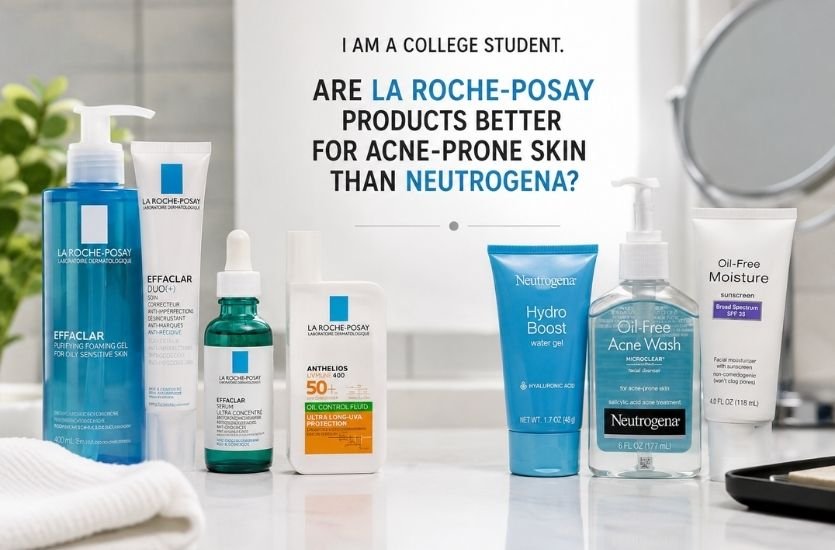
College life can be exciting, but acne can make it considerably more frustrating. Between lectures, exams, late nights, stress, changing routines, and a limited student budget, finding skincare that actually works can feel like another assignment.
That leads to a common question among students: Are La Roche-Posay products better for acne-prone skin than Neutrogena?
The short answer is not necessarily. Both La Roche-Posay and Neutrogena offer products designed for acne-prone skin, including formulas containing well-established ingredients such as salicylic acid and benzoyl peroxide. Neutrogena also offers adapalene 0.1% products, while La Roche-Posay’s Effaclar range includes acne treatments featuring salicylic acid and benzoyl peroxide.
The real question is not which logo is printed on the bottle. It is which formula, active ingredient and routine are appropriate for your particular skin.
Also Read: Glossywise Com: What Is It, How Does It Work, and Is Glossywise Com Legit?
La Roche-Posay vs. Neutrogena for Acne-Prone Skin
At first glance, the two brands may seem very similar. Both are widely recognized skincare brands with products aimed at oily, blemish-prone and acne-prone skin.
La Roche-Posay is particularly well known for its Effaclar range, which is formulated around oily and acne-prone skin. The brand lists ingredients such as salicylic acid, benzoyl peroxide and glycolic acid across its Effaclar products and emphasizes formulations designed with skin tolerance in mind.
Neutrogena, meanwhile, has a broad acne portfolio that includes salicylic-acid products, benzoyl-peroxide treatments, cleansers, moisturizers, patches and adapalene 0.1% gel. Its newer Evenly Clear range is specifically designed to address acne and post-acne marks.
So, La Roche-Posay is not automatically better than Neutrogena for acne-prone skin. The better option depends on what your skin needs.
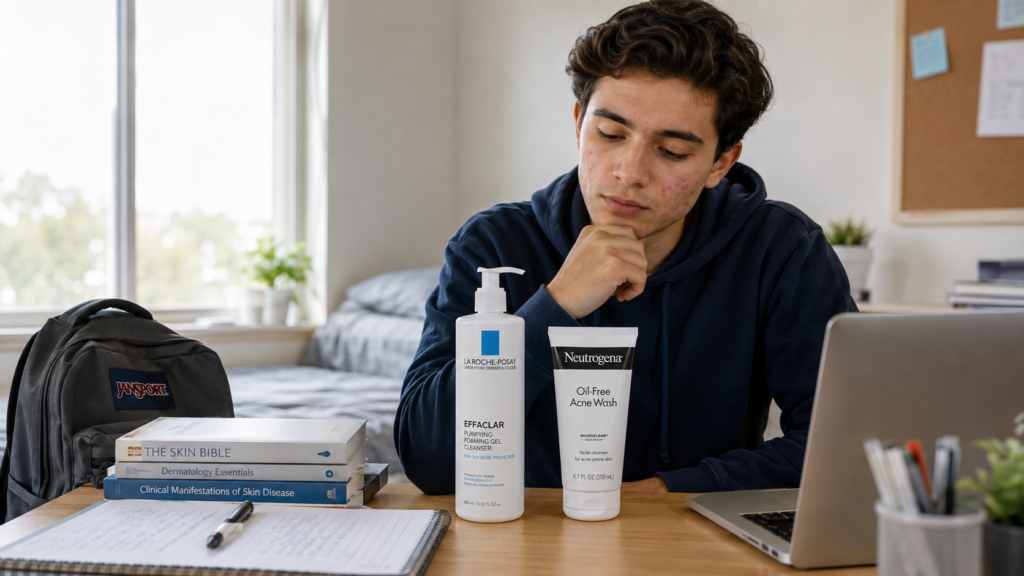
Why the Active Ingredient Matters More Than the Brand
Here’s the part many college students overlook: dermatologists generally focus on active ingredients, not simply brand names.
The American Academy of Dermatology recommends evidence-supported acne treatments including benzoyl peroxide, topical retinoids, salicylic acid and azelaic acid.
That means a $10–$20 product containing an appropriate active ingredient may be more useful for your acne than a more expensive product simply because it comes from a premium skincare brand.
Salicylic Acid for Clogged Pores
If your main concerns are blackheads, whiteheads and clogged pores, salicylic acid can be particularly useful.
According to the American Academy of Dermatology, salicylic acid helps open clogged pores and exfoliate the skin and is especially useful for whiteheads and pimples.
Both La Roche-Posay and Neutrogena offer salicylic-acid acne products, so this category does not give one brand an automatic victory.
Benzoyl Peroxide for Inflamed Acne
If you are dealing with red, inflamed pimples, benzoyl peroxide may be a more relevant ingredient.
The AAD explains that benzoyl peroxide reduces acne-causing bacteria and is an established acne treatment.
La Roche-Posay’s Effaclar range currently includes a 5.5% micronized benzoyl peroxide treatment, while Neutrogena also offers several benzoyl-peroxide products.
However, stronger does not always mean better. Benzoyl peroxide can cause dryness or irritation, particularly when someone is new to acne treatment.
Adapalene for Persistent Breakouts
For students struggling with recurring clogged pores and breakouts, adapalene is another ingredient worth knowing.
The AAD identifies topical retinoids such as adapalene as effective acne treatments because they help unclog pores and reduce inflammation.
Neutrogena currently sells an adapalene 0.1% acne treatment through its Evenly Clear range.
This illustrates why comparing entire brands can be misleading. One person may prefer a Neutrogena adapalene product, while another may prefer a La Roche-Posay cleanser or moisturizer.
Is La Roche-Posay Better for Sensitive Acne-Prone Skin?
This is where La Roche-Posay can become particularly appealing.
Acne-prone skin is not always oily, tough or resistant. Some students have acne alongside redness, dryness, sensitivity or irritation.
La Roche-Posay’s Effaclar range is specifically positioned for oily and acne-prone skin, and its formulations include ingredients intended to address blemishes while considering skin tolerance.
However, this does not mean every La Roche-Posay product will be gentler for every individual. Acne treatments themselves can irritate the skin regardless of the brand.
The AAD notes that benzoyl peroxide, salicylic acid and topical retinoids can dry and irritate skin. A suitable moisturizer can help the skin tolerate these treatments.
So if you have sensitive skin, the smartest approach is not simply to buy the most expensive acne product. Instead, introduce active ingredients gradually and pay attention to how your skin responds.
Is Neutrogena Better for College Students on a Budget?
For many students, price matters.
A skincare routine that costs a large portion of a monthly student budget is difficult to maintain. Neutrogena has a broad acne range, including cleansers, treatments, moisturizers, patches and other products, giving students plenty of options at different price points.
This makes Neutrogena particularly attractive to students who want affordable acne skincare without building an elaborate routine.
That does not make every Neutrogena product better than every La Roche-Posay product. It simply means that value and accessibility can be major advantages.
For a college student, consistency is often more important than buying the most expensive bottle on the shelf.
What About Moisturizer for Acne-Prone Skin?
This may sound strange if your skin is already oily, but skipping moisturizer can sometimes make an acne routine harder to tolerate.
The AAD explains that acne treatments such as benzoyl peroxide, salicylic acid and adapalene can dry and irritate the skin. Dermatologists may therefore recommend a moisturizer to help reduce dryness and improve treatment tolerance.
When shopping for acne-prone skin, look for terms such as oil-free, non-comedogenic or won’t clog pores.
This is another area where neither brand automatically wins. The best moisturizer is the one that suits your skin, does not cause problems and fits comfortably into your budget.
La Roche-Posay or Neutrogena: Which Is Better for Different Acne Concerns?
The answer becomes much clearer when the comparison is based on individual concerns.
For blackheads and clogged pores: Look for a salicylic-acid product. Both brands offer options.
For inflamed pimples: Benzoyl peroxide may be useful, and both brands offer products containing it.
For persistent acne and clogged pores: Adapalene is an evidence-supported option, and Neutrogena currently offers an adapalene 0.1% product.
For sensitive, acne-prone skin: La Roche-Posay may be attractive because its Effaclar range emphasizes acne-prone and sensitive-skin considerations, but individual formulas still matter.
For students seeking a wide selection: Neutrogena’s extensive acne range provides multiple treatment formats and ingredients.
For students on a tight budget: Compare the price of the specific products rather than assuming one entire brand is cheaper.
A Simple Acne Routine for a College Student
You do not need a bathroom shelf full of products to create a reasonable acne routine.
A simple routine can begin with a gentle cleanser, one appropriate acne treatment, a non-comedogenic moisturizer and broad-spectrum sunscreen.
The important word is simple.
Adding five different acne treatments at once may sound productive, but it can make irritation more likely and make it difficult to determine which product is helping or causing problems.
The AAD advises people using non-prescription acne treatments to select an active ingredient appropriate for their acne and give the treatment time to work rather than constantly switching products.
Don’t Expect Overnight Results
This is perhaps the most important lesson for a busy college student.
Acne treatment usually requires patience.
The AAD notes that some acne treatments may take several weeks before improvement becomes noticeable.
That means switching from La Roche-Posay to Neutrogena—or from Neutrogena to another brand—after only a few days may not tell you anything useful.
Give an appropriate routine time to work, while following the product’s directions and watching for significant irritation.
What If Your Acne Keeps Getting Worse?
Skincare products are not a substitute for professional medical care when acne is severe or persistent.
If you have painful deep acne, cysts, nodules, significant scarring or acne that does not improve with appropriate over-the-counter treatment, speaking with a dermatologist is a better next step.
The AAD specifically recommends seeking professional help when acne causes cysts or nodules, leaves scars, or has not cleared with non-prescription treatment.
A dermatologist can also help determine whether your breakouts are actually acne or another condition that looks similar.
What About Benzoyl Peroxide Safety?
There has also been recent discussion about benzoyl peroxide products and benzene formation under certain conditions.
The AAD explains that the FDA tested benzoyl-peroxide acne products in 2025 and found that more than 90% had undetectable or extremely low benzene levels, while some products with elevated levels were voluntarily recalled. The AAD recommends following storage instructions and avoiding excessive heat.
This is not a reason to assume that La Roche-Posay or Neutrogena acne products are inherently unsafe. It is simply a reminder to store benzoyl-peroxide products according to their instructions, especially in hot environments.
So, Are La Roche-Posay Products Better Than Neutrogena?
After looking beyond the brand names, the answer is clear: there is no universal winner.
La Roche-Posay may be the more appealing choice for someone who wants an acne-focused range with an emphasis on sensitive and oily skin, particularly within Effaclar. Neutrogena may be the more practical choice for a college student who wants a broad selection of affordable acne treatments, including salicylic acid, benzoyl peroxide and adapalene.
The deciding factor should be the specific product and active ingredient, not the popularity of the brand.
If one product gives your skin the right treatment without excessive dryness or irritation, fits your budget and is easy to use consistently, it may be the better choice for you.
Final Verdict
So, “I am a college student. Are La Roche-Posay products better for acne-prone skin than Neutrogena?”
Not automatically.
La Roche-Posay may have an advantage for students who prioritize acne-focused formulas and sensitive-skin considerations. Neutrogena can be an excellent choice for students looking for accessible, versatile and budget-conscious acne treatment options.
Ultimately, effective acne skincare comes down to choosing the right active ingredient, using it consistently, protecting the skin barrier and giving the routine enough time to work.
The smartest college-student skincare routine is not necessarily the most expensive one. It is the one that matches your acne, suits your skin, fits your budget and is realistic enough to follow every day.
Also Visit: Expand Magazine