









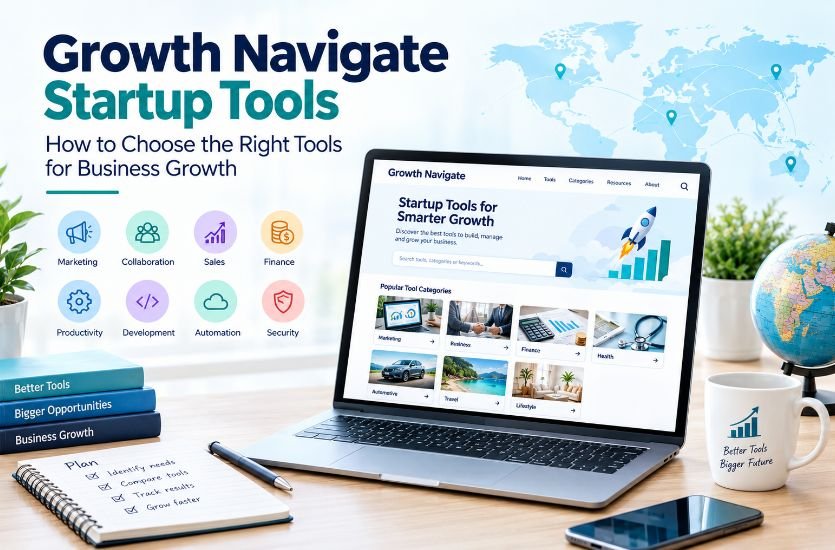
Launching a startup requires more than an innovative idea. Founders must manage marketing, sales, customer relationships, finances, team communication, and daily operations while working with limited time and resources. The right digital tools can make these responsibilities easier by organizing workflows, reducing repetitive tasks, and helping teams make informed decisions.
Growth Navigate Startup Tools is a keyword associated with resources and software directories designed to help entrepreneurs explore tools for business development. The specific page at GrowthNavigate.com highlights tools for copywriting, team collaboration, and sales, while other similarly named websites offer different resources and selection frameworks. Understanding these distinctions is important when researching the topic.
For startup founders, the main objective is not to collect as many applications as possible. It is to identify the tools that address current business challenges, fit the available budget, and support sustainable growth.
Quick Answer: What Are Growth Navigate Startup Tools?
Growth Navigate Startup Tools refers to digital software, platforms, and resources that help startup founders manage essential business activities and identify opportunities for growth. Depending on the platform and context, the term may describe a specific startup-tools directory or a broader collection of tools for marketing, sales, analytics, productivity, automation, and business management.
The purpose of these tools is to help startups operate efficiently, understand customer needs, organize their work, and make better decisions as the business develops.
Read Growth Navigate Funding: Business Capital & Growth Strategies
Understanding the Growth Navigate Startup Tools Concept
The phrase combines two important ideas: navigating business growth and selecting suitable startup tools. Navigating growth means identifying the next business priority, understanding what prevents progress, and choosing a practical way to address that challenge.
For example, a startup struggling to generate website traffic may need search engine optimization and content marketing tools. A company receiving inquiries but losing potential customers may benefit more from customer relationship management software. A small team spending hours on repetitive administrative work might achieve better results by introducing workflow automation.
Growth Navigate Startup Tools can help readers explore these different needs rather than assuming every startup requires the same software. The most useful approach is to identify a specific business problem before comparing available solutions.
Key Categories of Growth Navigate Startup Tools
Startup software covers several business functions. Each category serves a different purpose, and the right combination depends on the company’s industry, development stage, and objectives.
1. Marketing and SEO Tools
Marketing tools help startups reach potential customers, publish useful content, and build visibility across digital channels. Search engine optimization tools can support keyword research, competitor analysis, backlink monitoring, and website performance evaluation.
For startups that rely on organic traffic, these resources can help identify relevant search queries and develop content around customer needs. Email marketing platforms and social media management tools can also help businesses communicate with their audiences consistently.
However, software alone cannot guarantee better search rankings or increased sales. Results depend on content quality, audience relevance, competition, and the effectiveness of the overall marketing strategy.
2. Customer Relationship Management Tools
Customer relationship management, commonly known as CRM, is an important part of startup operations. CRM software helps businesses maintain customer records, organize leads, monitor sales opportunities, and manage follow-up activities.
Without a centralized system, founders may lose track of conversations across email, spreadsheets, messaging applications, and other communication channels. A CRM creates a more organized process for handling potential customers.
HubSpot CRM and Zoho CRM are examples of platforms that offer customer management capabilities. Early-stage businesses can compare their features, available plans, integrations, and ease of use before selecting a solution.
The objective is to maintain clear customer records and create a consistent sales process without introducing unnecessary administrative work.
3. Project Management and Team Collaboration
As a startup grows, coordinating tasks becomes increasingly difficult. Team members may work on different projects, manage separate deadlines, and depend on information from colleagues to complete their responsibilities.
Project management software helps organize assignments, deadlines, progress updates, and responsibilities in one place. Collaboration platforms also support communication, document sharing, and the exchange of ideas.
Tools such as Notion, Asana, Slack, and Miro serve different purposes within this category. Some focus on project planning, while others emphasize communication, documentation, or visual collaboration.
Choosing the right platform can reduce confusion and improve accountability. Nevertheless, startups should avoid maintaining several applications that perform nearly identical functions.
4. Analytics and Performance Tracking
Business growth becomes easier to evaluate when founders understand what is happening across their websites, marketing campaigns, and customer journeys.
Analytics tools collect and organize information that helps businesses assess traffic, engagement, conversion rates, and other relevant performance indicators. Google Analytics 4, for example, helps website owners examine user interactions and traffic sources.
For software companies, product analytics can provide additional insight into how customers use specific features, where users stop progressing, and which experiences encourage continued engagement.
The value of analytics depends on collecting reliable data and interpreting it correctly. Founders should begin with a small number of meaningful indicators rather than creating complicated dashboards that provide little practical guidance.
5. Automation and Artificial Intelligence Tools
Automation tools help startups connect applications and reduce repetitive manual activities. Common examples include transferring information between systems, creating notifications, organizing incoming leads, and initiating follow-up tasks.
Zapier is one example of a platform used to connect supported applications and automate workflows. Artificial intelligence tools can also assist with drafting content, summarizing information, generating ideas, and supporting software development.
These capabilities can be particularly useful for small teams that cannot immediately hire specialists for every business function. However, automated processes require appropriate testing and oversight, especially when they involve customer information, financial records, or external communications.
The best automation strategy starts with a repeated task that consumes time and has a clearly defined outcome. Automating a poorly designed process can simply make mistakes happen faster.
Popular Tools Featured in Startup Software Directories
Startup tool directories help founders discover potential solutions without researching every product independently. The Growth Navigate startup-tools page at GrowthNavigate.com features products across copywriting, collaboration, and sales categories.
The following examples illustrate how different tools can support startup operations.
| Tool | Primary purpose | Potential startup use |
|---|---|---|
| Jasper | AI-assisted content creation | Developing marketing content |
| Copy.ai | AI-assisted writing and workflows | Supporting content and business communication |
| Grammarly | Writing assistance | Improving clarity and proofreading |
| Slack | Team communication | Coordinating internal discussions |
| Asana | Project management | Tracking assignments and deadlines |
| Notion | Documentation and workspace management | Organizing company knowledge |
| Loom | Video messaging | Explaining tasks and sharing updates |
| HubSpot Sales Hub | Sales management | Organizing customer interactions and sales activities |
| Zoho CRM | Customer relationship management | Maintaining lead and customer records |
| Pipedrive | Sales pipeline management | Tracking deals and sales progress |
The suitability of these products depends on a startup’s actual requirements. Their inclusion in a directory does not automatically mean that every business needs them or that one option is better than all alternatives.
Founders should also verify current features, pricing, usage limits, and integration options directly with each provider before committing to a subscription.
How Growth Navigate Startup Tools Can Support Business Growth
Improving Operational Efficiency
Startups often operate with small teams that must handle several responsibilities simultaneously. The right tools can organize workflows, reduce repetitive work, and make important information easier to access.
For example, connecting a website contact form to a CRM can reduce manual data entry. A project management platform can help team members understand their responsibilities without requiring constant status meetings.
These improvements may free up time for product development, customer research, and other activities that contribute more directly to business objectives.
Strengthening Customer Acquisition
Acquiring customers requires a coordinated approach to marketing, sales, and communication. SEO tools can help identify relevant search opportunities, analytics platforms can measure website activity, and CRM systems can organize potential customers.
When these systems support a clear process, founders can better understand how prospective customers discover the business and move toward making a purchase.
However, purchasing several marketing applications does not automatically generate demand. Businesses still need a useful product, a clearly defined audience, effective messaging, and a compelling reason for customers to choose their offering.
Supporting Data-Based Decisions
Founders frequently face decisions about marketing budgets, hiring, product features, and customer retention. Reliable business data can help replace assumptions with measurable evidence.
For instance, analytics may reveal that a large percentage of website visitors leave before completing a registration process. The team can investigate the problem, test a potential improvement, and compare the results.
This approach encourages continuous learning instead of making expensive changes based solely on intuition.
Preparing for Business Expansion
A process that works for five customers may become difficult to manage when the company serves hundreds. As transaction volumes and team responsibilities increase, startups may need more structured systems for customer support, financial management, reporting, and workflow coordination.
Selecting flexible tools early can make future transitions easier. Nevertheless, founders should avoid paying for advanced capabilities long before the business has a genuine need for them.
How to Choose the Right Startup Tools
Selecting software requires more than comparing feature lists. A practical decision should account for the problem being solved, the team’s capacity, the available budget, and the expected benefit.
Identify the Business Problem First
Before searching for a new application, determine which activity needs improvement. The problem might involve missed sales follow-ups, inconsistent publishing, unclear project ownership, or limited visibility into website performance.
A clearly defined problem makes it easier to evaluate whether a proposed tool offers a meaningful solution.
Match Tools to the Startup’s Stage
An early-stage startup usually has different requirements from an established company with multiple departments. A new business may need a basic CRM, website analytics, shared documentation, and a simple project management system.
As the company develops, specialized tools may become useful for advanced reporting, customer segmentation, automation, or product analytics.
The right choice should reflect current operational needs while allowing reasonable room for growth.
Evaluate the Total Cost
Subscription prices are only one part of the overall cost. Founders should also consider onboarding, training, integrations, usage limits, maintenance, and the time required to manage the software.
A free plan may be sufficient for a small team, while a paid subscription may become worthwhile when it provides a clear operational advantage. The important question is whether the expected benefit justifies the total expense.
Check Integrations and Data Management
Startup tools are more useful when they can exchange information reliably. Poor integration can create duplicate records, inconsistent reports, and additional manual work.
Businesses should review supported integrations, data export options, access controls, and security practices before adopting a new platform. They should also consider whether the application can work with the systems already used by the team.
Test Before Making a Long-Term Commitment
Whenever possible, founders should evaluate a trial or free version using a realistic business task. A short test can reveal whether the interface is practical, the setup is manageable, and the software delivers the expected benefit.
The decision should be based on actual usage rather than marketing claims alone.
Common Mistakes to Avoid When Using Startup Tools
One common mistake is adopting too many applications at the same time. Every additional platform introduces setup requirements, notifications, training needs, and potential integration problems. A smaller, well-organized software stack is often easier to maintain.
Another mistake is choosing software because it is popular rather than because it solves a specific problem. A sophisticated tool may be unnecessary for a startup that only needs a basic workflow.
Founders should also avoid ignoring employee adoption. Even powerful software provides limited value when team members do not understand how to use it or cannot incorporate it into their regular responsibilities.
Finally, businesses should not confuse activity with progress. Publishing more content, sending more emails, or automating more tasks does not necessarily mean the company is growing. Each tool should support a meaningful business outcome, such as qualified leads, improved customer retention, reduced processing time, or higher conversion rates.
The Future of Growth Navigate Startup Tools
Startup software continues to evolve as artificial intelligence, automation, analytics, and cloud-based collaboration become more accessible. These developments are giving small teams additional ways to perform work that previously required more people or specialized technical resources.
AI-assisted development tools, for example, can support coding and testing, while intelligent automation can help coordinate activities across connected applications. Improved analytics can also help businesses understand customer behavior and identify areas that deserve attention.
Despite these developments, technology does not replace sound business judgment. Founders still need to understand their customers, maintain financial discipline, protect sensitive information, and evaluate whether their systems are producing useful results.
The most effective approach is to adopt new capabilities carefully, measure their impact, and make changes when the evidence supports them.
Conclusion
Growth Navigate Startup Tools represents a useful topic for entrepreneurs looking to understand the software and digital resources that support startup development. From marketing and CRM systems to analytics, collaboration, and automation, different tools can help businesses organize their operations and address specific growth challenges.
The best software stack is not necessarily the largest or most expensive. It is the combination of tools that fits the startup’s current stage, budget, team, and objectives. By defining business problems first, comparing suitable options, and measuring results, founders can build a more efficient operating system without creating unnecessary complexity.
Ultimately, sustainable startup growth depends on combining appropriate technology with strong execution, customer understanding, and consistent evaluation.