









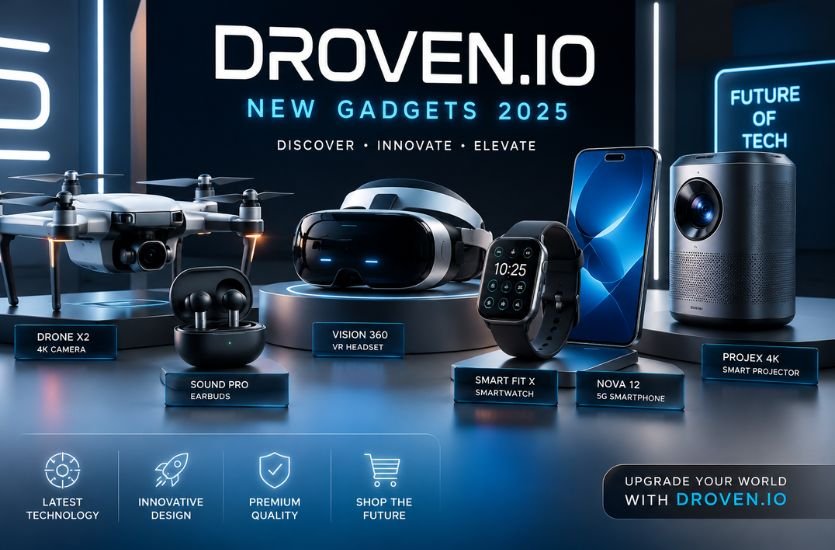
Technology no longer waits for users to tell it what to do. In 2025, the most interesting gadgets began moving toward a different idea: devices that understand context, automate routine tasks, and work together more intelligently.
That shift is at the heart of the interest surrounding “droven.io new gadgets 2025.” Droven.io’s technology coverage focuses on emerging technology, AI, gadgets, devices, and technology trends. Its own 2025 gadget coverage highlights the broader movement toward smarter, more connected, and more efficient consumer technology.
But there is an important distinction worth making from the beginning. Droven.io is best understood as an editorial and technology-information platform, rather than a manufacturer with a single proprietary lineup of “Droven” gadgets. Therefore, searches for Droven.io new gadgets 2025 are more useful when interpreted as an exploration of the gadgets, devices, and technology trends discussed in connection with the platform.
So, what actually made 2025 different? And which innovations were genuinely useful rather than simply futuristic?
Also Read: Xuzhanikanoz3.2.5.0: What It Is, Reported Features, Safety, and What You Should Know
What Is Droven.io New Gadgets 2025?
The phrase Droven.io new gadgets 2025 generally refers to searches and discussions surrounding new consumer technology, smart devices, AI-powered hardware, wearables, connected-home products, and other emerging gadgets associated with Droven.io’s technology coverage.
Droven.io’s own 2025 smart-device coverage emphasizes several characteristics of modern gadgets, including stronger AI integration, improved connectivity, automation, better battery performance, security, and energy efficiency.
This makes the topic broader than a conventional product list.
Instead of asking only, “What gadgets were released?”, a better question is:
“What did new gadgets actually change about the way people use technology?”
That question reveals the bigger story.
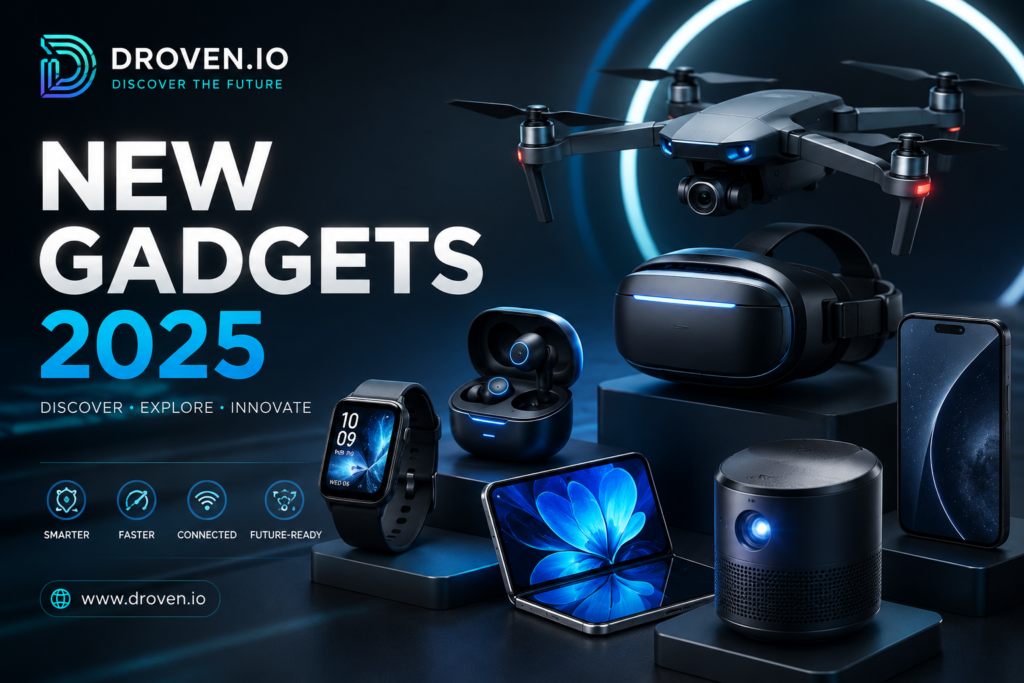
Why New Gadgets in 2025 Felt Different
For years, the word smart often meant that a device could connect to Wi-Fi or be controlled through a smartphone.
In 2025, that definition started becoming much broader.
AI increasingly became part of hardware itself. Wearables became more focused on continuous information. Smart homes moved toward automation. Computers gained dedicated AI capabilities. Foldable devices continued experimenting with new form factors, while robotics and autonomous systems brought AI into the physical world.
The important development was therefore not simply more gadgets.
It was more intelligence inside everyday gadgets.
AI-Powered Gadgets Became a Major Trend
One of the strongest themes associated with Droven.io new gadgets 2025 is the growing role of artificial intelligence in consumer technology.
AI can help devices perform tasks such as:
- Voice interaction
- Image recognition
- Personalization
- Translation
- Automated recommendations
- Device optimization
- Predictive functions
- Smart automation
The appeal is obvious.
Imagine a device that requires fewer menus, fewer taps, and fewer manual instructions because it can understand what you want in natural language.
That is the direction modern smart-device development has been taking.
However, AI should not automatically make a gadget better. A useful AI feature solves a genuine problem; an unnecessary AI feature simply adds another marketing term to the specification sheet.
Smart Home Gadgets Move Beyond Remote Control


7
Smart-home technology was another major part of the new gadgets 2025 conversation.
Earlier generations of smart-home products primarily allowed users to control devices remotely. You could switch lights on from a phone, adjust a thermostat, or view a security camera while away.
The next step is automation.
A modern smart-home setup can combine sensors, connected devices, rules, and AI to make decisions with less direct input.
For example, instead of manually controlling every light, a smart system can respond to occupancy, time, or other environmental information.
The real question is no longer:
“Can I control this device with my phone?”
It is:
“How much unnecessary work can this device remove from my day?”
That is a much stronger definition of smart technology.
Wearable Technology Becomes More Personal
Wearables remained one of the most interesting categories in 2025.
Smartwatches, fitness trackers, and smart rings increasingly focused on collecting information continuously rather than simply displaying notifications.
Common capabilities include activity tracking, heart-rate monitoring, sleep information, workout metrics, notifications, location features, and other health-related measurements.
Droven.io’s broader gadget coverage places wearables among the important developments in modern smart-device technology.
But consumers should be careful with health-related claims.
A consumer wearable is not automatically a medical device, and measurements can vary depending on sensors, software, device fit, and other factors. Health information should therefore be interpreted appropriately rather than treated as a professional medical diagnosis.
AI PCs and Smarter Computing
Another important development was the growth of AI-capable computers.
Instead of sending every AI-related task to remote cloud servers, newer computers increasingly include hardware designed to handle certain AI workloads locally.
This can provide potential benefits such as:
- Faster processing for supported tasks
- Reduced dependence on cloud services
- Greater privacy for some workloads
- Better power efficiency for specific AI operations
- New software capabilities
For consumers, however, the presence of an AI processor alone does not guarantee a meaningful improvement.
The better question is whether the software actually uses that hardware to deliver something useful.
Foldable Smartphones Continue to Experiment
Foldable smartphones remained one of the most visually distinctive areas of consumer technology.
The concept is simple but powerful: make the display larger without making the entire device permanently larger.
Foldable designs can provide advantages for multitasking, reading, gaming, video, and productivity.
But they also introduce compromises.
Potential buyers need to consider hinge durability, display durability, weight, thickness, battery performance, software support, repair costs, and long-term reliability.
A futuristic design may attract attention, but durability ultimately determines whether it is worth owning.
AR and VR Gadgets


5
Augmented reality and virtual reality continued to represent an important part of the future-gadget landscape.
AR attempts to place digital information into the user’s physical surroundings, while VR creates a more immersive digital environment.
Potential applications include gaming, education, training, design, entertainment, remote collaboration, and industrial visualization.
But the challenge is not simply creating impressive technology.
The technology also needs to be comfortable enough, useful enough, and affordable enough for people to use regularly.
That means factors such as weight, battery life, software availability, field of view, comfort, and ecosystem support can matter as much as display resolution.
Robotics and Autonomous Devices
Perhaps the biggest leap from digital AI to physical technology is robotics.
Software can analyze information on a screen. A robot has to understand and interact with the unpredictable physical world.
That makes autonomous devices particularly fascinating.
Potential applications include:
- Household assistance
- Cleaning
- Security
- Delivery
- Warehousing
- Inspection
- Navigation
- Industrial automation
Autonomous drones follow a similar path, combining cameras, sensors, navigation systems, and increasingly sophisticated software.
But greater autonomy also creates questions about safety, privacy, reliability, regulation, and responsibility.
Smart Gadgets for the Home and Kitchen
The smart-gadget trend also extended into everyday household equipment.
Droven.io’s 2025 smart-device coverage discusses categories including smart assistants, AI-enhanced televisions, security systems, portable projectors, and smart kitchen technology.
The interesting part is not simply that appliances can connect to the internet.
It is the possibility of automation and personalization.
A connected kitchen appliance, for example, could potentially simplify repetitive tasks, while smart entertainment systems can personalize recommendations and integrate multiple services.
However, consumers should always ask whether a connected feature provides real value or merely adds another app and another account to manage.
Energy Efficiency Is an Important Gadget Feature
Performance has traditionally dominated technology marketing.
But battery life and energy consumption became increasingly important as devices became more powerful.
This is particularly relevant to:
- Smartphones
- Smartwatches
- Wireless earbuds
- AI laptops
- Smart cameras
- Portable gaming devices
- Drones
- AR/VR devices
AI creates an additional engineering challenge because more computation can mean more energy consumption.
That makes efficient processors, local AI hardware, battery optimization, and intelligent power management increasingly important.
The best future gadgets therefore need to be powerful and efficient, rather than powerful at any cost.
Security and Privacy Matter More Than Ever
Here is a question many gadget buyers overlook:
What happens to the data your new device collects?
Modern gadgets can potentially collect information about locations, routines, preferences, voice commands, health metrics, home activity, and other personal behavior.
That makes security a fundamental part of gadget evaluation.
Before purchasing a connected device, users should consider:
- What information does it collect?
- Where is that information stored?
- Is the data encrypted?
- Does the company provide software updates?
- Can unnecessary permissions be disabled?
- How long will the device receive support?
- Does it require a permanent cloud connection?
A gadget can be technologically impressive and still be a poor purchase if its privacy protections are inadequate.
What Makes a New Gadget Worth Buying?
Not every new gadget deserves your money.
A good purchasing framework looks beyond the launch date and specifications.
| Factor | What to Ask |
|---|---|
| Purpose | What problem does it solve? |
| AI | Is the AI genuinely useful? |
| Battery | How long does it realistically operate? |
| Compatibility | Does it work with your existing devices? |
| Privacy | What personal data does it collect? |
| Security | How frequently does it receive updates? |
| Durability | Is it designed for long-term use? |
| Repairability | Can it be repaired economically? |
| Price | Does its functionality justify the cost? |
| Longevity | Will it remain useful in a few years? |
This approach separates innovation from novelty.
A gadget does not become valuable simply because it is new.
Droven.io New Gadgets 2025: What Consumers Should Understand
A major point of confusion surrounding this keyword is the assumption that every product mentioned online is an official Droven.io product.
That is not necessarily the case.
Droven.io’s own technology content covers smart devices and emerging technology, while third-party pages sometimes describe specific “Droven.io” products with detailed prices, features, or performance claims that are not clearly confirmed by Droven.io itself.
For that reason, readers should distinguish between:
Droven.io’s technology coverage
and
a product officially manufactured or sold by Droven.io.
That distinction is especially important when researching prices, specifications, availability, warranties, or product launches.
Who Can Benefit From Following New Gadget Trends?
Technology Enthusiasts
Tech enthusiasts can use emerging-gadget coverage to discover new hardware concepts and follow where consumer technology is heading.
Professionals
AI PCs, smart collaboration equipment, automation, and connected devices can potentially improve workplace productivity.
Smart-Home Users
People building connected homes can compare different approaches to lighting, security, entertainment, appliances, and automation.
Businesses
Companies can monitor emerging hardware that may influence automation, customer experiences, data collection, and workplace technology.
Everyday Consumers
Even people who are not technology enthusiasts can benefit from understanding gadget trends because smart technology is increasingly becoming part of ordinary daily life.
The Bigger Picture Behind Droven.io New Gadgets 2025
The most important story is not one particular gadget.
It is convergence.
A wearable can communicate with a smartphone. The smartphone can connect to an AI service. The AI can interact with smart-home devices. Those systems can potentially coordinate with cameras, computers, vehicles, and other connected products.
In other words, individual gadgets are gradually becoming components of larger technology ecosystems.
That creates enormous possibilities—but also greater complexity.
More connected devices can mean more accounts, more software dependencies, more data collection, and more potential security risks.
The future of gadgets therefore depends on more than raw technological capability.
It depends on usefulness, interoperability, privacy, security, affordability, and reliability.
Frequently Asked Questions
What does “Droven.io new gadgets 2025” mean?
It is a search phrase associated with Droven.io’s coverage of new gadgets, smart devices, emerging consumer technology, and broader technology trends in and around 2025.
Is Droven.io a gadget manufacturer?
Droven.io is better understood as a technology and editorial platform rather than a clearly established manufacturer of a proprietary consumer-gadget lineup. Its content discusses gadgets, devices, AI, and emerging technology.
What types of gadgets are associated with the 2025 coverage?
Major themes include AI-powered devices, wearables, smart-home technology, smart entertainment devices, foldable smartphones, AR/VR, robotics, autonomous systems, and energy-efficient technology.
Are all products mentioned online officially made by Droven.io?
No. Readers should verify individual products, prices, specifications, and availability against an original manufacturer or official source before treating a third-party claim as confirmed.
Why are AI gadgets important in 2025?
AI is increasingly being integrated directly into hardware, allowing devices to offer more personalized interactions, automation, recognition, recommendations, and other intelligent features.
What should I check before buying a new gadget?
Look at its real-world usefulness, specifications, compatibility, battery life, privacy, security updates, warranty, durability, repairability, and total cost of ownership.
Final Thoughts
The real story behind Droven.io new gadgets 2025 is bigger than a list of shiny new devices.
2025 demonstrated how quickly artificial intelligence, automation, connected ecosystems, wearable technology, smart homes, robotics, and immersive computing are moving into everyday products. Droven.io’s own gadget coverage reflects this wider transition toward devices that are more connected, intelligent, efficient, and personalized.
But the smartest purchase is not necessarily the newest one.
The best gadget is the one that solves a genuine problem, performs reliably, protects your information, works with your existing technology, and remains useful after the excitement of launch day disappears.
That is ultimately what makes the new-gadget conversation of 2025 worth following—and why the search for Droven.io new gadgets 2025 continues to attract attention from technology enthusiasts and everyday consumers alike.
Also Visit: Expand Magazine