








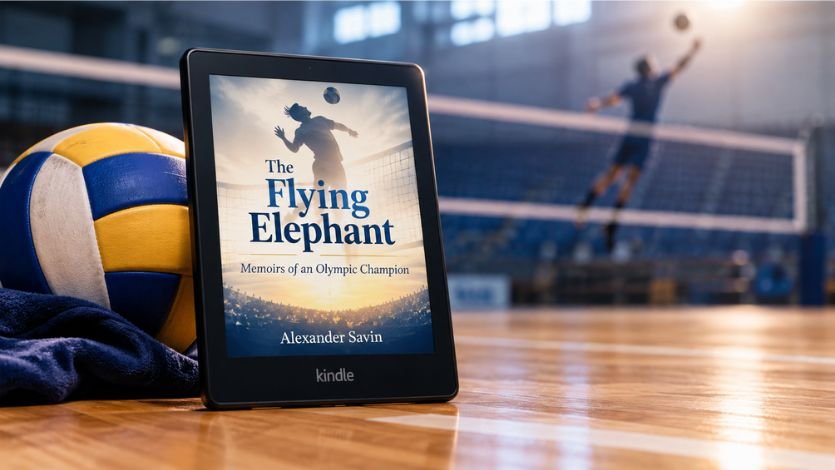
If you are searching for The Flying Elephant Memoirs of an Olympic Champion Kindle Edition Alexander Savin, you are looking at a sports memoir connected to one of the most successful periods in Soviet volleyball. Written by Alexander Savin, the book presents the story of an elite volleyball career shaped by Olympic competition, international sport, teammates, coaches, training, and the wider world surrounding Soviet volleyball.
Savin was part of the Soviet men’s volleyball team that won silver at the 1976 Montreal Olympics and gold at the 1980 Moscow Olympics. Those results give the memoir an important historical foundation, but the book is more than a record of medals. It provides a personal perspective on the sporting world in which those achievements took place.
The English Kindle edition has been reported as a substantial digital book of approximately 514 pages, with more than 240 photographs. Current edition information gives its publication date as October 26, 2025, although readers should always check the current retailer listing for the latest edition details.
Quick Answer
The Flying Elephant: Memoirs of an Olympic Champion is a sports memoir by Alexander Savin, the former Soviet volleyball player and Olympic champion. Savin won Olympic silver in Montreal in 1976 before becoming part of the Soviet gold-medal team at Moscow in 1980.
The English Kindle edition is reported to contain around 514 pages and more than 240 photographs, making it both a personal sports memoir and a visual record of an important period in volleyball history.
The Flying Elephant Book Details
| Detail | Information |
|---|---|
| Full title | The Flying Elephant: Memoirs of an Olympic Champion |
| Author | Alexander Savin |
| Main subject | Volleyball and Olympic sport |
| Format | Kindle edition |
| Language | English |
| Reported publication date | October 26, 2025 |
| Reported length | 514 pages |
| Photographs | More than 240 reported |
| Reported file size | Approximately 68.8 MB |
| Olympic highlights | Silver in 1976, gold in 1980 |
| Amazon identifier reported by current sources | B0FXVDWW16 |
The edition information above comes from current online descriptions of the English Kindle version. Kindle page counts, availability, pricing and marketplace features can vary, so those details should be confirmed on the relevant retailer page before purchase.
Who Is Alexander Savin?
Alexander Savin was a Soviet volleyball player who competed at the highest international level during a particularly important period in the sport.
His Olympic record is one of the clearest reasons the memoir attracts attention. Savin competed for the Soviet Union at the 1976 Montreal Games, where the team earned silver, and again at the 1980 Moscow Games, where the Soviet team won gold.
His career therefore connects two different Olympic experiences. Montreal represented a silver-medal finish, while Moscow ended with the Soviet Union at the top of the podium.
That progression provides an interesting background for a memoir because Olympic success is rarely represented accurately by medals alone. Behind every result are years of preparation, teammates, coaches, competition, setbacks and personal experiences.
Alexander Savin and Soviet Volleyball
To understand the significance of the memoir, it helps to understand the period in which Savin competed.
The Soviet Union was a major force in international volleyball, and its national teams regularly competed for major titles. Savin’s career developed inside that sporting environment, making his memories relevant not only to his own biography but also to the history of Soviet volleyball.
Current descriptions of the book associate the memoir with Savin’s experiences around CSKA Moscow and the USSR national team, as well as memories involving teammates and coaches.
This historical context gives the book two dimensions. It can be read as the story of one athlete, but it can also be approached as a personal record of a particular generation of volleyball.
What Is The Flying Elephant About?
At its core, The Flying Elephant is a memoir about Savin’s life and career in elite volleyball.
Descriptions of the English edition emphasize subjects such as training, competition, teammates, coaches, international tournaments and Olympic experiences. The book also includes a substantial collection of photographs, which adds a visual element to the written account.
A memoir differs from an ordinary sports reference book because it focuses on personal experience. Official statistics can establish that an athlete competed in an Olympic final or won a medal, but they cannot fully explain what the athlete remembers about the people, preparation and environment surrounding those events.
That is where a first-person sports memoir can provide additional value.
From Olympic Silver to Olympic Gold
One of the most important parts of Savin’s sporting history is the contrast between his two Olympic appearances.
Montreal 1976
At the 1976 Summer Olympics in Montreal, the Soviet men’s volleyball team finished with the silver medal.
For Savin, this represented an Olympic podium finish but not the championship.
Moscow 1980
Four years later, at the 1980 Moscow Olympics, Savin was part of the Soviet team that won the men’s volleyball gold medal.
The two results provide a natural storyline for the memoir: an Olympic silver medal followed by Olympic gold.
Rather than treating these results as isolated statistics, readers can use them as milestones for understanding Savin’s place within Soviet volleyball.
Why Is the Book Called The Flying Elephant?
The unusual title naturally raises a question: why “The Flying Elephant”?
Several secondary descriptions connect the nickname with the contrast between Savin’s physical presence and his movement and athletic ability on the volleyball court. The phrase suggests an athlete who combined considerable size with the ability to move and perform explosively.
However, the precise origin of the nickname should be treated carefully unless it is confirmed directly through the memoir or a primary interview. Secondary websites provide different descriptions of the title, so readers should distinguish the commonly repeated explanation from independently documented biography.
Either way, the title captures an interesting idea at the center of elite sport: physical characteristics do not always determine how an athlete moves or performs.
What Can Readers Expect From the Memoir?
The available descriptions suggest that the book goes beyond a simple list of victories.
Readers interested in the memoir can expect material connected with:
Elite Volleyball
The central subject is Savin’s experience as a high-level volleyball player.
Olympic Competition
His Olympic experiences, including the 1976 silver and 1980 gold, form an important part of the story.
Teammates and Coaches
Descriptions of the book emphasize memories of people who were part of Savin’s sporting environment.
Training and Preparation
The memoir is also associated with the preparation required for international competition and the demands of elite sport.
Soviet Volleyball History
Because Savin competed during the Soviet era, his personal story is connected to a broader chapter in international volleyball.
The 240+ Photographs
One of the most notable features repeatedly mentioned in descriptions of the English edition is its photographic collection.
Current sources report more than 240 photographs. The images are described as covering sporting and personal material connected with Savin’s career and the volleyball environment around him.
This matters because photographs can add historical context that ordinary text cannot provide.
A written memoir can describe a teammate or competition, while an archival photograph can show the people, uniforms, venues and atmosphere of the period.
For readers interested in sports history, this makes the book potentially useful as a visual document as well as a memoir.
The English Kindle Edition
The English Kindle edition makes Savin’s story accessible to readers who do not read the original language of the memoir.
Current publication information identifies the English edition as a Kindle book published in October 2025. Reports list a 514-page print length and approximately 68.8 MB of file size, with the large file size associated with the extensive photographic material.
Reported contributors to the English edition include Andrei Savine, Julia Savine and Alfredo Cabero, with Peter Murphy credited for the introduction.
Readers should distinguish these edition credits from the authorship of the memoir itself: Alexander Savin is the author, while the other names are associated with translation, editing or introductory material.
Why the Kindle Format Can Be Useful
A lengthy illustrated memoir can be convenient in digital format.
The Kindle edition allows readers to carry the book without needing a physical copy. Depending on the device and application, Kindle readers can also adjust text, search through the book and use standard reading and highlighting features.
The digital format may be particularly useful for readers who want to explore a long memoir in shorter sessions.
However, readers who particularly enjoy archival photographs may prefer a larger tablet or display because image presentation can differ between reading devices.
The Historical Value of the Memoir
The book has potential value beyond its role as an athlete autobiography.
Savin’s career belongs to a generation of Soviet volleyball players whose achievements occurred several decades ago. As time passes, first-person memories can become useful sources for understanding how sporting environments were experienced by the people who participated in them.
That does not mean every memory in a memoir should automatically be treated as an independently verified historical fact.
Memoirs are personal accounts. They contain memories, interpretations and individual perspectives.
The strongest approach is therefore to read The Flying Elephant as Savin’s account of his experiences, while using official Olympic records and other historical sources to verify specific dates, results and statistics.
The Human Side of Olympic Sport
One reason sports memoirs remain popular is that competition results rarely tell the whole story.
A medal table can show that an athlete won gold.
It cannot show the years of preparation behind that achievement.
It cannot fully explain relationships between teammates.
It cannot recreate the atmosphere of a training camp.
And it cannot capture every personal memory connected with an Olympic competition.
A memoir attempts to fill some of those gaps.
That is particularly relevant to The Flying Elephant, because Savin’s Olympic career provides a clear historical framework while the memoir offers a personal perspective on the sporting world around those achievements.
Who May Be Interested in The Flying Elephant?
Volleyball Fans
Readers who follow volleyball history have an obvious reason to explore Savin’s story.
Olympic History Readers
The book is particularly relevant to people researching the Soviet men’s volleyball teams at the 1976 and 1980 Games.
Sports Memoir Readers
Those who enjoy first-person accounts from athletes may appreciate the combination of personal experience and sporting history.
Sports Historians
The connection with Soviet volleyball gives the memoir potential value as a source of personal recollection from an important period.
Readers Interested in Soviet-Era Sport
The book provides an individual perspective on an athlete who competed under the Soviet sporting system.
What Makes This Memoir Interesting?
Several elements make the book stand out.
First is the author’s direct connection to Olympic volleyball. Savin was not an outside commentator writing about an era he never experienced. He was part of the Soviet teams competing at the Olympics.
Second is the contrast between his two Olympic results: silver in Montreal and gold in Moscow.
Third is the reported photographic collection of more than 240 images.
Finally, the memoir offers an opportunity to examine volleyball history through an individual’s memories rather than through competition statistics alone.
Things to Consider Before Reading
The book may not be equally suitable for every reader.
Someone looking for a purely statistical history of Olympic volleyball may prefer a reference source rather than a memoir.
Similarly, readers expecting a fast-paced match-by-match account should understand that a memoir is generally broader than competition results.
The book is more appropriate for readers interested in the person, career and historical environment behind the medals.
Another important consideration is that independent reviews of the English edition remain relatively limited. Much of the current online discussion comes from recent book-guide websites and the book’s own promotional material. Therefore, strong claims about the book’s emotional impact or literary quality should be understood as individual opinions rather than established critical consensus.
Frequently Asked Questions
Who is the author of The Flying Elephant?
Alexander Savin is the author of The Flying Elephant: Memoirs of an Olympic Champion.
What sport did Alexander Savin play?
Savin was a volleyball player who represented the Soviet Union at the international level.
What Olympic medals did Alexander Savin win?
He was part of the Soviet men’s volleyball team that won silver at the 1976 Montreal Olympics and gold at the 1980 Moscow Olympics.
Is The Flying Elephant available on Kindle?
Yes. Current sources describe an English Kindle edition of the memoir. Availability and pricing can vary by Amazon marketplace.
How many pages does the Kindle edition have?
Current edition descriptions report a 514-page print length. Kindle page displays can vary according to device and settings.
Does the book contain photographs?
Yes. Multiple current descriptions report more than 240 photographs.
When was the English Kindle edition published?
Current edition information gives October 26, 2025 as the reported publication date.
What is the meaning of “Flying Elephant”?
The title is commonly explained in secondary coverage as a reference to Savin’s combination of physical size and athletic movement. The precise origin of the nickname should be checked against primary material if an exact historical account is required.
Is this book only for volleyball fans?
No. Volleyball is central to the memoir, but its historical and autobiographical aspects may also interest Olympic-history readers, sports historians and readers interested in Soviet-era international sport.
Final Thoughts
The Flying Elephant: Memoirs of an Olympic Champion Kindle Edition Alexander Savin offers readers a personal route into the history of elite Soviet volleyball.
Alexander Savin’s Olympic record gives the memoir a strong foundation: silver with the Soviet Union at Montreal 1976 followed by gold at Moscow 1980. His story also belongs to a wider period in which Soviet volleyball played an important role on the international stage.
The English Kindle edition adds accessibility for modern readers and is reported to contain approximately 514 pages and more than 240 photographs. Those images give the book an additional historical dimension, particularly for readers interested in the people and sporting environments behind the official results.
Ultimately, The Flying Elephant is best approached not simply as a book about an Olympic gold medal, but as a memoir connected to an athlete, a team, a generation and an important chapter in volleyball history.
For readers searching for The Flying Elephant memoirs of an Olympic champion Kindle edition Alexander Savin, the book provides an opportunity to explore that story from the perspective of someone who was actually part of it.
Also Read: Extroly com: What Is Extroly.com? Complete Guide, Features, Content & More