








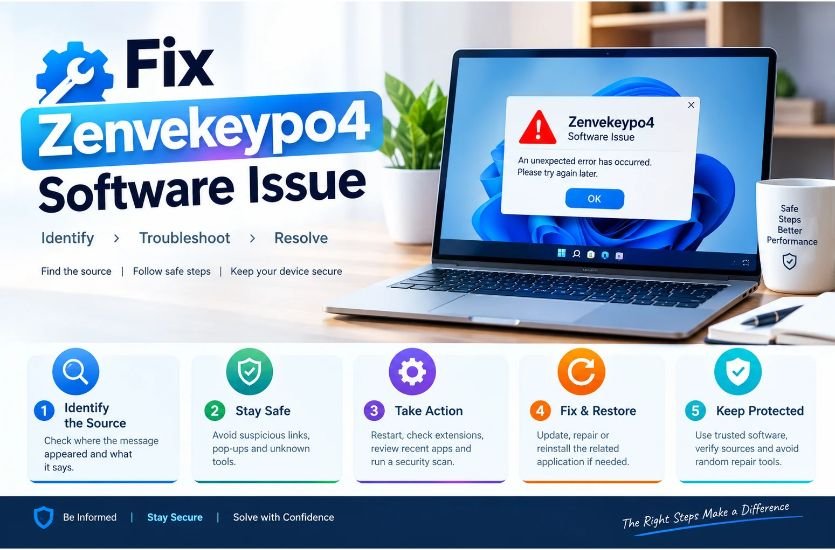
If you are searching for Fix Zenvekeypo4 Software Issue, you may have encountered an unfamiliar error, browser warning, pop-up, software message, file name, or system-related notification containing the term “Zenvekeypo4.” The unusual name can make the situation confusing because it is difficult to determine whether the problem belongs to a genuine software application, a browser notification, an unwanted program, or another component of the computer.
The most important point is that the publicly available information about Zenvekeypo4 is inconsistent. Some websites describe it as software associated with workflow, productivity, automation, or system functions, while other sources discuss the term in connection with suspicious pop-ups, redirects, or potentially unwanted activity. There is also no clearly established technical documentation that provides a universally accepted Zenvekeypo4 error code, official troubleshooting database, supported operating-system list, or definitive installation procedure.
Therefore, the safest way to fix a Zenvekeypo4 software issue is not to assume what the name means. Instead, first determine where the term appeared, what the complete message says, and what changed on the device before the problem occurred. Once the source is identified, the appropriate solution becomes much easier to determine.
Quick Answer: How to Fix Zenvekeypo4 Software Issue
If Zenvekeypo4 suddenly appears in a browser pop-up, redirect, notification, or unfamiliar warning, do not immediately download a repair program or click a “Fix Now” button. Close the suspicious page or notification, restart the browser, review recently installed extensions and applications, and run a security scan with trusted security software.
If Zenvekeypo4 is connected to a legitimate application that you intentionally installed, restart the application and computer, check for updates, verify permissions, inspect the exact error message, and consider repairing or reinstalling the underlying application from its legitimate source.
The most important solution is to identify the actual source of the Zenvekeypo4 message rather than downloading an unknown tool specifically advertised as a Zenvekeypo4 fixer.
What Is Zenvekeypo4?
Zenvekeypo4 is a difficult term to identify because online descriptions do not consistently agree about its identity or purpose. A website using the Zenvekeypo4 name exists and describes itself broadly as a platform providing information about software problems, errors, settings, and solutions. However, its publicly available material does not provide the level of technical documentation normally expected for an established software product, such as a clearly identified developer, detailed version history, system requirements, or comprehensive technical documentation.
Other websites describe Zenvekeypo4 in different ways. Some characterize it as workflow or productivity software, while others associate the term with security, system optimization, or other technical functions. These descriptions conflict enough that they should not automatically be treated as confirmed facts.
This distinction is important when troubleshooting. A software name appearing on several websites does not necessarily prove that those websites have independently verified the same product.
Consequently, the term Zenvekeypo4 software issue should initially be treated as an identifier that needs investigation rather than as a clearly documented error belonging to one known application.
Why Is the Zenvekeypo4 Software Issue Difficult to Identify?
A normal software problem can usually be traced to a recognized application. Users can identify the publisher, check the official documentation, locate known error codes, verify system requirements, and follow a recommended repair procedure.
The Zenvekeypo4 situation is different because public information is fragmented. Some pages provide generic troubleshooting instructions, while others make strong claims about the identity or security status of the term. The lack of consistent technical documentation makes it difficult to establish one universal explanation for every Zenvekeypo4-related message.
This means that two people searching for the same keyword could actually be dealing with completely different problems. One person might have an ordinary application crash, while another might have encountered a browser notification or suspicious webpage.
For that reason, the first troubleshooting question should always be:
Where exactly did the Zenvekeypo4 message appear?
The answer can completely change the appropriate solution.
Common Situations Where the Term May Appear
The Zenvekeypo4 name may be encountered in several different environments.
It could appear inside an application error message. In that case, the underlying application and its installation should be investigated first.
It could appear inside a web browser. If the message arrived through a webpage, redirect, notification, or pop-up, the problem may have more to do with browser behavior than with installed desktop software.
It could appear in a downloaded file or installer. This situation requires additional caution because unfamiliar executable files should not be opened simply because their names appear in a troubleshooting search.
It could also appear in a security notification or system-related message. In that case, the complete warning, file location, application name, and security-software findings are much more useful than the keyword alone.
Is Zenvekeypo4 a Serious Software Problem?
The seriousness of the problem depends on how the term appeared.
If it is simply an error message produced by an application that you recognize and intentionally installed, it may be an ordinary software malfunction caused by corrupted files, outdated components, permissions, configuration problems, or compatibility issues.
If the term suddenly appears through aggressive browser pop-ups, redirects, fake warnings, or a page demanding that you install an unfamiliar repair tool, the situation deserves more caution. Several websites discussing the keyword specifically warn users about this type of deceptive behavior. However, those websites do not by themselves establish that every Zenvekeypo4 reference is malware.
Therefore, users should distinguish between a real application problem and a potentially deceptive warning.
That distinction is one of the most important parts of safely resolving the issue.
Step 1: Read the Complete Error Message
Do not troubleshoot from the word “Zenvekeypo4” alone.
Write down the complete message displayed on the screen. Look for an error number, application name, file name, file extension, folder location, publisher name, or description of what went wrong.
For example, an error mentioning a specific application executable provides substantially more information than the isolated term Zenvekeypo4.
If the message contains a phone number, asks you to purchase technical support, demands immediate action, or tells you to download an unfamiliar program, do not follow those instructions until the message has been independently verified.
Step 2: Determine Whether the Message Came From a Browser
One of the most important checks is determining whether the message came from your browser.
A webpage can display messages designed to resemble Windows security warnings, application errors, virus notifications, or system alerts. A browser notification can also continue appearing after the original webpage has been closed if notification permissions were previously granted.
If Zenvekeypo4 appears only while visiting a particular webpage, that is important evidence that the browser environment may be involved.
Do not automatically interpret a browser pop-up as proof that the computer has a serious system infection.
Step 3: Close Suspicious Pop-Ups Without Interacting With Them
If an unexpected Zenvekeypo4 warning appears inside a browser and asks you to download software, install a “fix,” call support, or grant unusual permissions, avoid interacting with the buttons in the warning.
Close the browser tab or window using the normal browser controls. If the page prevents normal closing, ending the browser process through the operating system may be appropriate.
The reason for this caution is simple: a deceptive page can use technical language and alarming graphics to persuade users to install software they did not originally need.
Several articles discussing the Zenvekeypo4 keyword specifically recommend investigating the source before downloading supposed repair utilities.
Step 4: Restart the Browser
After closing a suspicious page, completely restart the browser.
If the message disappears and does not return, it may have been generated by the webpage rather than by an installed application.
If the warning returns repeatedly, investigate browser notifications, extensions, recently installed software, and browsing data.
A repeated pop-up should not automatically be interpreted as proof of malware, but it is a reason to investigate further.
Step 5: Check Browser Notifications
Modern browsers allow websites to request permission to send notifications.
If you accidentally allowed notifications from an unfamiliar website, those notifications can later appear outside the original webpage and may look like ordinary system messages.
Open the browser’s notification or site-permission settings and review websites that are allowed to send notifications.
Remove permission from unfamiliar or suspicious websites.
This step can be particularly useful when the Zenvekeypo4 message appears as a notification rather than as an error inside an application.
Step 6: Review Recently Installed Browser Extensions
Browser extensions can modify webpages, display advertisements, redirect searches, or interact with browsing sessions.
If the problem started after installing a new extension, temporarily disable that extension and observe whether the behavior stops.
Do not install another unknown extension merely because a website claims that it will remove the Zenvekeypo4 problem.
Use the browser’s own extension-management interface and remove extensions that you do not recognize or no longer need.
Step 7: Check Recently Installed Applications
If the Zenvekeypo4 reference appears outside the browser, inspect applications installed around the time the problem began.
On Windows, the installed-applications section can help identify recently added programs.
Look for unfamiliar applications, especially software installed immediately before the first appearance of the problem.
However, do not delete random system files simply because their names look unfamiliar. Windows contains many legitimate components that users may not recognize.
The objective is to identify a clear connection between the new problem and a recently installed application.
Step 8: Run a Security Scan
If Zenvekeypo4 appeared unexpectedly, especially after downloading an unknown file, visiting suspicious websites, or installing unfamiliar software, run a scan using trusted security software.
A security scan is preferable to downloading a random “Zenvekeypo4 removal tool” from an unverified website.
If the security software detects a specific threat, follow its documented removal or quarantine procedure.
The scan result is much more useful than an unsupported assumption that the Zenvekeypo4 name itself proves that malware is present.
Step 9: Check the File Location
If a specific Zenvekeypo4 file is identified, examine its location before taking action.
A file stored inside the installation directory of a legitimate application may belong to that application. A randomly located executable appearing in a temporary directory or an unfamiliar download folder deserves closer investigation.
The file name alone is not enough to establish whether a file is safe or dangerous.
Check the file’s properties, publisher information, digital signature where available, and the application that installed it.
If security software identifies the file as malicious, follow the security software’s recommendations rather than manually experimenting with the file.
Step 10: Restart the Computer
A full restart can resolve temporary software conflicts, locked processes, incomplete updates, and memory-related problems.
If Zenvekeypo4 is associated with an application that stopped responding, close the application and restart the computer before attempting more complicated changes.
If the issue disappears after restarting but returns repeatedly, record when it returns and what action triggers it. That information can help identify whether the problem is related to startup software, networking, browser activity, or another application.
Step 11: Check for Software Updates
If you know which legitimate application is producing the message, check whether that application has a newer version.
Outdated applications can experience compatibility problems after operating-system updates or changes to other dependencies.
Only obtain updates from the application’s legitimate publisher or a trusted software distribution channel.
Do not use a search result advertising an unofficial “Zenvekeypo4 update” unless you can verify that it belongs to the actual publisher of the software.
Step 12: Repair or Reinstall the Underlying Application
If Zenvekeypo4 is clearly connected to a legitimate application that you intentionally installed, the application’s repair or reinstall function may resolve corrupted installation files.
Before reinstalling, make sure important user data is backed up if the application stores files locally.
Uninstall the affected application through the normal operating-system process, restart the device if necessary, and install a fresh copy from the verified publisher.
This method is more appropriate when the problem can be traced to a known application than when Zenvekeypo4 appears only in a browser warning.
Step 13: Check Permissions
Some genuine applications fail because they lack permission to access required files, folders, devices, or network resources.
If the problem began after a security or operating-system change, review the application’s permissions.
On Windows, administrative privileges can sometimes affect how older applications operate. However, users should not permanently grant administrator access to an unknown program merely because a website recommends it.
If an application requires elevated permissions, first verify that the application itself is legitimate.
Step 14: Check Your Internet Connection
If the Zenvekeypo4 problem involves login failures, synchronization, online data, or remote services, network connectivity may be relevant.
Test another trusted website or application to determine whether the internet connection is working normally.
Restarting the router may help with temporary network problems, but it will not repair an incorrectly configured application or remove unwanted software.
If only one application is unable to connect while other services work normally, investigate that application’s server status, network permissions, proxy settings, or configuration.
Step 15: Clear Temporary Data Carefully
Corrupted temporary files and caches can sometimes cause applications or browsers to behave unexpectedly.
For a browser-related problem, clearing cached browsing data may resolve repeated page errors or stale content.
For an application, use the application’s own cache-clearing or repair function where available.
Do not randomly delete folders from Windows system directories simply because a troubleshooting article recommends clearing “all cache.”
The safest procedure depends on the software responsible for the problem.
Why You Should Avoid Random Zenvekeypo4 Repair Tools
This is one of the most important safety considerations.
When users search for an unfamiliar error, they may encounter websites offering a dedicated “Zenvekeypo4 fixer,” “Zenvekeypo4 repair tool,” or “Zenvekeypo4 removal program.”
The existence of such a download does not prove that the software is official.
Because there is no consistently documented Zenvekeypo4 product identity in the public sources reviewed, downloading an executable specifically marketed as a Zenvekeypo4 solution could create an additional security risk.
A legitimate troubleshooting process should identify the original application or source first.
Do not install an unknown program simply because it claims to repair the problem you searched for.
What If Zenvekeypo4 Appears After Visiting a Website?
If the term appears immediately after visiting a particular website, first consider the possibility that the website or an advertisement on it generated the message.
Close the page and see whether the warning continues.
If the warning disappears, review browser permissions and notifications.
If it continues after the browser has been closed, investigate startup applications, installed programs, browser extensions, and security notifications.
The important point is that a webpage can display a convincing warning without that warning representing an actual operating-system error.
What If Zenvekeypo4 Appears as a Windows Error?
A genuine Windows error usually provides additional information such as an application name, executable name, error code, or system component.
If the message specifically identifies Zenvekeypo4 but provides no recognizable publisher or application information, investigate the source before changing system files.
Avoid editing the Windows Registry simply because an online article recommends it.
Registry modifications can cause additional problems if performed incorrectly, and they are rarely the appropriate first response to an unidentified software name.
What If the Computer Becomes Slow?
If the device becomes unusually slow at the same time that the Zenvekeypo4 message appears, check system resource usage.
On Windows, Task Manager can show which applications and processes are consuming CPU, memory, disk, or network resources.
Look for a clear relationship between the unusual behavior and a specific process.
Do not terminate random Windows processes simply because their names look unfamiliar.
If an unknown process consumes substantial resources and a security scan identifies it as suspicious, follow the security software’s recommended response.
What If the Problem Started After a Download?
If Zenvekeypo4 appeared shortly after downloading a program, document, browser extension, or installer from an unfamiliar website, treat the timing as an important clue.
Do not reopen the downloaded file unnecessarily.
Run a security scan and inspect recently installed software.
If the download was supposed to be an update for another program, obtain the update directly from the legitimate publisher rather than using the same third-party download source.
What If the Issue Keeps Returning?
A recurring problem usually requires identifying the trigger rather than repeatedly restarting the device.
Record when the message appears.
Notice whether it happens during startup, while browsing, after opening a particular application, when connecting to the internet, or after downloading files.
This pattern can narrow the cause considerably.
If the message appears at startup, startup programs and scheduled tasks may deserve investigation.
If it appears only in a browser, browser permissions, extensions, and browsing activity become more relevant.
If it appears only when a particular application opens, the application’s installation and configuration should be examined.
When Should You Get Professional Help?
Professional assistance becomes appropriate when the problem is accompanied by suspicious security detections, repeated unauthorized browser behavior, unexplained account activity, important data loss, or system instability that cannot be safely diagnosed.
It is especially important to avoid experimenting with advanced system changes if you are not sure what a particular file or Windows component does.
A qualified technician can inspect the system while preserving important data and can determine whether the problem is an ordinary software failure or a potential security incident.
Frequently Asked Questions
What is the Zenvekeypo4 software issue?
The phrase “Zenvekeypo4 software issue” does not currently correspond to one consistently documented software error. Public websites use the term in different ways, so the actual problem must be identified from the context in which the name appeared.
Is Zenvekeypo4 definitely malware?
There is not enough reliable evidence to conclude that every occurrence of Zenvekeypo4 represents malware. Some websites make that claim, while other sources discuss it as a software-related term. If the name appears unexpectedly in suspicious pop-ups or redirects, however, it is sensible to treat the situation cautiously and perform a security check.
Should I download a Zenvekeypo4 repair tool?
No, not unless you can independently verify its publisher and legitimacy. Because the identity of Zenvekeypo4 itself is not consistently documented, an unknown repair utility could create more risk than the original problem.
Can restarting the computer fix the problem?
A restart can resolve temporary application failures, frozen processes, memory problems, and incomplete updates. It cannot by itself guarantee removal of unwanted software or resolve a persistent configuration problem.
Why does Zenvekeypo4 appear in my browser?
If the term appears only in a browser, it may be associated with a webpage, notification permission, redirect, advertisement, extension, or browser-related issue. Close the suspicious page and investigate browser permissions before downloading anything.
Should I delete a file named Zenvekeypo4?
Do not delete an unfamiliar file solely because its name contains Zenvekeypo4. First determine where the file came from, which application uses it, and whether trusted security software identifies it as a threat.
Can antivirus software fix the Zenvekeypo4 issue?
If the underlying problem is caused by malicious or potentially unwanted software, a trusted security scan may identify and remove the relevant threat. If the problem is an ordinary application error, antivirus software may not be the solution.
Final Takeaway
The safest way to Fix Zenvekeypo4 Software Issue is to avoid assuming that the keyword itself identifies a specific, well-documented application or error.
Current online information about Zenvekeypo4 is inconsistent. Some sources describe it as software, while others associate the term with suspicious warnings and browser activity. The available Zenvekeypo4-branded material discusses software problems broadly but does not establish a sufficiently detailed technical identity to support one universal repair procedure.
Therefore, the correct approach is to identify the source of the message first. If it belongs to a legitimate application, troubleshoot that application through restarting, updating, repairing, checking permissions, or reinstalling it from a verified source. If it appears as an unexpected browser warning or suspicious pop-up, avoid clicking its instructions, review browser permissions, inspect recently installed software, and run a trusted security scan.
Most importantly, do not allow an unfamiliar technical-sounding name to pressure you into downloading an unknown “fix.” A careful diagnosis is safer and more reliable than treating every Zenvekeypo4 message as the same software problem.
Also Read: Truzio Explained: What Is Truzio and Why Is It Trending Online?