









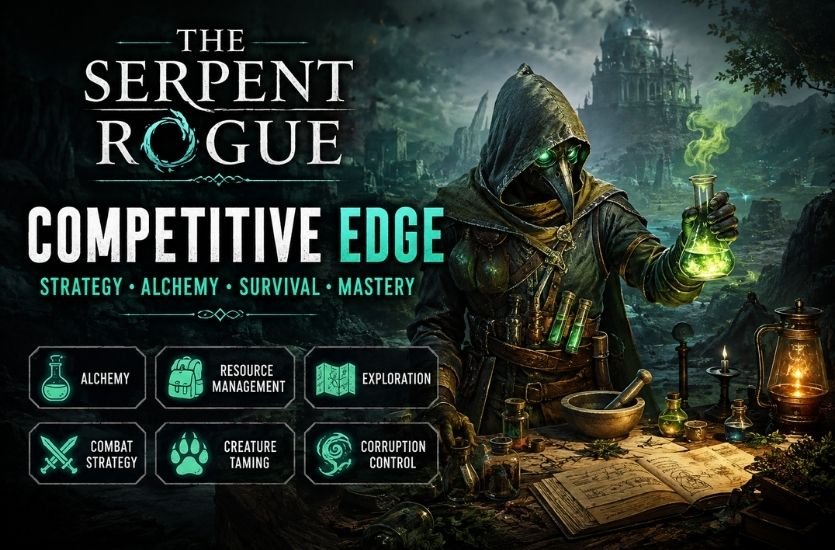
What if the biggest advantage in The Serpent Rogue has nothing to do with having stronger weapons? What if the real difference comes from knowing when to fight, what to carry, which ingredients to save, and when to turn back?
That is the idea behind Competitive Edge TheSerpentRogue.
The phrase does not refer to an official PvP mode, ranked ladder, perk, or in-game feature. Rather, current search results use it to describe the strategic advantage players gain by understanding and combining the game’s systems more effectively. The Serpent Rogue itself is a single-player action-adventure experience centered on alchemy, exploration, resource management, creatures, corruption, and experimentation.
If you want to survive longer, waste fewer resources, and make every expedition more productive, developing this kind of The Serpent Rogue competitive edge is far more valuable than simply trying to attack everything in sight.
What Is Competitive Edge TheSerpentRogue?
In simple terms, Competitive Edge TheSerpentRogue means developing a deeper understanding of the game’s mechanics so that you can make better decisions than you did before.
Because The Serpent Rogue is primarily a single-player game, there is no conventional competition against other players. The “competitive edge” is therefore about mastery rather than multiplayer competition.
A skilled Warden understands that almost every decision has consequences. Taking too many items can create inventory problems. Entering dangerous territory without preparation can turn a successful expedition into a failed run. Fighting unnecessarily can consume resources that would be more valuable later.
The result is a gameplay philosophy built around knowledge, preparation, experimentation, efficiency, and adaptability.
The Serpent Rogue: Understanding the Game First
Before discussing strategy, it helps to understand what makes The Serpent Rogue different.
Developed by Sengi Games and published by Team17, the game places players in the role of the Warden, an alchemist exploring a corrupted world. Its gameplay combines exploration, crafting, alchemy, survival mechanics, creature interactions, and combat.
The game does not simply ask you to defeat enemies. It asks you to understand the world around you.
That distinction is important.
A player who understands the game’s systems can often accomplish more with fewer resources than someone who relies purely on direct combat.
And that is where the real TheSerpentRogue competitive edge begins.
Why Alchemy Creates the Biggest Competitive Edge
Imagine entering a dangerous area knowing exactly which items you need and which potions can help you handle the situation.
That is considerably different from entering blindly and hoping your weapons are enough.
Alchemy sits at the heart of The Serpent Rogue. Players collect ingredients, investigate their properties, experiment with combinations, and use the resulting knowledge to create useful items. Search results consistently identify alchemy and research as major components of the game’s strategic depth.
This makes The Serpent Rogue alchemy one of the most important related concepts for anyone searching for a competitive advantage.
Learn Ingredients Instead of Randomly Collecting Them
A common beginner mistake is treating every ingredient as equally valuable.
Experienced players gradually learn:
- Which ingredients are useful
- Which combinations are worth testing
- Which resources should be saved
- Which items are unnecessary
- Which discoveries can improve future runs
Knowledge therefore becomes a resource of its own.
The more you understand the alchemy system, the less you need to rely on trial and error.
Research and Experimentation: Knowledge Is Power
What happens when you stop treating experimentation as a gamble and start treating it as research?
You begin turning every discovery into future knowledge.
The game’s design encourages players to investigate ingredients and understand how different systems interact rather than simply following a conventional weapon-upgrade path.
This creates an important principle:
A failed experiment can still become a successful lesson.
That mindset is especially useful for beginners.
Instead of asking, “Why did I fail?” ask, “What did this run teach me?”
That question gradually produces a genuine competitive edge in The Serpent Rogue.
Resource Management: The Hidden Advantage
Here is the mistake that can quietly ruin an otherwise excellent run: carrying too much.
Resource management is one of the central challenges of The Serpent Rogue. Reviews and strategy guides repeatedly highlight gathering, inventory management, and resource efficiency as important parts of the experience.
A strong player does not simply collect everything.
Instead, think about the purpose of every item.
Before leaving an area, ask:
Do I need this?
Will I use it soon?
Is it worth the inventory space?
Could I return later for it?
This simple decision-making process can make expeditions more efficient.
Inventory Discipline
Inventory management is therefore another major TheSerpentRogue competitive advantage.
A useful approach is to prioritize:
- Essential survival items
- Important alchemy ingredients
- Valuable resources
- Situational items
- Low-priority objects
The goal isn’t to carry the maximum amount.
The goal is to carry the right amount.
Exploration and Route Planning
Exploration is another area where experience creates an advantage.
A beginner may wander around searching for resources. An experienced player gradually develops a mental map of useful locations, dangerous areas, and efficient routes.
That knowledge reduces wasted movement and unnecessary risk.
Build Efficient Exploration Habits
Instead of entering an area without a plan, establish a purpose for each expedition.
For example:
Gathering run: focus on collecting ingredients.
Research run: focus on discovering properties and combinations.
Preparation run: gather what is needed for a future objective.
Recovery run: retrieve important resources after a difficult encounter.
This makes each trip more intentional.
Corruption Management: Don’t Let the Environment Control You
The world itself can become part of the challenge.
Corruption is one of the defining environmental systems in The Serpent Rogue. Search results describe corruption and changing environmental conditions as important factors in planning exploration and resource gathering.
Instead of viewing corruption purely as an obstacle, experienced players can treat it as something that must be anticipated.
Before entering a dangerous area, consider:
- Your available resources
- Your route back
- Your current objective
- Your ability to survive an unexpected encounter
- Whether the potential reward justifies the risk
This is risk management, and it is one of the clearest forms of competitive edge available in the game.
Combat: Preparation Beats Brute Force
What if the best way to win a fight is to make the fight easier before it begins?
That is an important lesson in The Serpent Rogue.
Reviews have described the game’s combat as relatively simple compared with its broader systems, while emphasizing the importance of exploration, resource management, and alchemy.
Instead of approaching every encounter with the mindset of “attack first,” consider:
Can I avoid this fight?
Do I have the right resources?
Can I prepare before engaging?
Is the reward worth the cost?
This defense-first mentality can significantly improve consistency.
Understanding Enemy Behavior
Another way to develop a competitive edge TheSerpentRogue is to observe creatures rather than immediately attacking them.
Learn how enemies behave.
Notice:
- How they react to your presence
- When they become aggressive
- How they move
- Whether they can be avoided
- Whether environmental positioning can help
- Whether fighting them is actually necessary
The more predictable an enemy becomes, the less threatening it feels.
In other words, knowledge turns uncertainty into control.
Creature Taming and Companions
The game’s creature systems provide another interesting strategic layer.
Players can interact with creatures and, under the right circumstances, tame or use them as companions. Search results also highlight follower and creature-management mechanics as potential sources of utility.
This means the player does not always have to approach the world as a lone fighter.
Understanding:
- Creature behavior
- Favorite foods
- Taming requirements
- Companion utility
- Follower options
can provide additional flexibility.
The broader lesson is simple: not every creature is merely an enemy.
The Power of Adaptability
One of the strongest related keywords around this topic is The Serpent Rogue strategy.
But strategy here should not mean following one rigid build.
The environment changes. Your resources change. Your discoveries change. Your objectives change.
Therefore, the strongest players adapt.
If an expedition is becoming too dangerous, change the plan.
If resources are running low, retreat.
If a combat encounter isn’t worth the cost, avoid it.
If an ingredient combination produces an unexpected result, investigate it.
This flexibility is what turns experience into an actual advantage.
Common Mistakes That Destroy Your Advantage
Even experienced players can lose efficiency through small mistakes.
Carrying Everything
More resources do not automatically mean more success. Excess inventory can create unnecessary problems.
Fighting Every Enemy
Combat should serve a purpose. Fighting simply because an enemy is nearby can waste valuable resources.
Ignoring Alchemy
Treating alchemy as optional means ignoring one of the game’s most important systems.
Exploring Without a Goal
Random exploration can consume time and resources without producing meaningful progress.
Ignoring Environmental Threats
A successful run can quickly become a failure if you underestimate corruption or other hazards.
Repeating the Same Mistake
Failure is useful only when you learn from it.
Competitive Edge TheSerpentRogue for Beginners
If you’re starting the game, don’t try to master everything immediately.
Start with the fundamentals.
Step 1: Learn the World
Explore carefully and identify important locations.
Step 2: Study Ingredients
Pay attention to what you collect and what you discover.
Step 3: Experiment With Alchemy
Use experimentation to understand the crafting system.
Step 4: Control Your Inventory
Don’t automatically take everything you see.
Step 5: Choose Your Fights
Not every enemy needs to be defeated.
Step 6: Learn From Every Run
Treat mistakes as information rather than wasted time.
This approach builds a foundation for a much stronger The Serpent Rogue competitive edge.
Advanced The Serpent Rogue Strategy
Once the fundamentals become comfortable, efficiency becomes the next goal.
Rather than simply asking, “Can I survive this?”, start asking:
“Can I complete this objective with fewer resources?”
That change in thinking is significant.
Advanced players can focus on creating repeatable routines for:
- Gathering
- Brewing
- Exploration
- Combat preparation
- Risk assessment
- Inventory management
- Recovery
- Route planning
The objective is to make good decisions consistently rather than depending on luck.
What Really Separates Skilled Players?
It isn’t necessarily faster reflexes.
It isn’t necessarily better equipment.
And it isn’t about a hidden “competitive edge” button.
The biggest difference is system knowledge.
A skilled player understands that alchemy, exploration, resources, corruption, combat, and creatures are interconnected. Current strategy coverage repeatedly identifies these interconnected systems as the foundation of gaining an advantage in The Serpent Rogue.
Once you understand those relationships, the game becomes easier to read.
Related Keywords for Competitive Edge TheSerpentRogue
This topic naturally covers several closely related search terms, including:
- Competitive Edge TheSerpentRogue
- TheSerpentRogue competitive edge
- competitive edge in The Serpent Rogue
- The Serpent Rogue competitive advantage
- The Serpent Rogue strategy
- The Serpent Rogue tips
- The Serpent Rogue guide
- The Serpent Rogue gameplay
- The Serpent Rogue alchemy
- The Serpent Rogue potion crafting
- The Serpent Rogue research
- The Serpent Rogue resource management
- The Serpent Rogue inventory management
- The Serpent Rogue corruption
- The Serpent Rogue combat strategy
- The Serpent Rogue survival tips
- The Serpent Rogue exploration
- The Serpent Rogue creature taming
- The Serpent Rogue companions
- The Serpent Rogue beginner guide
- The Serpent Rogue advanced strategy
- how to get a competitive edge in The Serpent Rogue
- how to play The Serpent Rogue
- The Serpent Rogue best strategies
- The Serpent Rogue alchemy guide
These terms fit naturally because they describe the actual systems players use to become more efficient.
Final Thoughts
Competitive Edge TheSerpentRogue isn’t about beating another player. It’s about becoming better at understanding the game.
The strongest advantage comes from combining alchemy knowledge, careful resource management, intelligent exploration, corruption awareness, enemy observation, creature interaction, and disciplined decision-making.
The biggest lesson may be the simplest one:
Don’t play The Serpent Rogue harder. Play it smarter.
When you understand what to collect, what to craft, what to avoid, when to fight, and when to retreat, small decisions begin producing larger advantages. That is the real meaning behind the Competitive Edge TheSerpentRogue keyword—and the key to becoming a more efficient Warden.