

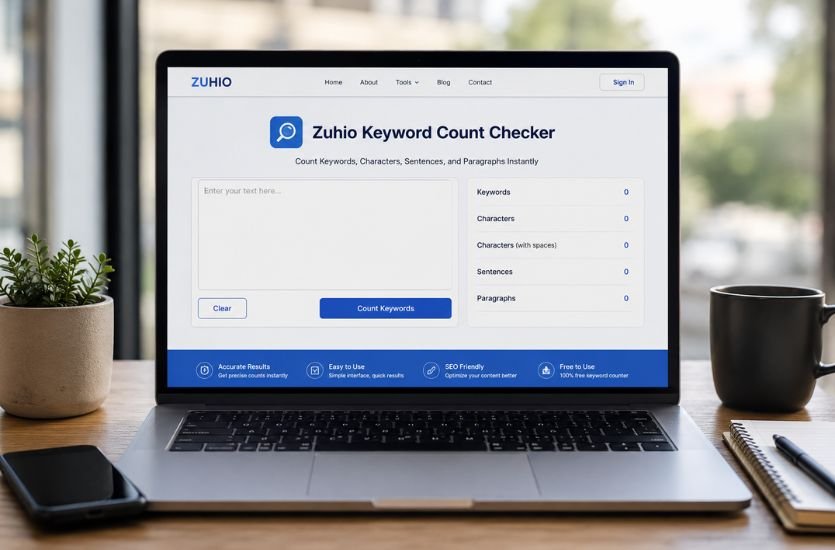
What if you could find out in seconds whether your target keyword is barely being used—or repeated so often that your article starts sounding robotic? That is the basic problem the Zuhio Keyword Count Checker is designed to solve.
Keyword usage is easy to underestimate when you are writing a long article. You may think a phrase appears “often enough,” only to discover that it occurs just a few times. The opposite can happen too: an SEO-focused draft may repeat the same phrase so frequently that readability suffers.
The Zuhio Keyword Count Checker offers a simple way to measure that usage. Current web sources describe it as a browser-based tool that accepts pasted content, checks a target keyword or phrase, and reports its frequency and keyword density.
But there is an important question: Does counting keywords actually improve SEO? The answer requires more nuance than simply chasing a percentage.
What Is the Zuhio Keyword Count Checker?
The Zuhio Keyword Count Checker is a lightweight online keyword analysis tool focused primarily on keyword frequency. Instead of manually searching through an article and counting every occurrence, you can enter your content and target keyword and receive a numerical result.
The core concept is straightforward:
Keyword count = the number of times your target keyword appears in the content.
The tool is therefore useful when you want to check whether a keyword has been used naturally throughout an article, landing page, product description, or other text.
Several current sources describe Zuhio as a free, browser-based utility that does not require complicated setup or a full SEO subscription.
That simplicity is arguably its biggest advantage.
You do not need to open a large SEO dashboard just to answer one question: “How many times did I use this keyword?”
How Does Zuhio Keyword Count Checker Work?
The workflow is designed to be simple.
1. Prepare Your Content
First, write your article naturally. Avoid trying to force your keyword into every paragraph while drafting.
This is important because writing for a percentage rather than for readers can produce unnatural sentences.
2. Enter the Target Keyword
Enter the exact word or phrase you want to analyze.
For example, if your primary keyword is:
zuhio keyword count checker
you can enter that phrase as the target term.
Long-tail phrases are particularly useful to check because manually finding every exact occurrence in a long article can take time.
3. Add Your Content
Paste the article or other text into the checker.
Depending on the implementation or version being described, sources report additional functionality such as case-insensitive matching, whole-word options, highlighted matches, and multi-keyword tracking. However, these features are not consistently documented across independent sources, so they should be treated as feature claims rather than universal guarantees.
4. Check the Results
The primary result is the number of times your target keyword occurs.
Some descriptions also report total word count and keyword density.
This gives you a quick snapshot of keyword usage before publishing.
What Is Keyword Density?
Keyword count and keyword density are related, but they are not identical.
Keyword count tells you how many times a keyword appears.
Keyword density expresses that number as a percentage of the total word count.
The basic formula is:
Keyword Density = (Keyword Occurrences ÷ Total Words) × 100
For example, imagine you have a 1,500-word article and your target keyword appears 15 times.
15 ÷ 1,500 × 100 = 1%
So your keyword density would be approximately 1%.
This calculation provides context that a raw count cannot provide. Ten keyword mentions in a 500-word article represent very different usage from ten mentions in a 3,000-word guide.
Current sources describing Zuhio consistently emphasize this distinction between keyword frequency and keyword density.
Is There a Perfect Keyword Density for SEO?
Here is where many SEO articles oversimplify the subject.
There is no universal “perfect” keyword density that guarantees Google rankings.
Some third-party guides suggest ranges such as 1%–2%, but even those sources generally describe them as guidelines rather than absolute rules.
The better approach is to use keyword density as a diagnostic metric, not a target that must be reached at all costs.
Suppose you are writing a 2,000-word article. You should not add your keyword repeatedly simply because a calculator says you have not reached a particular percentage.
Instead, ask:
- Does the article clearly cover the searcher’s topic?
- Does the primary keyword appear naturally?
- Are important variations and related concepts included?
- Is the content easy to read?
- Does each section provide useful information?
- Have you avoided repetitive or awkward wording?
Those questions are more meaningful than chasing an arbitrary density number.
Why Use a Keyword Count Checker?
It Saves Time
Manually counting a phrase throughout a long article is tedious.
A keyword frequency checker can give you the answer much faster, allowing you to spend your time improving the actual content.
It Helps Detect Keyword Overuse
Sometimes writers repeat an exact-match keyword without realizing it.
A keyword counter makes that repetition visible.
If an article repeatedly uses the same phrase in headings, introductions, conclusions, and body paragraphs, the resulting count can reveal a potential readability problem.
It Can Identify Underuse
The opposite problem also exists.
You may be targeting a phrase but barely mention it anywhere in the article. A quick count can help you identify that situation before publication.
It Supports Content Editing
The best time to use a keyword counter is often after the first draft is complete.
Write naturally first.
Check the keyword afterward.
Then make editorial adjustments where they genuinely improve clarity.
That workflow is also recommended by current guides covering the tool.
Zuhio Keyword Count Checker for Bloggers
Bloggers are one of the clearest audiences for a keyword frequency tool.
Imagine publishing a 2,000-word guide targeting a specific long-tail search query. Instead of manually searching through every paragraph, you can use a keyword counter to determine whether the phrase appears naturally throughout the article.
It can be especially useful during the final editing stage.
A blogger can check:
Primary keyword → Related keywords → Long-tail phrases → Repetition → Overall readability
However, keyword counting should never replace editorial judgment.
A blog post that contains the correct number of keywords but provides little value will not become a great article simply because its density looks good.
Zuhio Keyword Count Checker for SEO Professionals
SEO specialists can use keyword frequency analysis as one small part of a larger optimization workflow.
For example, an SEO professional may examine:
Keyword frequency → Keyword placement → Search intent → Content depth → Internal linking → On-page SEO → Technical SEO
The important distinction is that Zuhio is not described as an all-in-one SEO platform.
Current sources specifically note that keyword counting does not provide broader functions such as backlink analysis, search-volume research, technical audits, or rank tracking.
That limitation is not necessarily a weakness.
A specialized tool can be valuable precisely because it focuses on one simple task.
Keyword Count vs. Keyword Density
These terms are sometimes used interchangeably, but they answer different questions.
| Metric | What It Tells You |
|---|---|
| Keyword Count | How many times the keyword appears |
| Keyword Density | What percentage of the content consists of the keyword |
| Total Word Count | How long the content is |
| Keyword Placement | Where the keyword appears |
For example, an article could contain a keyword 10 times.
That sounds meaningful until you discover the article is only 400 words long.
The same 10 occurrences in a 3,000-word article tell a completely different story.
This is why looking at both keyword frequency and keyword density provides more useful context.
Does Keyword Density Affect Google Rankings?
This is one of the most important questions surrounding keyword density tools.
Do not treat keyword density as a ranking formula.
Modern search engines evaluate content using much broader signals than the percentage of times an exact phrase appears.
Keyword usage can help establish topical relevance, but repeatedly inserting the same phrase is not a substitute for useful content.
In fact, excessive repetition can create obvious keyword stuffing and make an article unpleasant to read.
A better SEO strategy is to use your primary keyword naturally while covering the broader subject with relevant terminology, concepts, entities, questions, and related phrases.
For example, an article about the Zuhio Keyword Count Checker can naturally discuss:
- keyword frequency
- keyword density
- SEO content
- keyword optimization
- keyword stuffing
- long-tail keywords
- content analysis
- on-page SEO
- search intent
- content readability
- keyword placement
That produces topical breadth without forcing the exact same phrase into every paragraph.
Keyword Stuffing: What to Avoid
Imagine reading a sentence like this:
“The Zuhio Keyword Count Checker is a keyword count checker that checks keyword counts using a keyword count checker for keyword counting.”
It contains the target concept repeatedly.
But it sounds terrible.
That is the problem with keyword stuffing.
A keyword should exist because it communicates something useful—not because an SEO checklist demands another occurrence.
If your keyword counter shows an unusually high frequency, inspect the actual sentences.
Ask yourself:
“Would I write this sentence if I were not thinking about SEO?”
If the answer is no, rewrite it.
Related Keywords for Zuhio Keyword Count Checker
To build a comprehensive article around the topic, publishers can naturally address related search terms and semantic variations such as:
- Zuhio keyword checker
- Zuhio keyword density checker
- Zuhio SEO tool
- Zuhio keyword tool
- keyword count checker
- keyword counter online
- keyword frequency checker
- keyword frequency tool
- keyword density checker
- keyword density calculator
- free keyword count checker
- free keyword density checker
- SEO keyword counter
- keyword occurrence checker
- keyword usage checker
- check keyword frequency
- count keywords in text
- keyword optimization tool
- SEO content checker
- keyword stuffing checker
- keyword analysis tool
- content keyword checker
- keyword counter for articles
- keyword checker for blogs
- keyword density tool for SEO
These related terms can be incorporated naturally through headings, explanations, FAQs, examples, and supporting sections rather than being placed together unnaturally.
What Zuhio Keyword Count Checker Does Not Do
Understanding limitations is just as important as understanding features.
The Zuhio Keyword Count Checker should not be confused with a comprehensive SEO platform.
Current descriptions indicate that its core purpose is keyword counting and density analysis rather than:
- backlink analysis
- competitor research
- keyword search-volume analysis
- rank tracking
- comprehensive technical SEO auditing
- complete website crawling
- full content strategy
- search-intent research
Sources also disagree somewhat about the exact feature set and reliability of the tool. For example, some pages describe additional functionality, while another recent review reports that testing encountered situations where the checker failed to return results.
That means users should verify the current interface themselves rather than assuming every feature mentioned in third-party articles is permanently available.
Is Zuhio Keyword Count Checker Free?
Multiple current third-party sources describe the Zuhio Keyword Count Checker as a free online tool that can be used without a traditional account or complicated setup.
However, because independent sources provide much of the available information about Zuhio, it is sensible to verify the current service and its features before relying on it for an important workflow.
For occasional content checks, a lightweight free keyword counter can be convenient.
For professional SEO campaigns, it should be considered only one component of a broader toolkit.
Is Zuhio Keyword Count Checker Safe and Reliable?
This question deserves a careful answer.
There is considerable third-party coverage of the tool, but documentation about its ownership, infrastructure, and complete feature set is not as extensive as that of major established SEO platforms.
One recent review specifically notes the lack of a clearly established single official Zuhio presence, while another source identifies the tool as being available through Zuhio’s website.
There are also conflicting reports concerning reliability. One recent review describes repeated testing failures, whereas other sources describe the checker as working quickly.
Therefore, users should avoid putting sensitive or confidential material into an unfamiliar online text tool unless they are comfortable with its privacy practices.
For ordinary public-facing drafts, the risk may be less significant, but professional teams should still consider their organization’s data-handling requirements.
How to Use Keyword Counting the Right Way
A smarter workflow looks like this:
Step 1: Research the search intent.
Step 2: Choose a primary keyword.
Step 3: Identify relevant secondary and long-tail terms.
Step 4: Write the article naturally.
Step 5: Use a keyword count checker after drafting.
Step 6: Review frequency and density.
Step 7: Remove unnatural repetition.
Step 8: Improve headings, internal links, examples, and topical coverage.
Step 9: Proofread for human readability.
Step 10: Publish only when the content genuinely satisfies the reader.
The key is simple:
Use the checker to improve the article—not to write the article.
Zuhio Keyword Count Checker vs. Manual Counting
Manual counting still works.
You can use your browser’s Ctrl + F function to find an exact phrase. You can also use a text editor or spreadsheet to analyze content.
But manual methods become inconvenient when:
- the article is very long;
- multiple keywords need to be checked;
- keyword density must be calculated;
- variations need to be compared;
- several articles require review.
A dedicated keyword counter can make this process faster.
For a single 300-word article, manual counting may be perfectly adequate. For dozens of SEO articles, automation becomes considerably more useful.
Best Practices for Keyword Optimization
The most effective keyword strategy is balanced.
Use the primary phrase where it genuinely belongs, particularly in important areas such as the page title, main heading, introduction, and relevant sections.
Then expand the article with semantically related terminology.
For this topic, for example, a strong article does not need to repeat “Zuhio Keyword Count Checker” in every paragraph. It can naturally discuss keyword frequency, keyword density, SEO content analysis, keyword optimization, long-tail phrases, and content readability.
This creates a better experience for both readers and search engines.
Frequently Asked Questions
What is Zuhio Keyword Count Checker?
It is a web-based keyword counting utility designed to determine how frequently a selected keyword or phrase occurs within text and, according to several current descriptions, calculate its density.
Is Zuhio Keyword Count Checker free?
Current third-party sources generally describe it as a free browser-based tool without requiring a conventional account.
What is the difference between keyword count and keyword density?
Keyword count is the raw number of occurrences. Keyword density expresses those occurrences as a percentage of the total word count.
Is 1% keyword density good?
It can be perfectly reasonable for many types of content, but there is no universal percentage that guarantees better rankings. The naturalness and usefulness of the content matter more than hitting an exact number.
Can Zuhio replace an SEO platform?
No. A keyword counter is a focused content-analysis utility. It does not replace comprehensive tools for keyword research, backlinks, rankings, technical SEO, or competitor analysis.
Can I use Zuhio for long-tail keywords?
Several current descriptions indicate support for keyword phrases rather than only individual words. However, exact functionality can vary, so users should verify the current implementation before depending on a specific feature.
Should I optimize an article to a specific keyword-density percentage?
No. Use density as a diagnostic signal. Do not force additional keyword mentions simply to reach a predetermined percentage.
Final Verdict
The Zuhio Keyword Count Checker addresses a very specific SEO problem: knowing how often a keyword appears in your content.
And sometimes, that simple answer is exactly what a writer needs.
It can help bloggers, copywriters, content marketers, SEO professionals, and website owners quickly identify keyword underuse or excessive repetition. Current sources consistently describe its central functionality as keyword frequency and density analysis.
But the tool should remain just that—a checking tool, not an SEO strategy.
The strongest content does not rank because a keyword appears a magical number of times. It succeeds because it answers the searcher’s question, demonstrates topical depth, communicates clearly, and provides genuine value.
So use a keyword counter at the right moment:
Write naturally. Check intelligently. Edit carefully. Publish confidently.
That is a far better SEO strategy than writing for a percentage.
Also Visit: Expand Magazine
Also Visit: SFFareboxing Schedules by SportsFanfare