






A jacket and a pair of pants can each look convincing on their own and oddly uncertain together. From across a room, the outfit almost resembles a suit; a little closer, the colors and surfaces fail to agree. The solution is not necessarily a more exact match. Separates often become easier to understand when the difference between the pieces looks chosen. Before studying a swatch at arm’s length, it is worth stepping back far enough to see the person wearing it.
Why Almost-Matching Can Feel Accidental
Take a hypothetical outfit made from a dark blue sport coat and similarly dark blue pants bought separately. Under one light they appear close; under another, one looks cooler and the other slightly warmer. Neither piece is defective. The uncertainty comes from the expectation their similarity creates. An observer may read the outfit as a matched suit and then notice that it is not. This is a visual possibility, not a prohibition against wearing neighboring shades.
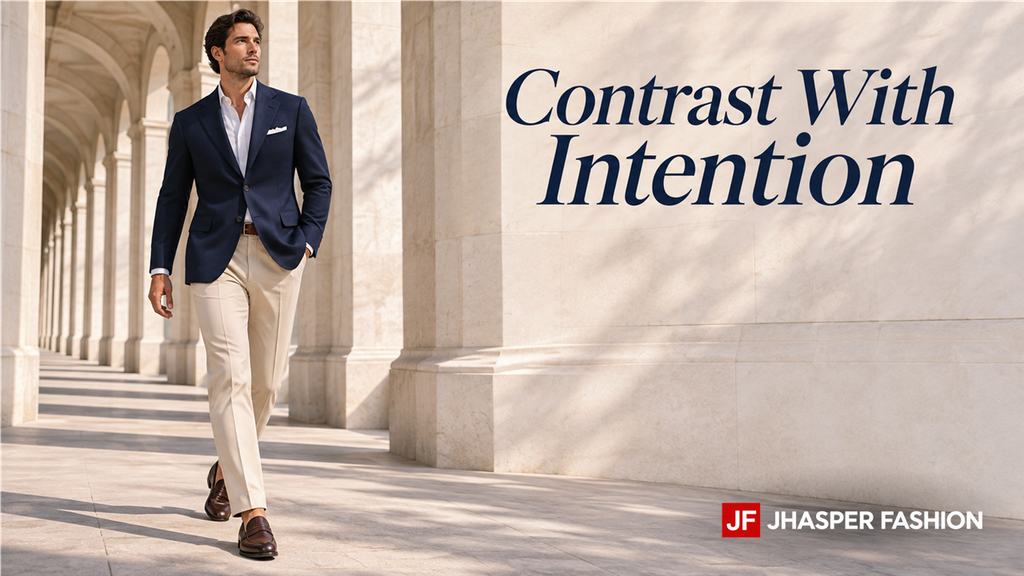
A clearer difference can release the outfit from that expectation. The wearer might try pants that are visibly lighter, or consider a sport coat whose surface reads differently from the pants. The purpose is not to maximize contrast in every direction. It is to make the relationship understandable. If the color difference is already pronounced, adding a conspicuous pattern, bright shirt, and assertive shoes may create more activity than the wearer actually wants.
There is also a distinction between a sport coat selected for separate wear and a suit jacket being asked to do a second job. Some suit jackets can work independently; others may retain a strongly matched-set character through their cloth and details. The useful question is how this particular jacket looks with these particular pants. Calling something a blazer does not change its appearance, and calling it a suit jacket does not by itself settle the question.
Read the Outfit From Conversation Distance
At conversation distance, small details retreat. The eye sees the division between upper and lower body, the overall lightness or darkness, and the way the clothes hang together. Step back from the mirror to judge those relationships rather than focusing on a lapel or crease. An appealing detail can belong to an outfit whose overall balance still feels unresolved.
Return to the hypothetical blue combination. Rather than exchanging one dark pair for another nearly identical shade, the wearer could try a distinctly lighter pair already in the closet. The first question is simply whether the separation now reads clearly. Only then do smaller decisions become worthwhile: whether the shirt is too stark, whether the shoes feel heavy, or whether the pants have more visual presence than expected. Changing everything at once makes the useful difference harder to identify.
A phone photograph can help preserve a comparison, but it should not become the only judge. Lighting and the camera can alter the relationship between shades. Look in person, move a little, and notice whether the clothes still seem to belong together once you stop arranging them. Judge whether the outfit expresses the ease or formality you intended, not whether the contrast follows a formula.
Balance Texture With the Rest of the Look
Now imagine a second case: a softly textured sport coat paired with very smooth, dark pants and highly polished shoes. The colors may be clearly different, yet the outfit can still feel divided between a relaxed upper half and a more formal lower half. That tension might be enjoyable if it is intentional. If it feels uneasy, the next adjustment need not be another color. It may concern the character of the surfaces instead.
Trying pants with a less glossy appearance could bring the pieces closer in mood while retaining their separation. Alternatively, a quieter shirt and less assertive footwear might allow the contrast to remain without dominating the outfit. These are experiments, not fixed prescriptions. The textured coat does not demand a particular fiber in the pants, and smooth cloth is not automatically formal. Weight, finish, pattern, and styling all contribute to what the wearer sees.
Texture also behaves differently at different distances. A fine pattern visible on a hanger may settle into an almost solid field when worn; a stronger weave may remain evident across a room. That is why a collection of attractive close-up fabric pictures cannot fully answer the styling question. The aim is not to repeat the same texture above and below the waist. It is to decide which differences deserve attention and which should stay in the background.
Bring the Whole Outfit to the Fitting
An appointment becomes more informative when the pieces that will surround the new garment are present. Bring the actual pants if commissioning a sport coat, along with the shoes you expect to wear. If pants are the missing piece, take the coat instead. The tailor can then discuss the relationship as an outfit rather than making assumptions from a description such as dark blue or casual. Those words cover too much ground to settle the visual question alone.
For a consultation with Jhasper Fashion, whose menswear range includes sports jackets and pants, that existing clothing supplies a practical reference for a new separate. Compare the available cloth with those familiar pieces rather than choosing from memory. Explain what feels uncertain about the current combination and whether you want a stronger distinction or a quieter overall impression.
There is room for personal taste in the answer. Some dressers enjoy close tonal relationships; others prefer a separation that is immediately apparent. What matters is recognizing the effect before committing to it. An outfit can be composed without every element agreeing, just as a conversation can be lively without everyone saying the same thing. The useful space between jacket and pants is the space in which their differences become part of the design, rather than something the wearer keeps trying to explain away.