








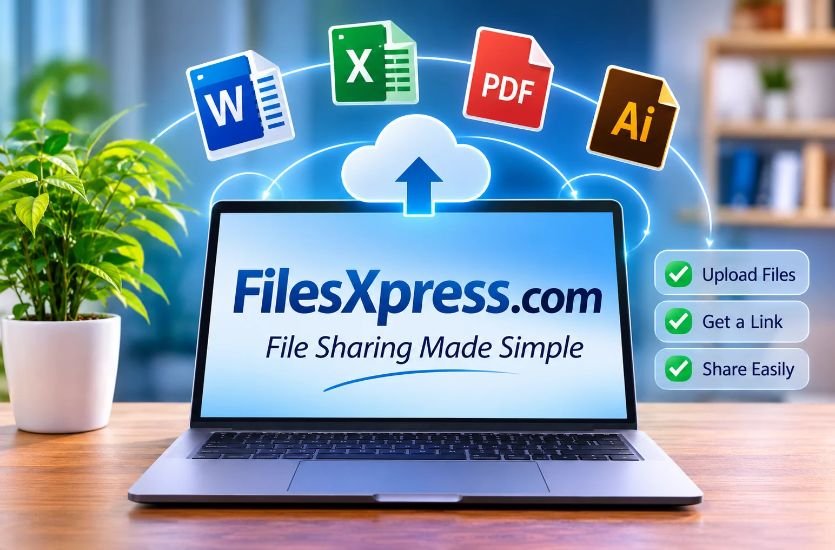
FilesXpress.com is a website associated with online file sharing, a service that allows people to upload digital files and share them with others through downloadable links. It became useful in situations where users needed to exchange documents, images, spreadsheets, and other files without attaching them directly to emails or online support conversations. Historical references to the platform show that it was particularly useful for customers communicating with technical-support professionals.
As online file-sharing technology has developed, websites and services have changed considerably. FilesXpress.com is an interesting example of how people previously exchanged digital information through simple upload-and-download systems. Understanding its background, historical functionality, and current online presence can help users who encounter the domain while searching for an old download link or researching file-sharing platforms.
Quick Overview of FilesXpress.com
| Detail | Information |
|---|---|
| Website | FilesXpress.com |
| Domain registration | April 25, 2015 |
| Historical purpose | Online file sharing |
| Main function | Uploading and sharing files |
| Sharing method | Downloadable links |
| Common file types | Documents, spreadsheets, PDFs, and other digital files |
| Historical users | Individuals and technical-support customers |
| Current website status | Current functionality requires verification |
| Website technology | Its current online presence has been associated with WordPress |
What Is FilesXpress.com?
FilesXpress.com is a domain historically associated with a straightforward online file-sharing service. Its original purpose was to make transferring digital files between individuals easier, particularly when traditional communication platforms had restrictions on attachments.
The basic concept behind the service was simple. A user could upload a file to the website, receive a downloadable link, and share that link with another person. The recipient could then access the shared content without needing to receive the original file as an email attachment.
This approach was useful for people who regularly exchanged documents or needed assistance with computer-related problems. Instead of explaining an issue through text alone, users could provide the actual file to another person for examination.
Historical online technical-support conversations provide examples of FilesXpress being used for exchanging Microsoft Word documents, Excel spreadsheets, PDF files, and Adobe Illustrator projects. These examples demonstrate the practical purpose the website served in everyday digital communication.
Today, FilesXpress.com also appears in online discussions and articles examining its historical purpose and current website presence. However, its original file-upload functionality should not be confused with its current availability. The existence of a domain does not necessarily mean that its previous services remain operational.
History and Background of FilesXpress.com
The domain FilesXpress.com was registered in April 2015, according to available domain-registration information. Its history is connected with the growing demand for convenient online file-sharing solutions during a period when email attachments and traditional communication platforms often had file-size limitations.
At that time, people frequently needed alternative ways to send documents, images, and other digital materials. File-sharing websites provided a convenient option because users could upload content separately and distribute a download link rather than attaching the entire file to a message.
FilesXpress became associated with this type of activity. Historical references suggest that its links appeared in technical-support discussions where customers needed to provide files to professionals investigating software problems.
The service’s straightforward approach was particularly useful for people who did not require advanced cloud-storage features. Instead of creating shared folders or managing complicated permissions, they could use a direct link to make a particular file available to another person.
The broader internet environment has changed significantly since then. Modern cloud platforms now provide storage, synchronization, collaboration, and access-management features. Consequently, older file-sharing websites have become less prominent as users increasingly prefer services offering more comprehensive functionality.
How Did FilesXpress.com Work?
The historical FilesXpress file-sharing process followed a relatively simple upload-and-download model. Users did not need advanced technical knowledge to understand the basic procedure.
The process generally involved uploading a file, obtaining a generated link, and sharing that link with the intended recipient.
Uploading Files to the Website
The first step involved selecting a file from a computer and uploading it through the website’s interface. Depending on the original service’s supported functionality, users could share different types of digital content.
This was particularly helpful when someone needed to provide a document or project file to a technical-support professional. Instead of describing the entire problem, the customer could provide the original material for inspection.
For example, someone experiencing difficulties with an Excel spreadsheet could share the workbook so that another person could examine its formulas and formatting.
Generating Download Links
After uploading a file, the historical service provided a link associated with the uploaded content. Users could copy this address and share it through an email, online discussion, or support conversation.
Historical references contain examples of FilesXpress addresses using patterns such as short links beginning with filesxpress.com/d- and longer addresses beginning with filesxpress.com/download-.
These links made file sharing more convenient because recipients did not necessarily need to navigate through complicated folder structures to locate the required document.
However, these examples describe historical link formats. They should not be interpreted as confirmation that the original download system remains functional.
Downloading Shared Files
The recipient’s role was relatively straightforward. After receiving the link, the person could open it and attempt to download the shared file.
This arrangement reduced the need for direct attachments and allowed individuals to exchange files through different communication channels.
For technical-support professionals, the process was especially practical because they could examine a customer’s original document, identify possible problems, and provide recommendations based on the actual file.
Why Did People Use FilesXpress.com?
The popularity of simple file-sharing websites was connected to the everyday challenges of transferring digital information.
Email platforms have traditionally imposed attachment-size restrictions, while some online support systems have limited file-upload capabilities. These restrictions created demand for separate websites where users could temporarily upload documents and share downloadable addresses.
FilesXpress was associated with this type of convenience.
One important reason for using such a service was accessibility. A browser-based upload system allowed people to share files without necessarily installing additional desktop software.
Another advantage was the ability to exchange files through existing conversations. Customers could provide a download link directly within a support discussion, allowing the professional assisting them to access the relevant material.
The approach also reduced unnecessary communication. Instead of sending several screenshots or describing every detail of a problem, users could provide the original document for examination.
These benefits explain why simple file-sharing services became useful parts of everyday internet activity.
Types of Files Shared Through FilesXpress.com
Historical technical-support discussions provide examples of several file formats associated with FilesXpress. These examples illustrate how people used the platform for different personal, professional, and troubleshooting purposes.
Microsoft Word documents: Word files were useful when customers experienced problems opening documents, accessing their contents, or working with particular file formats. Sharing the original document allowed another person to investigate the issue.
Excel spreadsheets: Spreadsheet files could be provided for assistance with formulas, calculations, formatting, and other technical difficulties. Sharing the original workbook was often more useful than sending a screenshot.
PDF documents: PDF files were another example of content exchanged through file-sharing services. Customers and support professionals could use them when investigating document-opening, printing, or conversion problems.
Adobe Illustrator files: Design projects sometimes required examination of their original source files. An Illustrator document could contain information about artboards, layouts, dimensions, and design elements that might not be visible in an exported PDF.
ZIP archives and other files: Compressed archives were also useful for grouping multiple documents or software-related materials into a single package.
These examples show that FilesXpress was associated with more than one particular document category. Its historical purpose was based on helping users exchange different types of digital information.
FilesXpress.com and Technical Support
One of the most interesting aspects of FilesXpress.com’s history is its connection with online technical-support conversations.
Customers frequently contact support professionals when they encounter problems with applications, documents, or computer systems. In many situations, explaining a technical problem through text alone is not sufficient.
For example, a person might experience an issue with a spreadsheet formula but struggle to explain exactly where the calculation is failing. Providing the original spreadsheet allows the professional to inspect the formula and investigate the problem more effectively.
Historical public support discussions show FilesXpress links being used in situations involving document compatibility, graphic-design projects, PDF problems, and other computer-related questions.
This illustrates how external file-sharing services helped support professionals communicate with customers when their primary discussion platforms did not offer convenient attachment options.
The approach also highlights an important principle of technical assistance: examining the original material can provide more useful information than relying entirely on descriptions or screenshots.
Nevertheless, sharing files with another person requires appropriate privacy precautions. Documents may contain personal details, confidential information, or other material that should not be distributed unnecessarily.
Is FilesXpress.com Still Working in 2026?
The current status of FilesXpress.com requires careful consideration because its historical purpose and present online presence are not necessarily the same.
Older references associate the domain with an upload-and-download service. However, more recent online coverage describes a different website experience, with general informational articles and WordPress-style publishing features.
A third-party domain report also retains the historical file-sharing page title and description. This illustrates why domain information and an actual working service should not be treated as interchangeable.
The availability of a homepage does not confirm that users can still upload files, generate download links, or retrieve previously shared documents.
For anyone researching FilesXpress.com, the most important distinction is between its historical file-sharing identity and its current website functionality. Without confirmation from a working upload interface or reliable service documentation, it would be inaccurate to claim that its original features are still available.
Users searching for an old FilesXpress download should therefore verify the destination and avoid assuming that historical links remain active.
Is FilesXpress.com Safe to Use?
Website safety is an important consideration whenever users encounter unfamiliar file-sharing platforms.
Online file-sharing services can be convenient, but they also involve transferring digital information between different people and systems. Users should understand the potential risks before downloading files or sharing personal documents.
One concern is the authenticity of download links. An old address may no longer lead to the same content that it originally provided. Websites can change their functionality, domains can be repurposed, and previously shared files can become unavailable.
Another concern involves downloadable programs. Executable files may contain legitimate applications, but they can also be used to distribute malicious software. Users should never run unfamiliar programs simply because they appear in an old technical-support conversation, and following safe online downloading practices can help reduce exposure to malware and suspicious files.
Privacy is equally important. Documents can contain names, addresses, financial information, business records, or other sensitive details. Uploading such material to a service without clearly documented privacy protections can create unnecessary risks.
A responsible approach involves verifying the website’s identity, examining the sender’s information, scanning downloaded files with updated security software, and avoiding the transfer of sensitive information through unfamiliar services.
It is also important to remember that HTTPS alone does not establish that a website or downloadable file is trustworthy. It protects the connection but does not guarantee the safety of the content.
Why Might Old FilesXpress.com Download Links Stop Working?
People sometimes encounter old FilesXpress links while searching through archived emails, technical-support conversations, online forums, or previously saved documents.
A link that worked several years ago may no longer provide access to the original file. There are several possible explanations for this.
File Removal or Expiration
Some file-sharing platforms use temporary storage arrangements. Uploaded content may be removed after a particular period, after a user deletes it, or when the service changes its storage policies.
If the original file is no longer stored on the platform, its download address may stop working.
Changes to Website Functionality
Online services regularly update their websites and technical infrastructure. A platform that previously supported direct uploads may later introduce different features or discontinue its original service.
Such changes can affect the availability of older download links.
Domain or Hosting Changes
Websites depend on domains, hosting providers, servers, and other technical systems. Changes involving these components can affect how older addresses operate.
Even when a domain remains registered, its previous services may no longer exist.
Incomplete or Incorrect URLs
Another possible reason is an incomplete link. Some online platforms automatically shorten or hide parts of addresses in public conversations.
If the original download address is incomplete, the recipient may be unable to reach the intended file.
For these reasons, an old FilesXpress.com link should not automatically be considered an active download location.
FilesXpress.com Compared With Modern File-Sharing Services
File-sharing technology has developed considerably since the introduction of simple upload-and-download websites.
Modern platforms provide more than basic file transfers. Many combine online storage, collaboration, synchronization, account management, and access-management features, allowing users to manage access to shared files more effectively.
For example, Google Drive provides cloud storage and document collaboration. Dropbox supports file synchronization and sharing, while Microsoft OneDrive integrates file storage with Microsoft’s wider productivity ecosystem.
These platforms illustrate how the modern file-sharing experience has expanded beyond the simple link-generation approach historically associated with FilesXpress.
| Feature | Historical FilesXpress model | Modern cloud platforms |
|---|---|---|
| File uploading | Yes | Yes |
| Download links | Yes | Yes |
| Cloud storage | Historical file hosting | Yes |
| Document collaboration | Not established | Available |
| File synchronization | Not established | Available |
| Access management | Not clearly documented | Available |
| Version history | Not established | Available |
| Account-based features | Not clearly documented | Available |
This comparison highlights the difference between older file-sharing methods and modern cloud-storage environments. It does not establish that every modern platform provides identical features or security protections.
What Should Users Consider Before Using a File-Sharing Website?
Choosing a file-sharing platform requires more consideration than simply finding a website that generates download links.
Users should pay attention to how their files are stored, who can access them, and whether the platform provides clear information about privacy and security.
A trustworthy service should explain its data-handling practices and provide understandable information about file retention. Access controls are also valuable because they help users determine who can view or download shared content.
Password-protected sharing and link-expiration options can provide additional control when available. These features are particularly important when exchanging business documents or personal information.
Another consideration is malware protection. A file-sharing platform should provide appropriate security measures, but users should still scan unfamiliar downloads independently.
For important documents, it is generally better to choose a well-established service with clearly documented policies rather than relying on an unfamiliar or outdated download link.
Frequently Asked Questions About FilesXpress.com
What is FilesXpress.com?
FilesXpress.com is a domain historically associated with an online file-sharing service. It was used to upload digital files and generate downloadable links that users could share with other people.
What was FilesXpress.com used for?
The historical service was used to exchange documents, spreadsheets, PDFs, design files, and other digital materials. It also appeared in online technical-support conversations where customers needed to provide files for troubleshooting.
How did FilesXpress.com work?
The historical process involved uploading a file, obtaining a generated download link, and sharing that link with another person. The recipient could then use the address to access the shared content.
Is FilesXpress.com still available?
The domain has an online presence, but its historical file-sharing functionality has not been independently confirmed as operational. Recent coverage describes a WordPress-style informational website rather than a verified working upload service.
Can I access old FilesXpress.com download links?
Some historical links may no longer work because the original files could have been deleted, the service may have changed, or the addresses may be incomplete. Users should verify old links before attempting to download anything.
What types of files were shared through FilesXpress.com?
Historical examples include Microsoft Word documents, Excel spreadsheets, PDF documents, Adobe Illustrator projects, ZIP archives, and other digital files.
Was FilesXpress.com useful for technical support?
Yes. Historical online support conversations show customers and technical-support professionals using the service to exchange documents and other materials needed to investigate computer-related problems.
Is FilesXpress.com safe for downloading files?
Users should exercise caution when dealing with unfamiliar or outdated download links. They should verify the sender, inspect the destination, scan downloaded files, and avoid running unknown executable programs.
What are the alternatives to FilesXpress.com?
Modern file-sharing alternatives include Google Drive, Dropbox, and Microsoft OneDrive. These platforms provide cloud-based file storage and sharing, with additional features depending on the service and account.
Final Thoughts
FilesXpress.com represents an earlier approach to online file sharing, when simple upload-and-download services provided a convenient way to exchange digital documents. Its historical presence in technical-support conversations demonstrates how useful these platforms were for people who needed to share original files without relying on traditional email attachments.
Although the website’s current presence differs from its historical identity, the basic concept behind FilesXpress remains relevant. Individuals and businesses continue to exchange documents, spreadsheets, images, and other digital materials through online platforms, making technology-related topics increasingly relevant to modern internet users
The main difference is that modern services increasingly combine file transfers with cloud storage, collaboration, privacy controls, and account management. Anyone encountering FilesXpress.com today should understand its historical background, verify the current website functionality, and take appropriate precautions before opening old download links.