








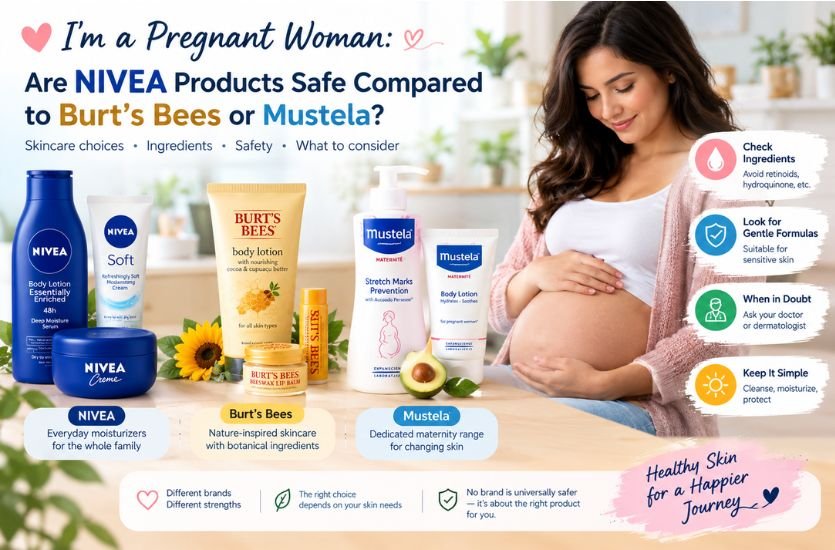
Pregnancy often brings changes in skin texture, sensitivity, hydration and pigmentation. As a result, many expectant mothers begin reviewing their skincare routines and asking whether their familiar moisturizers and body creams are suitable for use during pregnancy. NIVEA, Burt’s Bees and Mustela are three well-known skincare brands, but their products differ in formulation, fragrance, intended use and product range.
The important question is not simply which brand is considered the most natural or which one specializes in maternity care. Instead, pregnant women should understand the ingredients in each product, distinguish everyday moisturizers from active treatments, and seek professional guidance when a formula contains ingredients that require extra caution.
Quick Answer: Are NIVEA Products Safe During Pregnancy Compared to Burt’s Bees or Mustela?
Many basic moisturizing and cleansing products from NIVEA, Burt’s Bees and Mustela may be suitable during pregnancy when used as directed. However, no brand should automatically be considered safer than the others without examining the individual product and its ingredients.
NIVEA states that its cosmetics undergo safety and skin-compatibility evaluations and are considered suitable for pregnant and breastfeeding women under its product-safety policy. Burt’s Bees emphasizes naturally derived ingredients in many of its products, while Mustela offers a dedicated maternity skincare range. These differences can help consumers narrow their choices, but they do not replace an ingredient-by-ingredient assessment.
The American Academy of Dermatology recommends checking skincare labels during pregnancy and avoiding ingredients such as retinoids and hydroquinone. Pregnant women should consult their obstetrician or dermatologist before using uncertain acne treatments, skin-lightening products or other active formulations.
Understanding Skincare Safety During Pregnancy
Pregnancy can affect the skin in several ways. Hormonal changes may contribute to dryness, acne, increased sensitivity, uneven pigmentation and stretch marks. A product that previously felt comfortable may suddenly cause irritation, while a familiar moisturizer may continue to work well.
For everyday skincare, a simple routine is often sufficient. Gentle cleansing, regular moisturizing and appropriate sun protection can help maintain skin comfort without introducing unnecessary products. Choosing a formula that suits an individual’s skin type is more useful than switching brands solely because one advertises natural ingredients or maternity-specific benefits.
Skincare safety also depends on how a product is used. A basic body lotion is different from a concentrated acne treatment, a prescription cream or a skin-lightening formula. Products intended for treating medical conditions deserve closer attention because they may contain active ingredients that are not recommended during pregnancy.
NIVEA During Pregnancy: What Should Women Know?
NIVEA is widely recognized for everyday moisturizers, body lotions, facial creams, cleansers and other personal care products. Many of its products are designed to support skin hydration and help reduce moisture loss. For pregnant women experiencing dry or tight skin, a suitable moisturizer can be a practical addition to a daily routine.
The company states that its cosmetic products undergo safety and skin-compatibility assessments before being introduced to the market. Its published guidance considers these cosmetics suitable for pregnant and breastfeeding women. However, NIVEA also acknowledges that individual sensitivities vary and recommends seeking professional advice when personal health circumstances raise concerns.
This distinction matters because NIVEA sells many different formulations. A basic moisturizer cannot be evaluated in the same way as an anti-ageing cream, an acne treatment or a product intended to address pigmentation. Consumers should check the complete ingredient list and intended use of the exact product they plan to apply.
NIVEA Moisturizers and Fragrance Sensitivity
Some NIVEA creams and lotions contain fragrance. Fragrance is not automatically evidence that a cosmetic product is unsafe during pregnancy, but it can cause discomfort or irritation in people with sensitive skin. Pregnancy-related changes may make certain scents less tolerable, and individuals with eczema or a history of contact allergies may need extra care.
Women who experience irritation or prefer to minimize unnecessary fragrance exposure can consider a suitable fragrance-free moisturizer. They should also avoid assuming that every NIVEA product has the same formula, since ingredients can vary across product lines and markets.
Is It Necessary to Stop Using NIVEA?
Not necessarily. A pregnant woman who already uses a basic NIVEA moisturizer without irritation may not need to replace it simply because she becomes pregnant. The more important step is to check whether the product contains any ingredients that require avoidance or professional review.
If the product is marketed for acne, intensive anti-ageing or skin lightening, its active ingredients deserve particular attention. When uncertainty remains, a pharmacist, obstetrician or dermatologist can help assess the specific formula.
Burt’s Bees During Pregnancy: Are Natural Ingredients Better?
Burt’s Bees is known for nature-inspired skincare and personal care products, including lip balms, body moisturizers, creams and products containing botanical ingredients. Its emphasis on naturally derived ingredients may appeal to consumers who prefer plant-based formulations.
However, the term “natural” does not automatically mean safer during pregnancy. Plants produce a wide range of compounds, and botanical extracts and essential oils can cause allergic reactions or irritation in some individuals. A naturally derived fragrance can still be unsuitable for someone with sensitive skin.
The same principle applies to Burt’s Bees as to any other skincare brand: the full formula matters more than the marketing description. Pregnant consumers should examine the product label, particularly when considering concentrated essential oils, acne treatments or products that make strong claims about changing skin pigmentation.
Burt’s Bees Moisturizers and Lip Care
Basic moisturizing products and lip balms may be reasonable choices when their ingredients are appropriate for the intended use. Consumers should follow the directions on the packaging and avoid using products in ways that could lead to accidental ingestion of ingredients not intended to be swallowed.
People with fragrance allergies or sensitive skin should check for botanical extracts and fragrance components that may trigger symptoms. If a product causes redness, burning, swelling or persistent itching, stop using it and seek appropriate medical advice.
Does a Natural Formula Offer Greater Pregnancy Safety?
Not by itself. Natural-origin ingredients may provide useful moisturizing or conditioning benefits, but their origin does not establish their safety in every concentration or application. Likewise, a synthetic ingredient is not automatically harmful simply because it is laboratory-made.
A fair comparison should examine the product’s purpose, ingredient concentrations where available, evidence of safety, directions for use and individual skin tolerance. This approach provides a more reliable basis for choosing skincare during pregnancy than relying on a natural or organic label alone.
Mustela During Pregnancy: What Makes Its Maternity Range Different?
Mustela is known for skincare products designed for babies, families and expectant mothers. Its maternity range includes products intended to support skin hydration and help maintain skin comfort as the body changes during pregnancy. This focus can make Mustela a convenient option for women specifically looking for maternity skincare.
The brand describes its maternity formulations as safety-assessed, but individual products should still be reviewed before use. A maternity label is useful information about the product’s intended audience; it does not mean that every formulation will suit every person or that professional advice is unnecessary in all circumstances.
Mustela Maternity Moisturizers
Mustela offers stretch-mark products formulated with moisturizing ingredients, including glycerin, shea butter and avocado oil in certain formulations. Ingredients of this type can help condition the skin and support hydration. Maintaining moisture may improve skin comfort, especially when the abdomen, breasts and other areas expand during pregnancy.
However, moisturizing benefits should not be confused with proven stretch-mark prevention. Stretch marks develop through a combination of factors, including skin stretching, hormones and individual susceptibility. No cream can guarantee that stretch marks will not appear.
Is Mustela Automatically Safer Than NIVEA or Burt’s Bees?
No. Mustela’s maternity-focused range may make it easier to identify products intended for pregnancy, but that does not establish that the brand is universally safer than NIVEA or Burt’s Bees.
A suitable product from another brand may meet a pregnant woman’s skincare needs just as well. The most useful comparison considers the actual ingredients, product purpose, fragrance preferences and any relevant medical advice rather than the brand’s overall reputation.
Ingredients Pregnant Women Should Check Before Buying Skincare
Knowing which ingredients require caution is more important than memorizing a list of supposedly pregnancy-safe brands. Although many ordinary cosmetics can be used during pregnancy, certain active ingredients should be avoided or discussed with a healthcare professional.
Retinoids and Retinol
Retinoids are commonly found in some acne and anti-ageing products. They include prescription treatments such as tretinoin and tazarotene, as well as retinol in some over-the-counter cosmetics. Health professionals generally recommend avoiding topical retinoids during pregnancy.
Pregnant women should review the labels of products marketed for wrinkles, acne or skin renewal. If a retinoid has already been used before pregnancy was recognized, stop using it and discuss the exposure with an obstetrician or dermatologist rather than assuming that harm has occurred.
Hydroquinone
Hydroquinone is used in some skin-lightening products to reduce the appearance of dark patches. Because of concerns about its absorption and limited pregnancy safety information, dermatology guidance recommends avoiding it during pregnancy.
Women experiencing melasma or other pigmentation changes should ask a qualified healthcare professional about suitable alternatives instead of beginning a skin-lightening treatment independently.
Salicylic Acid and Other Acne Treatments
Salicylic acid is an exfoliating ingredient used in products for acne and clogged pores. Its suitability depends on factors such as concentration, application area and frequency of use. High concentrations and extensive use deserve particular caution, so pregnant women should discuss acne products with their healthcare professional.
Other active ingredients, including benzoyl peroxide, may also require individualized advice. Prescription acne medications should never be assumed suitable during pregnancy simply because they are applied to the skin.
Fragrance and Essential Oils
Fragrances and essential oils can be relevant for people who experience irritation, allergic reactions or increased sensitivity. These ingredients are not all equivalent, and their presence does not automatically mean that a product poses a pregnancy-related risk.
Nevertheless, women with sensitive skin may prefer a simple, fragrance-free formula. The full ingredient list should be reviewed, especially when a product contains several botanical extracts or concentrated aromatic oils.
NIVEA vs Burt’s Bees vs Mustela: Which Should You Choose?
The right choice depends on the type of skincare needed and the individual product being considered.
NIVEA may suit women seeking familiar, everyday moisturizing products. Its broad range means that each formula should be checked rather than assuming every item serves the same purpose.
Burt’s Bees may appeal to consumers who prefer nature-inspired skincare and botanical ingredients. However, natural-origin ingredients can still trigger irritation, and the word “natural” should not be treated as a guarantee of pregnancy safety.
Mustela may be especially convenient for women looking for products specifically marketed for maternity skincare, including moisturizers intended for skin changes during pregnancy. Its maternity focus can help with product selection, but it does not prove that every product is more effective or safer than comparable products from other brands.
Ultimately, there is no reliable basis for declaring one of these three brands the overall winner for every pregnant woman. The specific formulation, intended use and individual health circumstances should guide the decision.
Building a Simple Pregnancy-Safe Skincare Routine
A practical skincare routine does not need to include numerous products. Gentle cleansing, moisturizing and sun protection can address many everyday concerns while keeping the routine manageable.
For cleansing, choose a product that removes dirt and excess oil without leaving the skin uncomfortably tight. For hydration, use a moisturizer suited to the skin type and stop using it if it causes persistent irritation. For sun protection, a broad-spectrum sunscreen with SPF 30 or higher is a useful daily option; mineral formulas containing zinc oxide or titanium dioxide may be suitable choices for people seeking to minimize irritation.
Women experiencing acne, melasma, eczema or persistent rashes should not rely solely on cosmetic marketing claims. A dermatologist can help select appropriate treatments that account for pregnancy and individual skin needs.
It is also sensible to introduce new products gradually rather than changing an entire routine at once. This makes it easier to identify which product may be responsible if irritation develops.
Frequently Asked Questions
Can I use NIVEA Creme while pregnant?
A basic NIVEA moisturizer may be suitable during pregnancy when used as directed, and the company states that its cosmetics are considered safe for pregnant women. However, check the exact formula, especially if you have sensitive skin or are considering a product designed for a specialized treatment.
Is Burt’s Bees safer because it uses natural ingredients?
Not necessarily. Naturally derived ingredients can still cause irritation or allergic reactions. Pregnancy suitability depends on the complete formulation, intended use and available safety information rather than the origin of the ingredients alone.
Is Mustela specifically designed for pregnant women?
Mustela offers a dedicated maternity skincare range, including products intended for moisturizing and stretch-mark care. Other products in its wider range may have different intended uses, so the label should always be checked.
Can stretch-mark creams prevent stretch marks?
No cream can guarantee prevention. Moisturizers can help keep the skin hydrated and comfortable, but evidence does not establish that marketed stretch-mark creams reliably prevent stretch marks from developing.
What should I do if I am unsure about a product?
Check the ingredient list and the product’s intended use. If it contains retinoids, hydroquinone or an active ingredient whose pregnancy suitability is uncertain, ask an obstetrician or dermatologist before continuing to use it. Seek medical advice promptly if a product causes a significant reaction.
Conclusion: Choosing Skincare With Confidence During Pregnancy
For women asking whether NIVEA products are safe compared with Burt’s Bees or Mustela, the practical answer is that suitable products from all three brands may fit into a pregnancy skincare routine. None should be considered universally safer based on its name, natural-origin claims or maternity-focused marketing alone.
NIVEA offers everyday moisturizers, Burt’s Bees provides nature-inspired skincare, and Mustela has a dedicated maternity range. Each offers different options, but the most important step is to evaluate the exact product and its ingredients.
Choose gentle skincare that meets your needs, check labels carefully and avoid ingredients that medical guidance identifies as unsuitable during pregnancy. When a product’s safety is unclear, an obstetrician or dermatologist can provide advice tailored to your circumstances. A simple, well-chosen routine is generally more useful than switching brands without a clear reason.
This article is for informational purposes and does not replace personalized medical advice.
If you want more informative articles with different categories, visit Expand Magazine.