








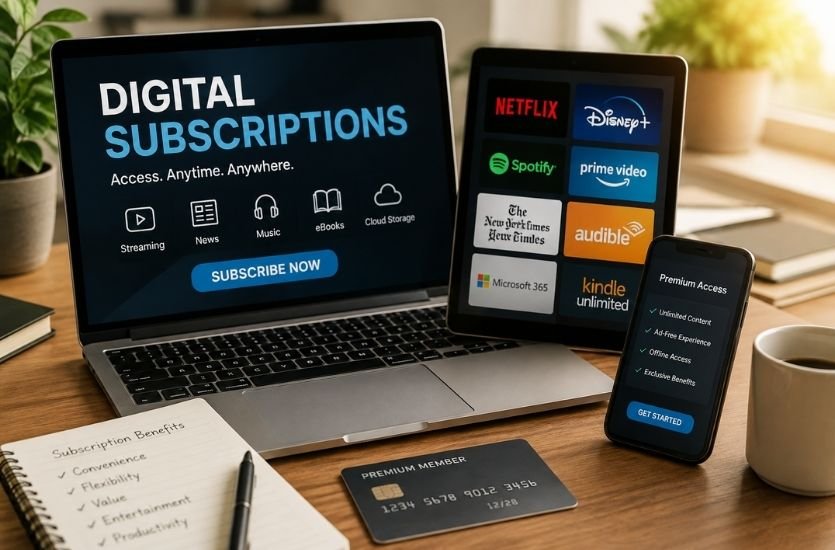
Stop for a second and think about your last month.
How many times did you pay for something without receiving a physical product?
Maybe you watched Netflix after dinner. Maybe you opened Spotify on your way to work or school. Perhaps your photos were backed up to Google One, you used Microsoft 365, edited something with Adobe, played a game through a subscription service, or asked an AI platform to help you with a task.
Now ask yourself something more interesting:
How many digital subscriptions are you actually paying for?
You might be surprised by the answer.
The subscription economy has quietly moved into almost every part of digital life. Companies offering digital subscriptions are no longer limited to entertainment platforms. Today, software companies, cloud providers, news organizations, education platforms, gaming companies, AI businesses, and creator platforms all use recurring payments to build long-term relationships with customers.
And there is a reason this model has become so powerful.
You are not simply buying a product.
You are paying for continued access to something you expect to keep using.
Also Read: Travelandleisure Worldmark: A Complete Guide to WorldMark by Wyndham and Travel + Leisure Co.
What Are Digital Subscriptions?
A digital subscription is a recurring payment that gives a customer ongoing access to a digital product, platform, service, content library, software, storage, or premium features.
The payment may be monthly, annually, or based on another recurring schedule.
The important part is continuity.
You pay today.
You continue receiving value tomorrow.
And if you keep finding that value useful, you continue paying next month.
For example, Netflix provides access to movies, television shows, documentaries, and other streaming content through a recurring membership. Its Pakistan service currently describes plans as monthly memberships that can be cancelled.
Similarly, Microsoft 365 uses a subscription model for productivity applications, cloud storage, security, and AI-related features.
That simple change—from ownership to ongoing access—has transformed how many digital businesses make money.
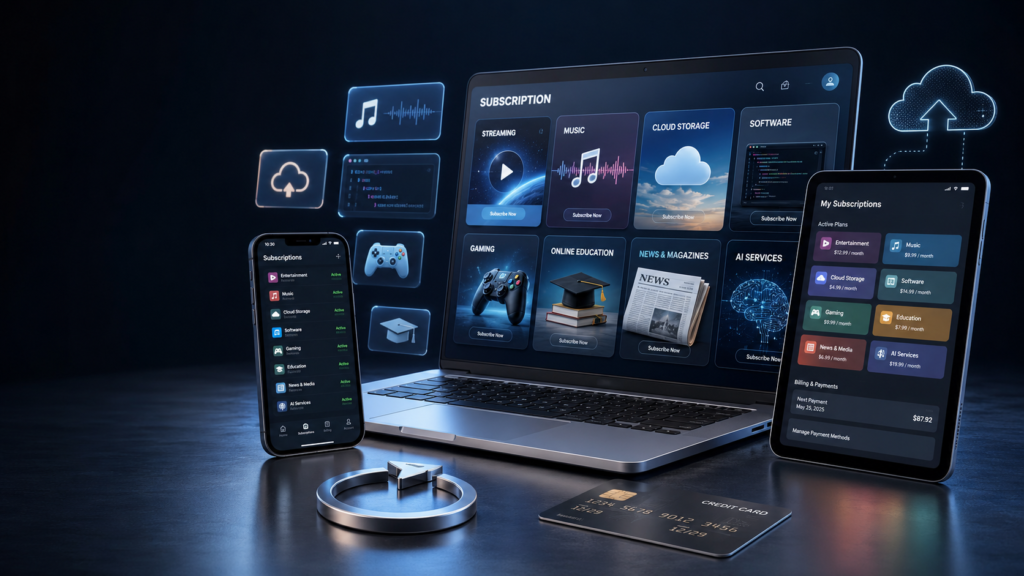
Why Are So Many Companies Offering Digital Subscriptions?
Here is where the story becomes much more interesting.
Imagine a company sells you a digital product once.
The transaction is finished.
Now imagine another company gives you access to a service and charges you every month.
The transaction never really ends.
That continuing relationship can be extremely valuable for a business.
For customers, the attraction is convenience. They can access software, entertainment, storage, education, news, games, or other services without necessarily making a large one-time purchase.
For businesses, subscriptions can create recurring revenue and provide opportunities to improve products continuously.
But there is another reason subscriptions are so powerful.
They Become Part of Your Routine
Think about your morning.
You might check your email.
Listen to music.
Use cloud storage.
Open productivity software.
Read the news.
Use an AI assistant.
Watch entertainment later in the day.
The interesting thing is that none of these activities necessarily feels like a “subscription activity.”
They simply become part of life.
That is exactly what many successful digital subscription companies want.
They want their service to become useful enough that cancelling it feels inconvenient.
Top Companies Offering Digital Subscriptions
There is no single industry controlling the subscription economy.
Streaming companies use subscriptions.
Software companies use subscriptions.
Cloud companies use subscriptions.
News organizations use subscriptions.
Gaming companies use subscriptions.
Education platforms use subscriptions.
And now AI companies are joining the same market.
Let’s look at the companies that make this model easy to understand.
Netflix: Streaming Entertainment Through a Subscription
Netflix official subscription page
Imagine having to buy every movie or television series you wanted to watch.
Your entertainment budget could disappear quickly.
Netflix changed that experience.
Instead of purchasing individual titles, customers pay for continuing access to a large streaming library.
Netflix’s model demonstrates one of the simplest forms of a digital subscription service: pay regularly and receive continuing access to entertainment.
Why Netflix’s Model Works
Netflix does not simply sell access.
It continually gives customers reasons to return.
New movies appear.
New series launch.
Original productions arrive.
Popular titles generate discussion.
The value of the subscription therefore depends heavily on the customer’s belief that there will always be something worth watching.
That creates an important lesson for every subscription-based company:
A subscription is only as strong as the continuing value behind it.
Spotify: Turning Music Into a Subscription Service
Remember when listening to music often meant purchasing an album?
The way people consume music has changed dramatically.
You search for an artist.
You create a playlist.
You discover a new song.
An algorithm recommends something else.
And tomorrow, you do it all again.
Spotify built its service around this continuing behavior.
Its Premium plans offer paid features while the platform also provides a free experience.
That makes Spotify a strong example of the freemium subscription model.
How Freemium Subscriptions Work
The idea is straightforward.
Give people enough value for free to attract them.
Then offer additional benefits that encourage them to upgrade.
The customer gets a chance to experience the service before paying.
The company gets an opportunity to convert free users into paying subscribers.
That approach has become extremely common across the digital economy.
Apple: Building a Subscription Ecosystem
Apple takes the subscription concept beyond a single product.
Its digital services ecosystem includes products such as Apple Music, Apple TV+, Apple Arcade, and iCloud+.
This illustrates an important development in the subscription economy.
Companies are not just selling subscriptions anymore. They are building ecosystems around them.
You may subscribe to one service.
Then another becomes useful.
Then another.
Eventually, several services become connected to the same digital lifestyle.
The Power of Subscription Bundles
Bundles can make multiple subscriptions feel like one larger product.
Instead of thinking about separate services, customers may think about the entire ecosystem.
For businesses, bundling can increase the number of products customers use while potentially improving retention.
Amazon: When a Subscription Becomes an Ecosystem
Amazon provides another fascinating example.
Prime is not simply about one digital product. It connects customers with a wider collection of shopping, entertainment, and other benefits.
That creates an interesting psychological effect.
You might initially subscribe for one reason.
Then you discover another benefit.
Then another.
Eventually, the subscription becomes difficult to judge as one individual service because it provides a collection of benefits.
Why Bundles Matter
This is why subscription bundles are becoming increasingly important.
Customers want value.
Companies want retention.
Bundles can potentially help both sides.
Google: Cloud Storage, AI, and Digital Services
Now think about your digital files.
Your photographs.
Your videos.
Your documents.
Your backups.
Where are they stored?
For millions of people, cloud infrastructure has become an essential part of digital life.
Google One provides subscription plans around storage and, depending on the plan, additional AI-related capabilities and other benefits.
This proves something important:
Digital subscriptions are not only about entertainment.
Sometimes, they are about infrastructure.
Why Cloud Storage Can Create Long-Term Demand
Your need for storage may increase over time.
More photos mean more space.
More videos mean more space.
More documents mean more space.
The larger your digital life becomes, the more useful additional storage can become.
That creates a natural environment for recurring subscriptions.
Microsoft: The Rise of SaaS Subscriptions
Now think about Word, Excel, PowerPoint, Outlook, and other productivity tools.
Software was traditionally something customers could purchase once and keep.
The modern software industry increasingly operates differently.
Microsoft 365 is an example of Software as a Service, commonly known as SaaS.
Customers pay recurring fees for continued access to software and related services.
Microsoft’s current subscription offerings also combine productivity applications with cloud storage, security, and AI features.
Why SaaS Subscriptions Changed Software
Software is no longer a static product.
It is continuously updated.
Security changes.
Features improve.
Cloud services expand.
AI capabilities are added.
A subscription allows the customer to remain connected to that development.
Adobe: Creative Software as a Subscription
If you edit photographs, create videos, design graphics, or work with digital content, Adobe is probably familiar to you.
Adobe’s Creative Cloud represents another major example of subscription-based software.
Instead of treating every software release as a separate purchase, the company provides ongoing access to its creative ecosystem through subscription plans.
Why Creative Software Fits the Subscription Model
Creative professionals often need the newest tools.
They need compatibility.
They need updates.
They need cloud services.
They may also need AI-powered features.
A recurring subscription can provide all of these as the software evolves.
Digital News and Media Subscription Companies
Now consider something that once seemed impossible.
Paying for news online.
For years, many people expected digital news to be free.
But major publishers discovered that readers could become paying digital customers when the content provided enough value.
The New York Times
The New York Times digital subscriptions
The New York Times is one of the strongest examples of a modern digital subscription business.
Its subscription ecosystem extends beyond traditional news and includes products such as Games, Cooking, Audio, Wirecutter, and The Athletic.
The company’s results show how powerful this model has become. In the second quarter of 2026, The New York Times reported approximately 13.35 million total subscribers, including about 12.80 million digital-only subscribers. Digital-only subscription revenue rose 16.4% year over year to $407.9 million.
That is more than just a newspaper selling digital access.
It is an example of a media company building a broader digital subscription ecosystem.
Why Digital News Subscriptions Work
Readers have unlimited access to information.
So why pay?
Because some readers value trusted reporting, investigative journalism, specialized coverage, exclusive content, games, audio, newsletters, and other premium experiences.
The subscription succeeds when the customer believes the value is greater than the monthly cost.
Companies Offering SaaS Subscriptions
Software is one of the largest categories in the digital subscription economy.
Instead of purchasing a program once, customers pay for continued access to software and related services.
Major SaaS Subscription Examples
Some well-known examples include:
- Microsoft 365
- Adobe Creative Cloud
- Salesforce
- Dropbox
- Canva
- Zoom
- Slack
These companies serve different audiences.
Some target individuals.
Some target small businesses.
Others focus heavily on large organizations.
But the underlying model remains similar.
Pay regularly and keep receiving access.
Why Businesses Like SaaS Subscriptions
For software companies, subscriptions can create an ongoing relationship with customers.
For customers, SaaS can reduce the need for large upfront purchases while providing continuous updates and cloud-based functionality.
This is one reason subscription-based companies have become so important in the technology sector.
Streaming Companies Offering Digital Subscriptions
Entertainment remains one of the most visible subscription categories.
Major examples include:
- Netflix
- Disney+
- Max
- Paramount+
- Peacock
- Hulu
- Apple TV+
- Prime Video
- Spotify
- Audible
- SiriusXM
Streaming platforms generally compete through content libraries, original programming, exclusive releases, pricing, bundles, and user experience.
But there is a catch.
The Streaming Customer Can Leave
A customer can subscribe today.
Watch a few shows.
Cancel tomorrow.
Return months later.
That makes customer retention extremely important.
Streaming companies therefore need to continuously answer one question:
“Why should the customer keep paying next month?”
Gaming Companies Offering Digital Subscriptions
Gaming has also moved strongly toward subscription-based access.
Consider services such as:
- Xbox Game Pass
- PlayStation Plus
- Nintendo Switch Online
- EA Play
- Ubisoft+
From Buying Games to Accessing Libraries
The traditional gaming model was simple.
Buy a game.
Own the game.
Play the game.
Subscription gaming changes that relationship.
You may instead pay for access to a collection of games, online multiplayer features, discounts, trials, or other benefits.
This is another example of the digital economy moving from ownership toward access.
Why Gaming Subscriptions Appeal to Players
A subscription can provide access to multiple games without requiring customers to purchase every title individually.
For frequent players, the ability to explore a larger library can make a subscription attractive.
Cloud Storage Companies Offering Digital Subscriptions
Your digital life keeps getting bigger.
More photographs.
More videos.
More documents.
More backups.
More files.
That creates an obvious opportunity for cloud-storage companies.
Major examples include:
- Google One
- iCloud+
- Microsoft OneDrive
- Dropbox
- Box
Cloud Storage as Digital Infrastructure
Once you depend on cloud storage every day, it stops feeling like an optional product.
It becomes part of your digital infrastructure.
That can make cloud storage particularly well suited to a recurring subscription model.
Education and Learning Subscription Companies
Now imagine wanting to learn artificial intelligence, business, technology, languages, or another professional skill.
Would you rather buy one course at a time?
Or have access to a much larger educational library?
That is where online education subscriptions become interesting.
Companies such as Coursera and other learning platforms have helped make subscription-based education more accessible.
Why Education Works as a Subscription
Learning is rarely finished in one session.
You might learn one subject this month and another next month.
A subscription can therefore provide flexibility.
The customer receives access to a wider collection of learning resources while the company creates an ongoing relationship.
Professional and Creator Subscription Platforms
Not every digital subscription business is operated by a giant corporation.
The creator economy has created another powerful form of subscription.
Platforms such as Patreon and Substack allow creators, writers, journalists, podcasters, and other professionals to build businesses around paying audiences.
The Creator Subscription Economy
A writer can offer a paid newsletter.
A podcaster can provide subscriber-only episodes.
A video creator can publish premium content.
A specialist can create a private community.
The subscription model has therefore expanded from company-to-consumer relationships to creator-to-audience relationships.
AI Companies Are Creating a New Subscription Category
And now we reach one of the fastest-changing parts of the story.
Artificial intelligence.
AI platforms are increasingly using subscription plans to provide access to advanced models, higher limits, premium tools, business features, priority access, and other capabilities.
That makes AI subscription companies one of the newest major categories in the digital subscription economy.
Why AI Is Different
AI can require significant computing resources.
A customer who sends a few simple requests may consume far fewer resources than someone using advanced AI tools heavily every day.
That creates a major pricing question.
Should AI companies charge a fixed monthly price, a usage-based price, or a combination of both?
The industry is still experimenting.
But AI has clearly added a new dimension to the subscription economy.
The Future of AI Subscription Pricing
One possible model combines a monthly subscription with usage limits.
A basic plan might provide a certain amount of access.
A premium plan could offer higher limits.
Businesses could receive even greater capacity.
Additional usage could potentially be charged separately.
That would combine the predictability of a subscription with the flexibility of usage-based pricing.
The Main Types of Digital Subscription Models
Not every company offering digital subscriptions uses the same approach.
Freemium Subscriptions
You receive basic access for free and pay for premium features.
Spotify is a familiar example.
The free tier attracts users while premium features provide an incentive to upgrade.
Tiered Subscriptions
Customers choose between multiple plans.
Higher-priced plans generally provide additional features, capacity, or benefits.
Individual Subscriptions
One person receives access through one account.
This is common across streaming, software, education, and productivity platforms.
Family Subscriptions
Several people can share one subscription.
Family plans can make the service more economical while expanding the number of people using the platform.
Business Subscriptions
Companies pay for multiple users and organizational features.
This model is especially important in SaaS.
Annual Subscriptions
Customers commit to a yearly plan instead of paying month to month.
Annual plans can provide companies with longer customer commitments.
Subscription Bundles
Several products or services are combined into one package.
Bundles can make customers feel that they are receiving more value from a single subscription.
Usage-Based Subscriptions
Customers pay according to how much they use.
This model is especially relevant to cloud computing, APIs, enterprise services, and AI.
Why Do Companies Want Recurring Revenue?
Here is the business secret behind the subscription boom.
A one-time sale ends.
A subscription creates another opportunity tomorrow.
And the day after that.
And the day after that.
That does not mean every customer stays forever.
Customers can cancel.
But if a company provides enough continuing value, the relationship can last for years.
This can give recurring revenue companies a more predictable revenue structure than businesses that depend entirely on one-time purchases.
The Importance of Customer Retention
Subscription companies do not simply need customers.
They need customers who stay.
A company may spend money attracting a new subscriber, but if that person cancels quickly, the economics of the relationship become less attractive.
That is why subscription businesses pay close attention to retention and churn.
In simple terms:
Getting the subscriber matters. Keeping the subscriber matters even more.
But There Is a Problem: Subscription Fatigue
Now turn the situation around.
Imagine paying for Netflix.
Then Spotify.
Then cloud storage.
Then software.
Then gaming.
Then news.
Then an AI service.
Then another streaming platform.
Suddenly, your monthly expenses are filled with subscriptions.
This is known as subscription fatigue.
Why Customers Are Becoming More Selective
Customers compare prices.
They cancel services they rarely use.
They switch between competitors.
They wait for discounts.
They choose bundles.
The modern subscriber is not automatically loyal.
They are constantly asking:
“Is this still worth paying for?”
That question can determine whether a digital subscription company succeeds or fails.
How Companies Can Fight Subscription Fatigue
The answer is not always to lower prices.
Companies can instead increase perceived value.
That might mean:
- Better content
- New features
- Improved software
- Larger libraries
- Better personalization
- Useful bundles
- Flexible plans
- Stronger customer support
The goal is simple:
Give customers a reason to stay.
What Makes a Digital Subscription Successful?
A company cannot simply put a monthly price on a website and expect customers to remain subscribed.
A successful subscription needs continuing value.
That could mean new movies.
Better software.
More storage.
Fresh journalism.
New games.
Educational content.
Advanced AI capabilities.
Or simply a service that becomes extremely convenient.
The strongest subscription companies understand something important:
The sale is not the finish line. It is the beginning.
Continuous Value
Customers need a reason to remain subscribed.
If the product stops improving, customers may begin questioning the price.
Strong User Experience
A complicated or frustrating service can quickly lead to cancellations.
Competitive Pricing
Customers compare subscriptions against competitors and free alternatives.
Regular Updates
New content, features, products, and improvements can reinforce the value of staying subscribed.
Personalization
Recommendations and customized experiences can make digital services more useful.
Flexible Plans
Different users have different needs, so multiple subscription tiers can expand the potential customer base.
Trust and Transparency
Customers increasingly expect clear pricing, transparent billing, and straightforward cancellation processes.
Digital Subscriptions Are Changing How We Think About Ownership
Think about the products you use every day.
Do you own the music?
Do you own the streaming shows?
Do you own the cloud storage?
Do you own the software?
Do you own access to an online course?
Increasingly, the answer is no.
You are paying for access.
And that shift is bigger than it first appears.
From Ownership to Access
The change can be seen almost everywhere.
Music moved toward streaming.
Movies moved toward streaming libraries.
Software moved toward SaaS.
Games moved toward digital libraries and memberships.
News moved toward paywalls and memberships.
Storage moved toward cloud subscriptions.
AI is now developing its own recurring access models.
The underlying idea remains the same:
Access can be more valuable than ownership when the digital product keeps changing.
The Future of Companies Offering Digital Subscriptions
So, where does this go next?
The subscription economy is likely to become more sophisticated rather than simply bigger.
Companies are combining products into bundles.
Software platforms are adding AI.
Streaming services are experimenting with different pricing structures.
Publishers are combining news with games, audio, and other digital products.
Education platforms are expanding course libraries.
Gaming companies are building larger digital libraries.
Cloud providers are adding AI capabilities.
AI companies are experimenting with new approaches to pricing and access.
Subscription Bundles Could Become More Important
As customers become overwhelmed by the number of subscriptions available, bundles may become increasingly attractive.
Instead of paying separately for several services, consumers may prefer packages that combine multiple forms of value.
For companies, bundling can create opportunities to cross-sell services and potentially reduce customer churn.
AI May Create New Subscription Models
AI could push the subscription industry toward hybrid pricing.
A customer might pay a monthly membership for access to an AI platform while also paying for usage beyond a certain threshold.
That would combine the predictability of a subscription with the flexibility of usage-based pricing.
Personalization Will Matter More
Digital services can increasingly adapt to individual users.
What you watch.
What you read.
What you listen to.
What you create.
What you search for.
The more useful and personalized the experience becomes, the stronger the reason a customer may have to continue subscribing.
Final Thoughts on Companies Offering Digital Subscriptions
The world of companies offering digital subscriptions is much bigger than Netflix and Spotify.
It includes Microsoft and Adobe in software, Google and Dropbox in cloud storage, Apple and Amazon in digital ecosystems, The New York Times in journalism, Coursera in education, gaming companies such as Xbox and PlayStation, and a rapidly expanding group of AI companies.
The common thread is simple.
Customers are paying for continuing access to continuing value.
That is why digital subscription companies have become so powerful.
But there is a catch.
Customers will continue paying only when they believe the service deserves a place in their lives.
So the future of the subscription economy may not ultimately belong to the company with the most subscribers.
It may belong to the company that gives its subscribers the strongest reason to stay.
And if you look at your own monthly expenses, you may realize something surprising:
You are not just watching the subscription economy happen.
You are already part of it.
Also Visit: Expand Magazine