









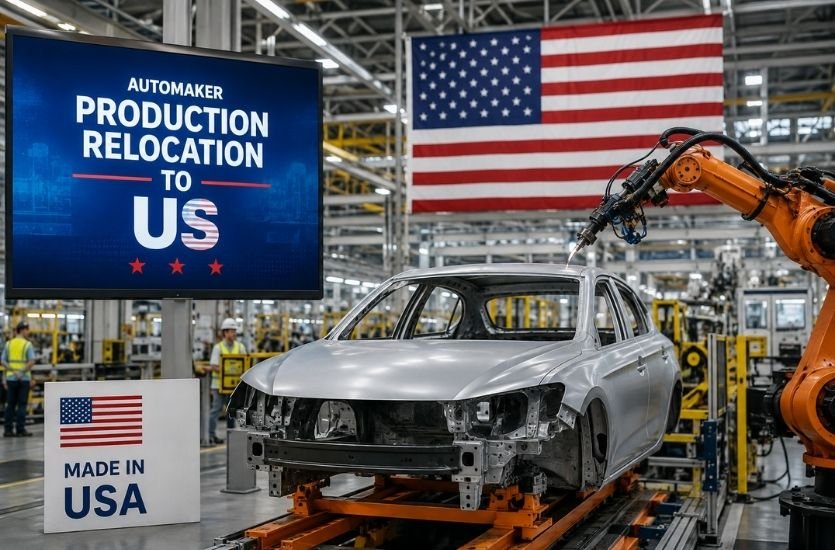
The global automotive industry is entering a new phase.
For decades, automakers built vehicles wherever production was most efficient. Mexico offered lower labor costs, Canada provided an established manufacturing base, Japan remained a major center for vehicle development and production, and China became increasingly important for both manufacturing and electric vehicles.
Now, that calculation is changing.
Automaker production relocation to US has become an increasingly important topic as tariffs, supply-chain concerns, trade uncertainty, national-security considerations, and pressure to strengthen domestic manufacturing push companies to reconsider where vehicles are built.
But there is an important distinction.
Automakers are not simply abandoning factories overseas and moving entire operations to the United States. Instead, many companies are shifting selected vehicle programs, expanding existing American plants, increasing U.S. production capacity, and reshoring models that were previously imported.
Ford’s decision to move production of some Lincoln models from China to the United States beginning in 2030 is one of the clearest recent examples. Toyota is also planning to shift some Tacoma production from Mexico to Texas, while other manufacturers are expanding American capacity.
So, what is driving this change—and what does the future of U.S. auto manufacturing look like?
Also Read: United Airlines Flight UA82 Emergency: What Happened on the Newark-to-Delhi Flight?
What Does Automaker Production Relocation to US Mean?
The phrase automaker production relocation to US describes the process in which an automobile manufacturer moves some vehicle production, assembly, or related manufacturing activity from another country to facilities in the United States.
This can happen in several ways.
An automaker may move a particular model from a foreign factory to an existing U.S. plant. It may increase production at an American factory that already manufactures vehicles. It may reopen or expand an underused facility. Or it may build a completely new manufacturing plant.
The broader concept is often called automotive reshoring or auto industry reshoring.
However, reshoring does not necessarily mean that every component is manufactured domestically. Modern vehicles depend on complex international supply chains, meaning a vehicle assembled in the United States can still contain parts manufactured in Mexico, Canada, Asia, Europe, and other regions.
That makes the current trend more complicated than simply saying that “car production is moving back to America.”
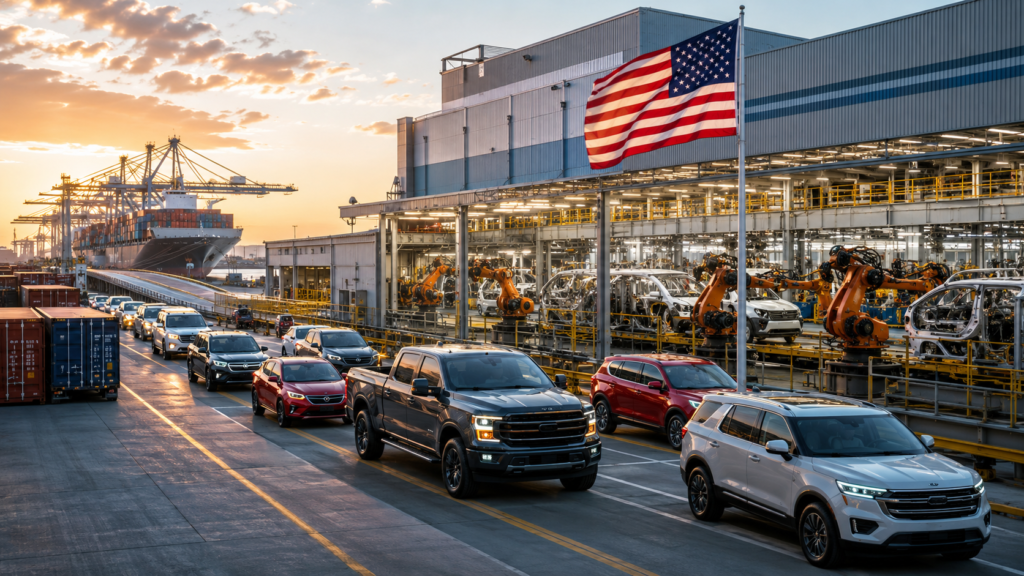
Why Are Automakers Moving Production to the US?
The biggest force behind the latest wave of automakers moving production to the US is trade policy.
U.S. tariffs have changed the economics of importing vehicles and automotive components. In March 2025, the White House announced a 25% tariff on imported passenger vehicles, light trucks, and certain automotive parts. A subsequent policy specifically stated that the administration wanted to encourage manufacturers to assemble more vehicles in the United States.
For an automaker, the calculation is straightforward in principle.
If importing a vehicle becomes significantly more expensive because of tariffs, producing that vehicle inside the United States can become more attractive.
But the decision is not simple.
A manufacturer must compare tariff costs with American labor expenses, factory construction costs, supplier availability, transportation costs, engineering requirements, and the enormous investment needed to change production lines.
That is why the current auto production shift to US is happening selectively rather than universally.
Tariffs Are Changing the Automotive Manufacturing Equation
Tariffs can influence automotive manufacturing decisions in two directions.
First, they can make imported vehicles more expensive.
Second, they can make domestically assembled vehicles relatively more competitive.
The White House has explicitly presented domestic automobile production as one of the goals of its tariff policy.
The Center for Automotive Research has also warned that automotive tariffs are creating operational and investment pressures across the industry, with manufacturers and suppliers seeking greater predictability and stronger coordination across North America.
Yet tariffs also create a second problem: the American automotive industry itself depends heavily on imported components.
A vehicle may be assembled in Michigan, Kentucky, Texas, Indiana, or another U.S. state while still relying on an international network of suppliers.
Therefore, U.S. auto manufacturing 2026 is not becoming completely independent from global supply chains. Instead, companies are trying to make those supply chains more resilient and economically manageable.
Ford’s Lincoln Production Move
One of the most significant recent examples involves Ford.
Ford announced plans to move production of some Lincoln models from China to the United States beginning in 2030.
The decision is particularly significant because the Lincoln Nautilus, one of Ford’s major China-built U.S. imports, faces a substantial U.S. tariff. Reuters reported that Ford confirmed a 52.5% tariff on the model.
Ford CEO Jim Farley said the company made the decision after the administration’s trade policy became clear.
The move represents a textbook example of China to US auto production relocation.
Rather than continuing to rely on Chinese manufacturing for vehicles intended for American consumers, Ford plans to increase domestic production.
The company has not yet disclosed exactly which U.S. facilities will build the affected Lincoln models.
That detail matters because the project should be described as a planned future production relocation, not a completed factory move.
Toyota’s Tacoma Production Shift
Toyota provides another important example.
The automaker plans to increase Tacoma production in Texas while shifting some production away from Mexico.
Toyota has committed billions of dollars to expanding its U.S. manufacturing operations, including a reported $3.6 billion investment associated with its Texas production footprint. Reuters reports that Toyota intends to move Tacoma production from its Baja California operation in Mexico to Texas.
But there is a crucial detail.
Toyota is not completely abandoning Mexican Tacoma production.
Instead, production is being redistributed.
This illustrates the broader strategy behind Mexico to US auto production: manufacturers can move a portion of output into the United States without completely dismantling their established foreign operations.
For Toyota, maintaining production flexibility across North America can be more practical than transferring an entire model to one country.
General Motors and U.S. Production Expansion
General Motors is another major company reshaping its production footprint.
GM has been investing in American manufacturing capacity while adjusting its international production strategy.
The company’s approach demonstrates that GM production relocation is not simply about closing foreign plants. It also involves deciding which vehicles should be produced closer to the American market and how existing American facilities can be used more effectively.
GM’s strategy is particularly important because the company has large manufacturing operations in the United States, Canada, Mexico, and China.
That geographic diversity gives GM flexibility—but it also exposes the company to tariffs and cross-border trade disruptions.
Honda Is Moving Production Toward Indiana
Honda offers another example of production localization.
The Japanese automaker has shifted production of its Civic hybrid for the U.S. market from Japan to Indiana, increasing the role of its American manufacturing network. Reuters also reports that Honda is considering whether to build another North American assembly plant, with future investment decisions influenced by uncertainty surrounding the USMCA trade agreement.
Honda’s situation demonstrates that Honda US production is about more than tariffs.
Demand patterns, hybrid strategy, factory capacity, trade agreements, and long-term regional planning are all part of the equation.
Honda has also adjusted its electric-vehicle strategy, making its production decisions increasingly connected to changing consumer demand.
Hyundai Expands North American Manufacturing
Hyundai is also expanding its manufacturing footprint in North America.
The company has announced plans to increase global production capacity significantly, with approximately 500,000 units of additional capacity planned for North America by 2030. Reuters also reported that Hyundai plans to introduce additional hybrid models in the region as it responds to changing market conditions.
This should not automatically be described as 500,000 vehicles being relocated from overseas factories to the United States.
The figure refers to North American capacity, not simply U.S. reshoring.
That distinction is essential for accurate reporting.
Nevertheless, Hyundai’s strategy demonstrates the broader movement toward greater regional manufacturing capacity.
Mercedes-Benz, Stellantis, Nissan and Other Automakers
The reshoring discussion extends beyond Ford, Toyota, GM, Honda, and Hyundai.
Mercedes-Benz has been expanding U.S. manufacturing capacity, while Stellantis has announced major investments designed to increase domestic production.
Nissan and other international manufacturers are also evaluating how to make better use of their existing U.S. manufacturing footprints.
The common theme is not necessarily that every company is building a new factory.
Instead, manufacturers are asking a different question:
Which vehicles should be built in America to serve the American market?
That question is becoming increasingly important as tariffs and trade restrictions alter the traditional economics of international automobile production.
Why Mexico Has Been So Important to Automakers
To understand the automotive production relocation to US, it is necessary to understand why companies built so much production capacity in Mexico in the first place.
The answer includes labor costs, geographic proximity, supplier networks, trade agreements, and decades of investment.
Mexico became deeply integrated into the North American automotive supply chain.
Vehicles and components can cross the U.S.-Mexico border during different stages of manufacturing before a finished vehicle reaches a customer.
The Center for Automotive Research has previously estimated that producing vehicles in Mexico can provide a substantial labor-cost advantage compared with manufacturing the same vehicle in the United States.
That cost advantage does not disappear simply because tariffs increase.
Instead, automakers must calculate whether tariff costs outweigh the savings generated by lower-cost production.
Canada Creates a New Complication
Canada has historically been another major part of the North American automotive manufacturing network.
However, trade tensions in 2026 have created new uncertainty.
Reuters reported on August 31, 2026, that a proposed U.S. 50% tariff on Canadian vehicles could put significant pressure on Toyota and Honda, both of which have substantial Canadian production exposure.
That development could potentially increase pressure on automakers to find additional production capacity in the United States.
But it also illustrates the danger of assuming that tariffs automatically produce reshoring.
GM, for example, has recently reached a labor agreement involving additional investment in Canadian production, demonstrating that companies can still invest outside the United States even during periods of intense trade pressure.
In other words, the future of North American auto manufacturing remains interconnected.
The USMCA Problem
The United States-Mexico-Canada Agreement remains a major factor in automotive manufacturing decisions.
The agreement replaced NAFTA and created the framework governing much of North America’s integrated automotive trade.
Automakers have repeatedly emphasized the importance of predictable trade rules.
In 2026, uncertainty surrounding the future of the agreement has made long-term investment decisions more difficult. Honda, for example, has indicated that it could reconsider plans for another North American assembly plant if the trade framework remains uncertain.
This is why USMCA and auto production are closely connected.
An automaker planning a factory expected to operate for decades needs confidence that the trade rules surrounding that factory will remain workable.
Why Automakers Cannot Move Everything to America
At first glance, moving production to the United States may sound simple.
It is not.
A modern automobile factory is a highly specialized operation involving thousands of workers, sophisticated robotics, tooling, logistics systems, suppliers, software, quality-control systems, and carefully engineered production processes.
Moving production therefore requires significant time and capital.
There is another problem.
American manufacturing is expensive.
Higher wages, real estate costs, utilities, regulatory expenses, and other operating costs can make U.S. production considerably more expensive than production in lower-cost countries.
As a result, a tariff must be large enough—or sufficiently persistent—to justify the cost of changing the manufacturing footprint.
The Supply Chain Is the Real Story
Perhaps the biggest misconception about automaker reshoring is that assembling a vehicle in the United States means the entire supply chain is American.
Modern vehicles make that impossible in many cases.
Engines, transmissions, batteries, electronics, semiconductors, seats, wiring systems, glass, tires, steel, aluminum, and thousands of smaller components can come from different countries.
Reuters reported that imported components remain deeply embedded in vehicles assembled in the United States, illustrating how tariffs on parts can affect domestic production as well as imports.
This creates a paradox.
A policy designed to encourage American auto manufacturing can also increase production costs for American-made vehicles if imported components become more expensive.
What Does Production Relocation Mean for American Jobs?
One of the strongest arguments for car manufacturing moving to America is employment.
When automakers increase domestic production, new factory investments can create jobs in assembly, engineering, logistics, maintenance, technology, management, and supplier operations.
The economic impact can extend beyond the automaker itself.
A new vehicle program can encourage suppliers to establish or expand nearby factories, creating additional employment.
This is why state governments often compete aggressively to attract automotive manufacturing investments.
The result can be the development of entire regional automotive ecosystems.
Could Production Relocation Increase Car Prices?
There is a catch.
Moving production to the United States can create jobs and strengthen domestic manufacturing, but it does not necessarily make cars cheaper.
If U.S. production costs are higher, automakers may pass some of those expenses to consumers.
Tariffs can also increase the price of imported parts.
Reuters previously reported estimates suggesting that automotive tariffs could add thousands of dollars of potential cost per vehicle depending on the model and supply-chain structure.
That means the long-term outcome could involve a trade-off:
more domestic production and stronger supply-chain resilience, but potentially higher vehicle prices.
Electric Vehicles Add Another Layer
The future of US auto manufacturing cannot be separated from electric vehicles.
EV production requires batteries, battery materials, power electronics, semiconductors, and other technologies that have highly international supply chains.
For automakers, deciding where to build electric vehicles can therefore involve national-security concerns, tariff exposure, battery sourcing requirements, consumer incentives, and demand forecasts.
At the same time, hybrid vehicles are becoming increasingly important.
Hyundai, Honda, Toyota, and other manufacturers are expanding hybrid strategies in response to changing consumer preferences and fuel costs.
This means the next wave of automotive manufacturing relocation may not simply involve gasoline vehicles.
It could increasingly involve hybrids, EV components, batteries, electronics, and other technologies.
Is This a Full Automotive Reshoring Revolution?
Not quite.
The phrase automotive reshoring revolution sounds dramatic, but the reality is more measured.
Some production is moving.
Some production is expanding.
Some projects are being delayed.
Some foreign factories are continuing to operate.
And some automakers are investing simultaneously in both U.S. and overseas facilities.
The global automotive industry remains too interconnected for an overnight manufacturing reversal.
Instead, the emerging model is one of strategic localization.
Automakers are attempting to place more production inside the markets where vehicles are sold while maintaining enough global manufacturing flexibility to control costs.
The Future of Automaker Production Relocation to US
The next several years could determine whether the current trend becomes a permanent transformation of the automotive industry.
Several factors will matter.
The first is tariff policy.
If high tariffs remain in place for years, companies will have stronger incentives to expand U.S. production.
The second is labor and operating costs.
If U.S. manufacturing becomes significantly more expensive than foreign alternatives, companies may continue to maintain international production.
The third is trade policy.
A stable USMCA framework could encourage companies to keep using integrated North American supply chains, while prolonged uncertainty could encourage more localized production.
The fourth is consumer demand.
Automakers will ultimately build vehicles where they believe they can produce them efficiently and sell them profitably.
The fifth is technology.
EVs, hybrids, autonomous vehicles, batteries, and connected-car systems are changing what an automotive factory looks like and which suppliers matter most.
What Automaker Production Relocation Means for the U.S. Auto Industry
The biggest change may not be the disappearance of foreign factories.
It may be the gradual transformation of the United States into an even more important manufacturing center.
Ford’s planned Lincoln reshoring from China, Toyota’s Tacoma production shift toward Texas, Honda’s increased U.S. production, Hyundai’s expanding North American capacity, and investments from other automakers all point toward a more localized manufacturing strategy.
But the story is not as simple as “foreign production is coming home.”
It is about economics.
It is about tariffs.
It is about supply chains.
It is about trade agreements.
And increasingly, it is about national industrial strategy.
Final Thoughts
Automaker production relocation to US is becoming one of the defining developments in the modern automotive industry.
Companies are reassessing where they manufacture vehicles because the traditional advantages of globalized production are being challenged by tariffs, geopolitical uncertainty, supply-chain risks, and changing trade rules.
Ford’s planned relocation of some Lincoln production from China to the United States is a powerful example. Toyota’s Tacoma strategy shows another approach: shift some production to America while maintaining a broader North American manufacturing network. Honda, Hyundai, GM, Stellantis, Mercedes-Benz, and others are also adjusting their manufacturing footprints.
Yet a complete return of global auto manufacturing to America is unlikely.
The future is more likely to be a hybrid model of domestic production and international supply chains, with automakers strategically deciding which vehicles, components, and technologies should be produced in the United States.
The real question is no longer simply whether automakers are moving production to America.
It is how much production they will move, which models will move, how quickly they can do it, and whether the economics of U.S. manufacturing can remain competitive for decades to come.
Also Visit: Expand Magazine