









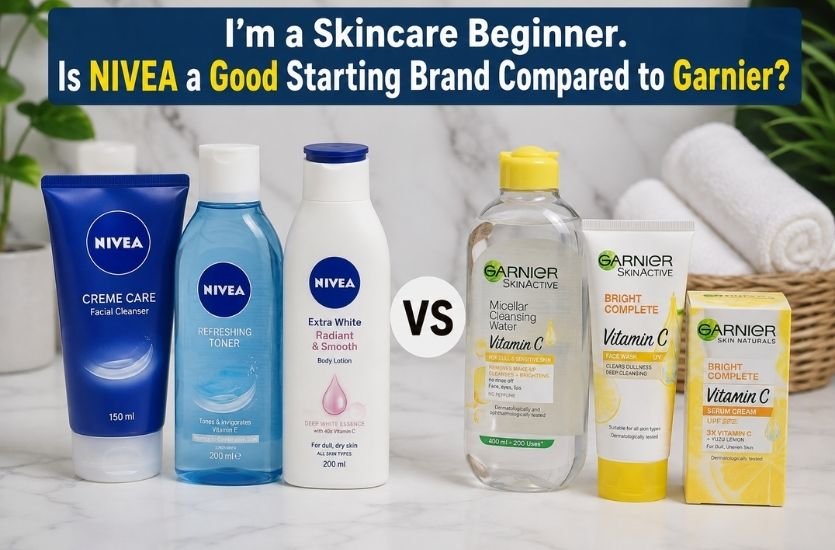
Starting skincare can feel like opening a book written in another language. One bottle promises hydration, another says vitamin C, another contains salicylic acid, while a fourth claims to brighten your complexion. Suddenly, choosing a simple moisturizer feels like a major decision.
If you are asking, “I’m a skincare beginner. Is NIVEA a good starting brand compared to Garnier?”, the answer is yes—but there is an important catch: neither brand is automatically better for everyone.
NIVEA can be an excellent starting point for someone who wants simple, moisture-focused skincare, while Garnier may be more appealing to beginners looking for cleansing, brightening, oil-control, or targeted products. The best choice ultimately depends on your skin type, skin concerns, ingredients, and how simple you want your routine to be.
And that is the part many quick comparisons miss.
Also Visit: QuikConsole Com: What Is It, How It Works, and Is It Legit?
NIVEA vs Garnier: The Short Answer
If you are completely new to skincare, you do not need a shelf full of products.
The American Academy of Dermatology recommends keeping a beginner routine simple: a gentle cleanser, moisturizer, and broad-spectrum sunscreen with SPF 30 or higher can form a strong foundation. It also emphasizes that consistency is more important than following a complicated 10-step routine.
With that principle in mind:
- NIVEA is particularly attractive if your priority is basic hydration and moisturization.
- Garnier is particularly attractive if you want targeted products for concerns such as dull-looking skin, oiliness, cleansing, or blemishes.
- Sensitive skin requires ingredient checking, regardless of the brand.
- Dry skin may prefer richer NIVEA formulas, while some oily or combination-skin users may prefer lighter Garnier products.
- You do not have to choose one brand exclusively. A routine can contain products from both.
So, is NIVEA a good starting brand compared with Garnier? Yes. But the right NIVEA or Garnier product matters more than the brand name itself.
Why NIVEA and Garnier Are Popular With Skincare Beginners
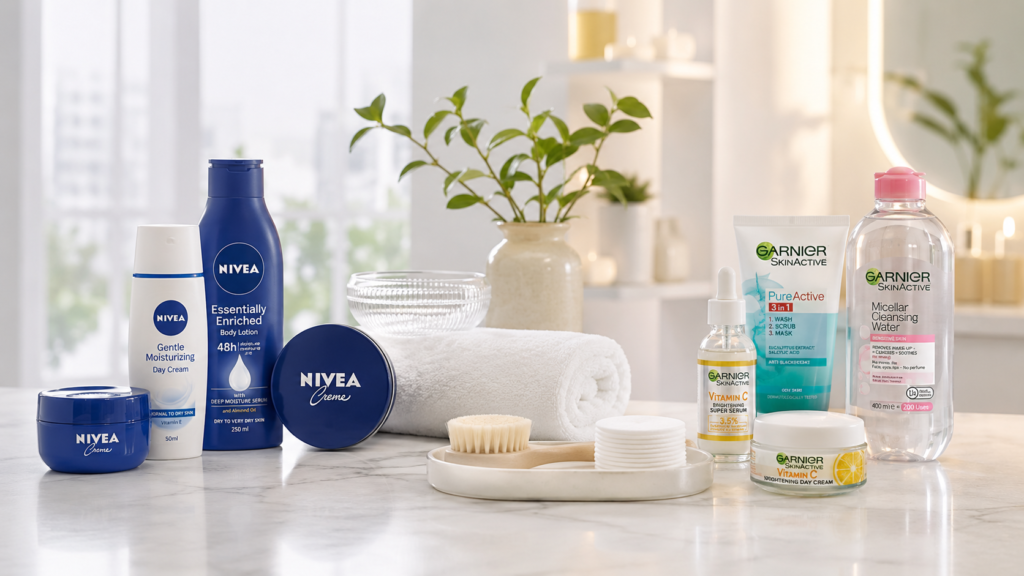
Walk into almost any supermarket, pharmacy, or beauty retailer and you are likely to encounter NIVEA and Garnier.
That accessibility is important for beginners. You can find products at different price points without immediately moving into expensive luxury skincare.
But the two brands have somewhat different identities.
NIVEA is strongly associated with moisturizers, creams, lotions, and everyday skin comfort.
Garnier is particularly visible in cleansing, micellar water, brightening products, and targeted skincare.
That does not mean NIVEA has no active skincare or Garnier has no moisturizers. Both brands have extensive product ranges. Rather, it describes the general direction beginners are likely to encounter when exploring each brand.
Recent search results for this exact question repeatedly make the same broad distinction: NIVEA is generally presented as the simpler, hydration-oriented option, while Garnier is more associated with targeted concerns and active ingredients.
But there is a better way to make the decision.
Don’t ask, “Which brand is better?”
Ask:
“What does my skin actually need?”
Is NIVEA Good for Skincare Beginners?
Yes, NIVEA can be a very reasonable starting brand.
For someone who has never had a skincare routine, a moisturizer-focused approach can be easier to understand than immediately experimenting with several active ingredients.
NIVEA offers a wide selection of moisturizing products, including its classic NIVEA Creme and products specifically formulated for sensitive skin. For example, NIVEA’s Sensitive Day Cream is listed as perfume-free and contains ingredients including glycerin, panthenol, and licorice extract.
That makes the brand worth considering if your first goal is simply to make your skin feel:
- less dry
- more comfortable
- softer
- adequately moisturized
However, there is an important misconception to avoid.
NIVEA is not automatically suitable for every sensitive-skin user
Some NIVEA products contain fragrance and fragrance allergens. Therefore, beginners should examine the individual ingredient list rather than assuming every product carrying the NIVEA name is fragrance-free.
The same principle applies to Garnier.
A brand’s reputation cannot replace reading the label.
Is Garnier Good for Skincare Beginners?
Absolutely.
Garnier can also be a good starting brand, particularly if you already know what you want your skincare routine to address.
The brand offers products across cleansing, micellar water, moisturization, brightening, and targeted skincare. Its Vitamin C range, for example, is positioned around cleansing and brightening, while other products use ingredients such as salicylic acid for blemish-prone or oily skin.
That variety can be both an advantage and a disadvantage.
If you know your concern, it gives you more options.
If you know nothing about skincare, too many options can create confusion.
Imagine seeing:
Vitamin C + niacinamide + salicylic acid + exfoliating acids + moisturizer + cleanser + serum.
It is tempting to buy everything.
That is exactly what a beginner should avoid.
NIVEA vs Garnier for Different Skin Types
Your skin type should influence the decision much more than brand popularity.
| Skin type or concern | Possible starting choice | Why |
|---|---|---|
| Dry skin | NIVEA | Moisturization is a major strength |
| Very dry skin | NIVEA | Richer moisturizing formulas may be appealing |
| Normal skin | Either | Both offer basic skincare options |
| Oily skin | Garnier may suit you | More lightweight and targeted options are available |
| Combination skin | Either | Choose products according to different areas of your face |
| Sensitive skin | Either, carefully selected | Look for gentle, fragrance-free formulas |
| Blemish-prone skin | Garnier may have an advantage | Targeted products include ingredients such as salicylic acid |
| Dull-looking skin | Garnier may have an advantage | Brightening-focused products are prominent |
| Simple hydration | NIVEA | Strong focus on moisturization |
| Targeted skincare | Garnier | Broad selection of concern-specific products |
This table is a starting framework, not a medical diagnosis. Skin can behave differently from person to person, and the same brand can contain products with completely different formulas.
NIVEA vs Garnier: Which Is Better for Dry Skin?
Here’s where NIVEA often becomes an attractive option.
If your face frequently feels tight after washing, looks flaky, or simply feels dry, your first priority should generally be adequate moisturization rather than immediately adding multiple active ingredients.
NIVEA’s long-standing strength is moisturizing skincare, making it a logical brand to investigate for someone whose main goal is hydration.
But richer does not always mean better.
A very rich cream can feel uncomfortable on some oily or combination skin types. Therefore, choose according to how your skin actually feels rather than assuming that the richest moisturizer is automatically the best.
NIVEA vs Garnier for Oily Skin
Now the balance can shift.
If your face becomes shiny quickly, particularly around the forehead, nose, and chin, you may prefer a lighter-feeling routine.
Garnier’s skincare portfolio includes products designed around cleansing and concerns associated with oily or blemish-prone skin. Its salicylic-acid micellar cleansing water is one example of a product aimed at this type of targeted concern.
However, oily skin still needs moisturizer.
This is one of the most common beginner misunderstandings.
Oily skin does not mean “no moisturizer.”
Instead, look for a moisturizer whose texture and formula suit your skin.
NIVEA vs Garnier for Acne-Prone Skin
If breakouts are your main concern, Garnier may provide more immediately relevant options because some products incorporate ingredients such as salicylic acid.
Salicylic acid is commonly used in skincare aimed at clogged pores and blemishes.
But beginners should resist the temptation to attack acne with several strong products simultaneously.
If you introduce a cleanser containing an active ingredient, then add a serum, exfoliant, scrub, and another treatment at the same time, you may have no idea which product is helping—or irritating—your skin.
A simpler approach is easier to understand and maintain.
And if acne is persistent, painful, severe, or leaving scars, a dermatologist is a better source of personalized treatment than choosing products based solely on a brand comparison.
NIVEA vs Garnier for Sensitive Skin
This is where the answer becomes more complicated.
There is no universal rule saying:
“NIVEA is for sensitive skin.”
or
“Garnier is for sensitive skin.”
Instead, look at the specific formulation.
The American Academy of Dermatology recommends gentle, non-abrasive cleansing and says fragrance-free products are preferable for people prone to irritation because added fragrance can trigger irritation or allergic reactions.
Therefore, if you have sensitive skin, examine:
- fragrance/parfum
- essential oils
- exfoliating acids
- alcohol-containing formulas
- active ingredients
- the product’s intended skin type
A product labeled for sensitive skin can still be different from another product from the same brand.
The ingredient list matters more than the logo.
NIVEA vs Garnier: Moisturizers
If the comparison is specifically about moisturizers, NIVEA has a strong case.
Moisturization is central to many NIVEA products, and the brand offers everything from rich creams to lighter formulations.
Garnier also has moisturizing products, including formulas focused on hydration and specific skincare concerns.
The question therefore becomes:
Do you simply want moisture, or do you want moisture plus a targeted concern?
If you simply want a basic moisturizer, NIVEA may be the easier place to begin.
If you want a moisturizer that is part of a targeted routine for a particular concern, Garnier may offer an option worth considering.
NIVEA vs Garnier: Cleansers and Micellar Water
This is an area where Garnier deserves particular attention.
Garnier is well known for its micellar-water products, which are designed to help remove makeup, dirt, and other substances from the skin.
Some Garnier micellar products are formulated around additional skincare benefits, such as vitamin C or salicylic acid.
For someone who wears makeup or simply wants a convenient cleansing product, this can make Garnier attractive.
NIVEA also offers facial cleansers, so this isn’t a situation where one brand is incapable of serving the purpose.
The real question is which individual cleanser suits your skin and routine.
NIVEA vs Garnier: Vitamin C and Brightening
If your main goal is a brighter-looking complexion or addressing the appearance of uneven tone, Garnier may have the stronger beginner-facing selection.
Its Vitamin C products are specifically marketed around brightening-related benefits.
But here’s the hook:
You don’t need vitamin C simply because everyone on social media is talking about it.
If you are a complete beginner and your skin is currently dry, irritated, or uncomfortable, establishing a basic routine may be more important than immediately adding a brightening serum.
Start with the foundation.
Add complexity only when you understand why you need it.
Should Beginners Use NIVEA and Garnier Together?
Yes.
There is absolutely no requirement to use one brand exclusively.
In fact, a mixed routine can make sense.
For example, someone might prefer:
Garnier cleanser → NIVEA moisturizer → sunscreen
The combination can work perfectly well if the individual products suit the person’s skin.
Another person might prefer:
gentle cleanser → Garnier targeted product → lightweight moisturizer → sunscreen
The goal isn’t to build a routine where every bottle has the same logo.
The goal is to build a routine where every product has a purpose.
What Should a Skincare Beginner Actually Buy?
This is probably more important than the NIVEA-versus-Garnier debate.
If you’re starting from zero, don’t buy ten products.
Start with the basics.
1. A Gentle Cleanser
Your cleanser should remove everyday buildup without leaving your face feeling painfully tight or stripped.
2. A Moisturizer
Choose according to your skin type.
Dry skin may prefer a richer formula, while oily skin may prefer something lighter.
3. Sunscreen
This is the step beginners frequently underestimate.
The American Academy of Dermatology recommends broad-spectrum, water-resistant sunscreen with SPF 30 or higher as part of a basic skincare routine.
Only after these basics are working comfortably should you start thinking about whether you need additional products.
A Simple Beginner Routine With NIVEA or Garnier
Morning
Cleanser → Moisturizer → SPF 30+ sunscreen
Evening
Cleanser → Moisturizer
That’s it.
No complicated 12-step routine.
No need to purchase every serum you see.
No need to change products every three days because someone on TikTok recommended another one.
The American Academy of Dermatology specifically emphasizes that consistency matters more than a 10-step routine.
What About Serums, Toners and Exfoliators?
They can have a place in a routine, but they are not automatically necessary for a beginner.
This is where Garnier’s broader active-focused selection can become both useful and potentially confusing.
A beginner may see vitamin C, niacinamide, salicylic acid, exfoliating acids, and other ingredients and assume that adding more must produce better results.
It doesn’t work that way.
More skincare is not necessarily better skincare.
If you introduce multiple new products simultaneously and develop irritation, you won’t know which product caused the problem.
Instead, introduce new products gradually.
How Should Beginners Patch-Test New Skincare Products?
If you’re trying a new skincare product, don’t immediately cover your entire face with it.
The American Academy of Dermatology recommends testing new skincare products on a small area before widespread use and monitoring the area for signs of irritation such as redness, itching, or swelling.
This is particularly useful when experimenting with unfamiliar active ingredients or products intended for sensitive skin.
If a product causes significant irritation, stop using it.
Common Skincare Beginner Mistakes
Buying Too Many Products
A bathroom shelf full of products doesn’t automatically equal a better routine.
Choosing Products Because They Are Trending
Popularity does not guarantee compatibility with your skin.
Ignoring Ingredients
The brand name tells you surprisingly little about how one particular product will behave.
Using Too Many Actives
Introducing several active ingredients simultaneously can make irritation and troubleshooting more difficult.
Skipping Sunscreen
A routine focused on cleansers and serums while ignoring daily sun protection is missing an important foundation.
Changing Products Constantly
Give your routine enough time to evaluate how your skin responds, unless a product causes irritation that requires you to stop sooner.
NIVEA vs Garnier: Which Brand Is More Beginner-Friendly?
This depends on what “beginner-friendly” means to you.
If beginner-friendly means:
“I want something straightforward for moisturizing and everyday skin comfort.”
NIVEA has a strong advantage.
If it means:
“I want a product targeted at dullness, oiliness, cleansing, or blemishes.”
Garnier may have the stronger selection.
If it means:
“I have sensitive skin and don’t know what to use.”
Neither brand should automatically win. Choose a suitable individual formula, preferably one designed with sensitive skin in mind, and pay close attention to fragrance and other potentially irritating ingredients.
Can NIVEA Be Used on the Face?
Yes, NIVEA makes products specifically intended for facial skincare.
But don’t assume that every NIVEA product is automatically a facial product.
The same principle applies to Garnier.
Check the product’s intended use, skin type, texture, and ingredient list before applying it to your face.
A product that works beautifully on your body isn’t necessarily the ideal product for your facial skin.
Is NIVEA Better Than Garnier?
There is no universal winner.
That’s the honest answer.
NIVEA can be better for one person, while Garnier can be better for another.
Think of them as different tools rather than two teams competing for a trophy.
NIVEA: particularly strong for simple moisturization and everyday skin comfort.
Garnier: particularly strong for cleansing and targeted concerns such as brightening and blemish-focused skincare.
And sometimes the best answer is:
Use both.
NIVEA vs Garnier: Final Verdict
So, “I’m a skincare beginner. Is NIVEA a good starting brand compared to Garnier?”
Yes. NIVEA is a good starting brand—but it isn’t automatically better than Garnier.
If you’re completely new to skincare and your priority is a simple, hydration-focused routine, NIVEA is a sensible place to begin.
If you already know that your main concern is oiliness, blemishes, dull-looking skin, cleansing, or brightening, Garnier may offer more targeted options.
For sensitive skin, don’t choose based on the brand alone. Check the individual formula and consider fragrance-free products, consistent with dermatology guidance.
Ultimately, the smartest beginner hierarchy is:
Skin compatibility → suitable ingredients → simple routine → consistency → brand name.
That’s the real answer.
You don’t need the most expensive skincare. You don’t need the biggest collection. And you certainly don’t need to use every trending ingredient.
You need a routine your skin tolerates and that you can actually maintain.
Frequently Asked Questions
Is NIVEA good for skincare beginners?
Yes. NIVEA can be a good starting option, particularly for beginners looking for straightforward moisturization and basic skincare. The specific product should still be selected according to skin type and ingredients.
Is Garnier good for skincare beginners?
Yes. Garnier offers many beginner-accessible products, particularly cleansers, micellar waters, moisturizers, and targeted skincare. Its active-oriented products should be introduced thoughtfully.
Is NIVEA better than Garnier for dry skin?
NIVEA may be a particularly appealing choice for dry skin because moisturization is a major focus of its range. However, the best product depends on the individual formula and your skin’s needs.
Is Garnier better than NIVEA for oily skin?
Garnier may offer more targeted choices for oily or blemish-prone skin, but product texture and ingredients matter more than the brand itself.
Which is better for sensitive skin, NIVEA or Garnier?
Neither brand is universally better. Look for an appropriate individual formula, and fragrance-free products may be preferable if your skin is prone to irritation.
Can I use NIVEA and Garnier together?
Yes. You can use products from both brands in the same routine as long as the individual products suit your skin and work well together.
What should a skincare beginner use first?
A simple routine can start with a gentle cleanser, moisturizer, and broad-spectrum SPF 30+ sunscreen.
Should beginners use vitamin C or salicylic acid?
They can be useful for particular concerns, but they are not mandatory parts of a beginner routine. Introduce targeted ingredients gradually rather than starting with several active products simultaneously.
Does expensive skincare work better?
Not necessarily. A good beginner routine does not require luxury products. Product suitability, consistency, and appropriate sun protection are more important than simply choosing the most expensive brand.
What is the biggest difference between NIVEA and Garnier?
Broadly, NIVEA is strongly associated with moisturization and everyday skin care, while Garnier has a prominent focus on cleansing and targeted products. However, both brands have extensive ranges, so individual products can differ considerably.
Final takeaway: If you’re standing in the skincare aisle wondering whether to put the NIVEA moisturizer or Garnier product in your basket, don’t ask which logo is more trustworthy. Look at your skin, identify your actual goal, check the ingredients, and start simple. That’s a much better way to begin a skincare journey than buying an entire routine at once.
Also Visit: Expand Magazine