








In the summer of 1680 an army of Campbells marched from Argyll to the far north-eastern corner of Scotland, three hundred miles, to take possession of a county.
The county was Caithness, and it had belonged to the Sinclairs for three hundred years. The sixth Earl of Caithness had died in 1676 so deep in debt that his creditor, Sir John Campbell of Glenorchy, one of the most acquisitive men in a family famous for acquisition, had taken over the estates and, by a piece of legal manoeuvring that Caithness still resents, the earldom itself. The Sinclairs did not accept this. George Sinclair of Keiss, the heir by blood, raised the county against the intruder, and Glenorchy came north with about seven hundred men to enforce his paper title with steel. The Sinclairs’ red tartan would come later, and so would its green twin, the Sinclair Hunting tartan, but the quarrel came first.
They met on 13 July 1680 at Altimarlach, a burn running into the Wick River a few miles west of Wick. The Sinclairs, by the Caithness account, had spent the previous night in Wick with a quantity of drink that the Campbells had thoughtfully allowed to reach them. In the morning Glenorchy’s men, sober and in position, caught them in the open, drove them into the river, and killed a great many. The story that the Campbells crossed the Wick dry-shod on the bodies of the drowned is the kind of thing that is said about such battles.
The victory did Glenorchy no good in the end. Within a few years the Privy Council restored the earldom to the Sinclair heir, and Campbell had to be content with being made Earl of Breadalbane instead. But the pipe tune his pipers are said to have played as they advanced at Altimarlach outlived the quarrel. It was The Campbells Are Coming, and Caithness has never much enjoyed hearing it.
The far north
The Sinclairs were Norman knights, from Saint-Clair in Normandy, who came to Scotland in the twelfth century and to Caithness in the fourteenth, when Henry Sinclair of Roslin inherited the earldom of Orkney from his mother’s Norse ancestors. A later Henry was made Earl of Caithness in 1455. They built their castles on the cliffs: Girnigoe, on its ledge of rock north of Wick, where the fourth Earl imprisoned his own son and heir for seven years on a diet, the story says, of salt beef and no water, and Keiss, and Dunbeath, and they ruled the flat, windswept, treeless country at the top of Scotland as something close to kings. Girnigoe is a ruin now, on its promontory, with the sea on both sides and the Orkney ferry going past, and it is the clan’s best monument.
Their crest is a cock, and their motto is Commit thy work to God. Their chief is the Earl of Caithness, and the Sinclairs are unusual among the clans in being thoroughly Norman, thoroughly northern, and only slightly Highland. Caithness was never a Gaelic county. Its people were Norse, its language was Scots, and its Highland dress was a late arrival.
A green tartan, and a doubtful story
The Sinclair clan tartan is red, one of the boldest reds in Scotland. The hunting tartan is green, and the archives tell an instructive story about it.
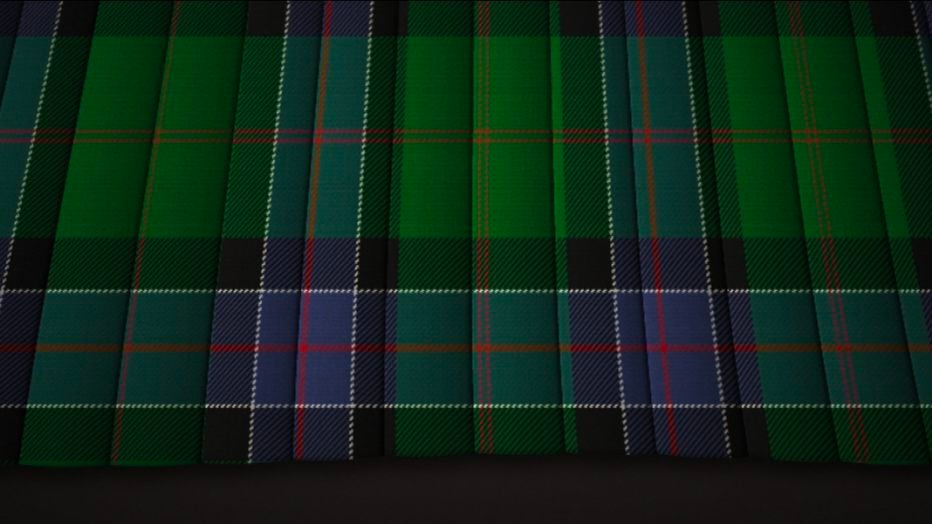
They record two hunting setts. One, dating from about 1884 and first shown in a magazine called The Clansman, is described as a variation of the hunting tartan “through misweaving,” a mistake that got into production. The other is the pattern derived from the Vestiarium Scoticum of 1842: a ground of green crossed by a band of black and a band of blue, with fine lines of red and white. It is the second that the mills weave, and it is a handsome, sober, well-balanced cloth.
Attached to it in some places is the claim that the Sinclairs wore a green tartan at the Battle of Flodden in 1513, where the whole Caithness contingent was killed except one drummer, and that Sinclairs have not worn green on a Monday since. The archives, in their dry way, note that since Flodden was in 1513, one must question the green tartan claim, which appears on a clan website without any source. The tradition about the Sinclairs at Flodden, and about Mondays, is old and real. The tartan is not. A hunting sett from an 1842 book cannot have been worn at a battle three centuries earlier, and there is no reason to pretend otherwise.
Retailers offer Sinclair Hunting tartan alongside the red clan sett and the dress version, in Modern and Ancient colours, made to order as kilts, skirts, sashes, scarves and ties, or by the yard. Sinclair, St Clair and Clyne are among the names that wear it. It is a practical cloth for highland games kilts too, since the dark green hides a day of mud.
Halkirk, the last Saturday in July
Halkirk is a village in the middle of Caithness, six miles from Thurso, laid out on a grid by Sir John Sinclair of Ulbster in the 1800s, and its Highland games, held on the last Saturday of July on the field by the river, are the biggest in the north of Scotland, with the heavy events, the pipes, the dancing and a fair that draws the whole county. They are also, unusually, a place where a man of fifty-two can still throw a hammer in front of a crowd and be taken seriously, because the games run a masters class in the heavy events.
Donnie Sinclair is that man. He is a fish merchant in Wick, he has thrown at Halkirk for thirty-one years, he has won the open hammer twice, in his twenties, and he has no intention of stopping. He throws in the family tartan, and he throws in the green, because, as he says, a hammer swung round your head three times in a red kilt looks like an ambulance.
The kilt is from Scottish Kilt, from a range of highland games kilts that the outfitter describes as built for throwing and heavy events, reinforced at the waistband and strap anchors, with room to hinge, in clan setts or athletic colours. His is the Sinclair hunting, in Modern colours, and it is his third from the same place in thirty years, because a throwing kilt gets thrown in, and gets muddy, and gets washed, and eventually gets retired.
What makes it different from his wedding kilt, which is the red, is invisible from the fence. The waistband is doubled and stitched through. The strap anchors are bar-tacked, because the whole load of a thrower’s hips going through the release lands on two straps and three buckles, and an ordinary kilt lets go there. The pleats are shallower and the rise sits higher, so the cloth hinges at the hip instead of binding across the thigh when he winds up. And it is a heavy washable weight that goes in the machine on Sunday morning with the field on it.
He wears it with a black vest, black shorts underneath, thick socks pushed down, and boots, and his hands are taped. His third throw of the hammer in the masters goes ninety-one feet and something, into a wind off the Pentland Firth, and the crowd along the rope, which is mostly Sinclairs and Gunns and people who are both, makes the noise Caithness makes.
A boy of about twelve, in a Sinclair red kilt that is slightly too long for him, has been watching from the fence all afternoon, and comes up as Donnie is untaping his hands.
“Why’s yours green?”
“Hunting. You don’t throw in the red. It’s for weddings.” Donnie nods at the boy’s kilt. “That’ll be for your sister’s.”
“My cousin’s. Are we not supposed to wear green on Mondays?”
“That’s the story. Flodden. All of them killed but the drummer.” He folds the tape. “Nobody wore this green at Flodden, mind. This is from a book in 1842. But it’s a good story and it’s a Saturday, so we’re fine.”
“What happened at the other one? The one with the Campbells?”
“Altimarlach. 1680. We’d been drinking. They hadn’t.” Donnie picks up the hammer for the next round. “Never drink the night before you throw, son. That’s the whole history of Caithness in one line.”
Commit thy work to God
The Sinclairs held the top of Scotland for six centuries against the weather, the Norse, the Campbells and their own creditors, and lost one battle to a pipe tune and a hangover. It is a hard country, and its history is told hard.
Their hunting tartan is a Victorian green with a doubtful story attached, and the honest thing is to say so and wear it anyway. Built for throwing, with the waistband doubled and the straps bar-tacked, on a fish merchant of fifty-two on the last Saturday of July at Halkirk, it does a job the red was never meant for, and does it in a wind.